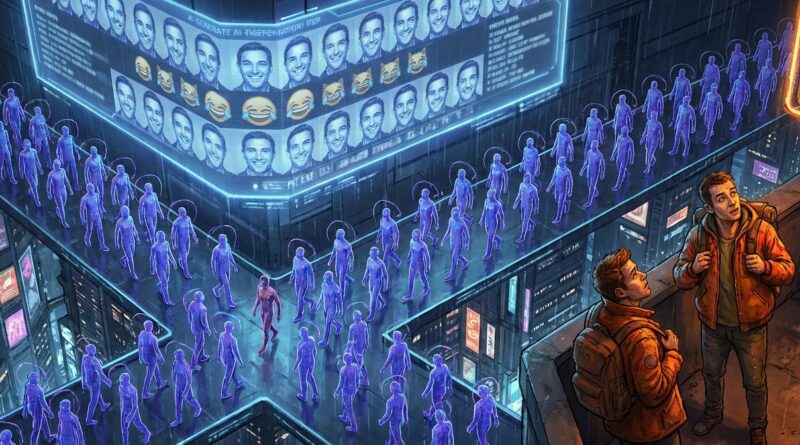
Are We the NPCs Now? How AI Turned Humans Into Background Characters in Our Own Evolution
You are not imagining it. The internet really does feel weirder now. You open an app for five minutes and somehow end up knee-deep in machine-made pictures, copy-and-paste opinions, and comments that sound oddly polished but spiritually empty. It is exhausting. Worse, it can make you feel lazy, cynical, or numb, like maybe you are the problem because you cannot keep up. But this is not a personal failure. It is an ecosystem problem. Human brains were built for small groups, limited signals, and actual pauses. They were not built to compete with systems that can post, remix, flatter, provoke, and imitate all day without getting tired. That is why so many people feel like background characters in their own feeds. The strange part is not that you are overwhelmed. The strange part is that we keep being told this is normal, healthy, and somehow progress.
⚡ In a Hurry? Key Takeaways
- Yes, parts of online culture now feel NPC-like because AI and bot systems can flood the zone faster than humans can think, react, or recover.
- If your feed feels dead, start curating harder. Follow fewer accounts, spend more time in smaller communities, and stop rewarding obvious sludge with attention.
- You are not broken for feeling numb or behind. This is an evolutionary mismatch, not proof that humans are obsolete.
When the internet starts feeling like a video game cutscene
There is a specific kind of online weirdness that is hard to describe until you feel it. Everyone is talking, but nobody seems present. Every debate arrives pre-packaged. Every “wild” opinion sounds focus-grouped. Every post is trying very hard to trigger a reaction while saying almost nothing.
That is where the NPC joke lands. It is funny because it feels true. Non-player characters are there to fill the scene, repeat a script, and keep the world looking busy. More and more, human users seem pushed into that role while automated systems do the real scaling, shaping, and steering.
It is satire, yes. But like most good satire, it hurts because it is close to reality.
Why this feels so insulting on a gut level
Humans like to think of evolution as a heroic ladder. Fish became amphibians. Amphibians became reptiles. Somewhere along the line, we got taxes, iced coffee, and push notifications. We assume that because we are clever, we should be in charge.
Then AI shows up and starts doing the one thing modern culture values most. Producing endless output.
Not wisdom. Not depth. Output.
That is the insult. The modern internet does not always reward the most thoughtful person. It often rewards the entity that can generate the most material, test the most angles, and never once needs a walk, a snack, or eight hours of sleep.
Against that standard, ordinary human behavior starts to look slow and inefficient. Which is a ridiculous metric for a species that also invented music, friendships, mourning rituals, and soup. But online, speed and volume can drown out nearly everything else.
This is not a moral failure. It is an ecological mismatch
If you feel flattened by all this, try a kinder frame. Your brain is not failing. Your environment changed faster than your instincts could.
We evolved in settings where attention was precious. A loud noise mattered. A rumor mattered. A social slight mattered. Novelty mattered. Platforms now use those same ancient settings like piano keys. Add AI to that mix and the whole thing scales into absurdity.
A bot does not get decision fatigue. An AI content farm does not have an off day. A synthetic account network does not feel embarrassed after posting something cringe at 2 a.m. It just keeps going.
That matters because your nervous system still pays full price for every bit of noise. You get stressed. Distracted. Imitative. Passive. You start consuming what is easiest to process, not what is most meaningful. Bit by bit, you slip into your own background mode.
What “NPC mode” actually looks like in real life
1. You repeat takes you did not fully think through
You read a hot opinion ten times from ten different accounts and suddenly it feels like your own view. Not because you are gullible. Because repetition works. Familiarity often masquerades as truth.
2. You react on cue
Outrage. Applause. Sneering. Dunks. The same emotional buttons get pressed so often that the response becomes automatic. You stop asking the useful question, which is, “Who benefits from me feeling this right now?”
3. You confuse visibility with reality
Just because a topic floods your feed does not mean it reflects what most humans care about. It may simply reflect what machines, algorithms, and engagement incentives can amplify most efficiently.
4. You stop making things unless they can perform
This one stings. A lot of people now hesitate to write, draw, joke, sing, or share unless it can beat machine-made output in public. That is how a culture gets quieter even while content explodes.
Why feeds feel “dead” even when they are crowded
This is the part many people struggle to name. The internet can be packed with activity and still feel empty.
That dead feeling usually comes from one of three things. First, too much synthetic content. Second, too much optimization. Third, too little risk of real human awkwardness.
Actual people are inconsistent. They are specific. They have odd phrasing, local references, uneven timing, and opinions that do not fit neatly into content buckets. Machine-shaped culture scrubs a lot of that away. The result is smooth, legible, and strangely lifeless.
Think of it like plastic fruit in a hotel lobby. Bright colors. Nice arrangement. Nothing to eat.
Humans vs AI evolution is the wrong fight, but the right metaphor
The phrase “humans vs AI” can make this sound like a robot apocalypse movie. It is not that simple. AI is not a new species waiting to replace us in a forest clearing.
But as a metaphor, evolution helps. Species adapt to environments. When the environment changes, some traits become liabilities. Right now, deeply human traits like slowness, reflection, uncertainty, and emotional recovery are treated online like bugs instead of features.
That does not mean those traits are worthless. It means the habitat is hostile to them.
Once you see that, the question changes. Instead of asking, “Why am I so bad at keeping up?” you ask, “Why is this system designed to make healthy human pacing look like weakness?”
How to reclaim some agency without moving into a cave
Curate like a gardener, not a hoarder
If an account posts obvious sludge, mute it. If a page leaves you feeling vaguely unreal, unfollow it. If a platform rewards quantity over signal, use it less intentionally. Your attention is not a civic dumping ground.
Spend more time in places where identity costs something
Small forums. Group chats with people you know. Niche communities where history matters. Places where you cannot just spawn infinite throwaway personas tend to preserve more human texture.
Make things that do not scale
Write a weird blog post. Send a thoughtful voice note. Share photos with friends instead of performing for strangers. Cook for people. Host something tiny. The best antidote to synthetic abundance is often small, real, unprofitable effort.
Slow down before joining the chorus
When a giant online consensus appears overnight, pause. Some of it may be real. Some of it may be momentum. Some of it may be bot-assisted theater. You do not need to clap on cue.
Protect your boredom
Boredom is not a bug. It is often the doorway to your own thoughts. If every spare moment gets filled by generated noise, your inner life starts sounding like everyone else’s feed.
The practical rule: reward signals of humanity
If you want more human culture online, reward the parts that still feel human. Comment on original work. Share things that have personality. Support creators with actual points of view. Do not feed junk just because it is fast, shiny, or weirdly addictive.
This sounds small. It is not. Culture is built from repeated tiny votes. Attention is one of the biggest votes you cast all day.
At a Glance: Comparison
| Feature/Aspect | Details | Verdict |
|---|---|---|
| Speed of content production | AI systems and bot networks can generate posts, replies, images, and trends nonstop, while humans need time, rest, and context. | Machines dominate volume. Humans should not try to win on speed. |
| Cultural texture | Human expression tends to be messier, more specific, and more surprising. AI output often looks polished but repetitive. | Humans still win on meaning, nuance, and lived experience. |
| Emotional impact on users | Constant exposure to optimized, synthetic content can make people feel numb, reactive, and strangely absent from their own online lives. | Needs active management. Better habits matter more than raw willpower. |
Conclusion
The reason this topic lands so hard is simple. It is not really about gadgets. It is about who is driving culture, setting the pace, and deciding what counts as real attention. As bots and AI systems flood more of our feeds, many people are feeling the same blunt evolutionary insult. Our brains were never built to compete with entities that do not sleep, do not get bored, and can produce infinite noise on demand. Seeing that clearly can actually be a relief. It means the dead, uncanny feeling is not proof that you are lazy, cynical, or broken. It is a sign that the habitat changed. Once you treat this as an ecological mismatch instead of a personal weakness, you can start acting like a field biologist of your own media diet. Notice the patterns. Spot when you have slipped into NPC mode. Reward the weird, specific, human stuff. Keep your sense of humor. Most of all, remember this. Background characters do not usually realize the set is fake. You do. That is a very human advantage.