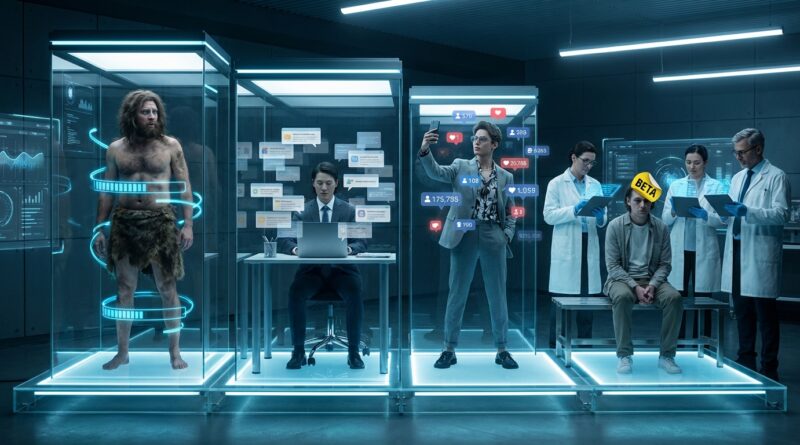
Beta-Testing Humanity: Why We Treat Our Own Species Like a Glitchy Software Update
You have probably seen it a hundred times by now. Someone cuts you off in traffic and they are an NPC. A date is awkward and clearly needs a personality patch. A friend changes their mind and apparently shipped a bad update. The joke lands because it is funny, but also because it feels uncomfortably close to how a lot of us now talk about people. That is the itch under the meme. Tech culture gave us a whole handy little menu of software words for human mess, and we use them constantly. Optimize. Filter. Mute. Upgrade. Uninstall. It can make ordinary life feel cleaner and more manageable. It can also flatten everyone around us into buggy systems instead of difficult, alive creatures. If you have felt weird about that shift, you are not overreacting. The satire is doing its job. It is pointing at a real change in how we see each other, and asking whether we still know the difference between a user experience problem and a person.
⚡ In a Hurry? Key Takeaways
- Calling people “NPCs” and talking about “patching” them is more than a meme. It shows how tech language is quietly reshaping how we think about human beings.
- When you catch yourself treating a relationship like a broken app, pause and switch back to human terms. Ask what the person is feeling, not what feature is failing.
- The jokes are not harmless if they train you to see other people as disposable software. Satire helps because it lets you notice the problem without turning into a scold.
The meme is funny because it is already half true
A good meme usually works like a cartoon sketch. It exaggerates something real until you can finally see it clearly.
That is why this particular strain of internet humor hits so hard. “Main character syndrome.” “Skill issue.” “Patch notes for my boyfriend.” “My coworker is running old firmware.” These jokes are not coming out of nowhere. They are built from the language we already use every day on platforms that sort, score, rank, recommend, and remove.
Spend enough time in software-shaped spaces and people start looking software-shaped too. We stop saying, “He is grieving and acting strange.” We say, “He is glitching.” We stop saying, “She is stubborn.” We say, “She is not update-compatible.” It sounds lighter. Smarter, even. But it also cuts away a lot of what being human actually is.
A satirical take on human evolution and technology
If you wanted to write a bleak little fake museum plaque about our species, it might read like this: “After millions of years of messy biological evolution, humans finally escaped the burdens of flesh by turning every social problem into an interface issue.”
That is the joke. It is also the warning.
We used to imagine future evolution in big dramatic terms. Bigger brains. Better bodies. Maybe glowing cities on Mars. Now the satire is much pettier and much more believable. Future human improvement looks like better notification settings, emotional load balancing, premium social filters, and cloud-backed identity sync. Not transcendence. Just a cleaner dashboard.
That shift matters. It tells us technology is no longer just a set of tools around human life. It is starting to provide the metaphors for human life itself.
Why “NPC” bothers people so much
“NPC” is one of those terms that feels like a joke until you think about what it strips away. In a game, an NPC exists to fill out the world. They repeat a script. They do not surprise you in any deep way. Their inner life does not matter because, for the player, it is not there.
Use that word often enough for real people, and you start practicing a dangerous habit. You reduce everyone outside your own viewpoint to background code. Their confusion is boring. Their routine is proof they are fake. Their disagreement is not disagreement. It is bad programming.
That is not just rude. It is comforting in a very specific way. If other people are basically scripted, then you never have to deal with the full discomfort of sharing the world with minds you cannot control.
Platforms train us to think like product managers
This did not happen by accident. A lot of modern tech nudges us toward a product mindset.
Apps ask you to track your sleep, your focus, your mood, your diet, your steps, your output, your engagement, your reach. Dating apps turn attraction into sorting. Social platforms turn friendship into visible activity. Professional networks turn identity into branding. Even self-care starts sounding like system maintenance.
Once everything is measurable, everything starts looking fixable. Once everything is fixable, patience feels inefficient. And once patience feels inefficient, people become frustrating because they refuse to behave like products.
They are inconsistent. They are slow. They get tired. They contradict themselves. They need context. They often do not know what is wrong. Real people are terrible software and excellent animals.
That last part is worth hanging onto. We are not failed machines. We are successful mammals.
The phone in your hand is not neutral
If this all sounds familiar, it connects nicely with How to Survive Being the Dumbest Ape in a Smart Phone Era. One reason human life feels oddly mechanical now is that the device mediating so much of it rewards interruption, simplification, and constant response. It trains us to confuse activity with meaning. After enough exposure, even our inner monologue starts to sound like an app store changelog.
Why this language feels useful in the first place
To be fair, software metaphors are not always silly or cruel. Sometimes they help.
Saying “my brain needs a reboot” is a quick, harmless way to admit exhaustion. Saying a routine is “good default settings” can be a neat shorthand. We use metaphors because they make slippery things easier to discuss.
The trouble starts when the metaphor stops being a shortcut and becomes the worldview. That is when a messy friend becomes a defective system. A lonely neighbor becomes low-value background activity. A partner who changes becomes a failed version release.
Human beings do not have clean version histories. We do not roll back neatly. There are no stable builds. The whole project is live, underfunded, emotional, and sticky.
The hidden fantasy behind “upgrading” people
There is another reason these jokes keep spreading. They flatter us.
If other people can be sorted into patched and unpatched, optimized and broken, then maybe we get to imagine ourselves as the rare premium build. The self-aware one. The one who escaped the matrix, read the docs, and installed the right mindset.
That fantasy is catnip online. It turns ordinary insecurity into superiority. It is easier to say “everyone else is an NPC” than to admit “I am lonely, overstimulated, and not sure how to connect anymore.”
That is why the sharpest satire in this area does not just mock “the normies.” It mocks the smug little dream that personhood can be upgraded like a phone. It points out the absurdity of trying to solve mortality, desire, boredom, and social friction with cleaner settings menus.
What gets lost when we speak this way
Three things, mostly.
1. Context
A person who seems repetitive may be exhausted, trapped, scared, depressed, overworked, or just shy. “NPC” wipes all that out in one tap.
2. Grace
Software language makes tolerance sound like poor standards. If a person is a buggy interface, why not replace them with a better one?
3. Mutual humility
The software view suggests you are the user and other people are the system. Real life is rougher than that. You are someone else’s confusion too. You are also weird, limited, contradictory, and running on suspicious legacy code.
How to keep the joke without swallowing the worldview
You do not need to become allergic to memes. That is not the point. The point is to notice when a joke starts training your instincts.
Use the bit, then translate back
If you joke that your friend “needs a patch,” fine. Then quietly ask yourself what is actually going on. Are they stressed? Defensive? Embarrassed? Lost? Translation is the key move.
Watch for disposable language
Mute, block, uninstall, replace. Sometimes those are healthy boundaries. Sometimes they are just consumer reflexes wearing therapist glasses. Not every difficult person should stay in your life, but not every inconvenience is corruption in the system either.
Remember that friction is not failure
Biological life is full of lag. You forget things. You misread tone. You need sleep. You get attached to the wrong person. You feel flat for no obvious reason. A machine that behaved like this would be a lemon. A human doing this is Tuesday.
Ask one grounding question
When someone irritates you, ask, “What would this look like if I described it without tech words?”
That one question is surprisingly powerful.
“He is glitching” becomes “He is overwhelmed.”
“She has bad programming” becomes “She learned a rough way of coping.”
“They are an NPC” becomes “I do not know their interior life, and I am filling in the blanks with contempt.”
At a Glance: Comparison
| Feature/Aspect | Details | Verdict |
|---|---|---|
| Software metaphors for people | Can be funny and useful as shorthand, but they flatten emotion, context, and dignity when used too literally. | Good servant, bad worldview. |
| Platform-shaped thinking | Apps and feeds encourage ranking, tracking, optimizing, and quick judgment, which can leak into relationships. | Useful for logistics, harmful for empathy. |
| Satire about human evolution and technology | Works best when it exposes the absurd idea that humans are unfinished products waiting for a better update. | Worth keeping. Just do not let the joke become your philosophy. |
Conclusion
The reason this stuff lands is simple. Right now the smartest satire really does hit a nerve. We casually call people NPCs, talk about “upgrading” our friends, and joke that future humans will just be firmware in the cloud because some part of us already feels the pressure to think that way. Naming the shift helps. It gives you language for the discomfort. It helps you see how AI talk and platform culture can recode relationships into UX problems and performance stats. And once you can see it, you can push back without becoming humorless. Keep the memes. Keep the jokes. Laugh at the absurdity. Just remember that the people around you are not buggy apps in need of cleaner code. They are animals, stories, habits, nerves, histories, hormones, hopes, and bad timing. So are you. That is not a design flaw. That is the whole strange feature set.