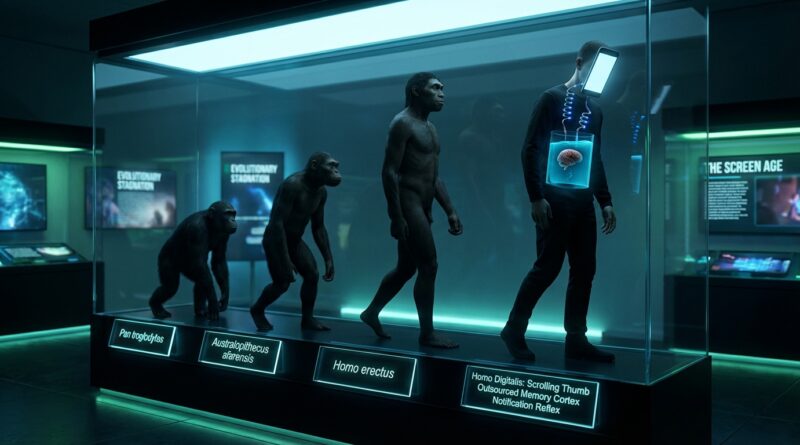
How to Survive Being the Dumbest Ape in a Smart Phone Era
You are not imagining it. The phone really is training you to forget things, interrupt yourself, and confuse movement with progress. You pick it up to check one message and 20 minutes later you are watching a stranger organize their refrigerator while your original thought dies quietly in the background. That is not a personal failure. It is a very expensive industry doing what it was built to do. The odd feeling many people have right now is simple. Our tools keep getting smarter, and a lot of us feel less sharp using them. Search bars remember what we do not. Keyboards finish sentences we did not fully think through. AI helpers volunteer answers before our brains have even warmed up. If this feels like a satirical take on human evolution and smartphone addiction, that is because it is. We invented a pocket oracle, then somehow became its emotional support ape.
⚡ In a Hurry? Key Takeaways
- Your phone is useful, but many “smart” features also weaken memory, focus, and independent thinking when used without limits.
- Start with three fixes: turn off non-human notifications, create no-phone zones, and do one task a day without search, autocomplete, or AI help.
- The goal is not to reject technology. It is to keep your attention, judgment, and patience from being rented out by default.
The New Evolutionary Crisis: Great Thumbs, Questionable Thinking
For most of human history, survival meant noticing real danger. A rustle in the bushes. Bad weather. That one berry Steve ate and then deeply regretted.
Now the danger is softer. It hums. It glows. It vibrates in your pocket and says things like, “We noticed you might want to re-engage.” No tiger ever used engagement metrics, but here we are.
Modern phones are brilliant at one thing. They remove friction. That sounds good until you realize friction is often what thinking feels like. Remembering a fact takes effort. Writing a message takes effort. Sitting with boredom takes effort. Deciding where to go, what to buy, who to trust, and whether you really need to respond right now all take effort.
When every tiny pause gets filled for you, your brain starts acting like an intern who assumes somebody else will handle the hard parts.
Why Smart Phones Can Make People Feel Dumber
1. Search has replaced recall
Why remember anything when the answer is two taps away? Fair question. The trouble is that memory is not just storage. It is part of how we connect ideas, make judgments, and notice patterns. If every missing fact gets outsourced instantly, the brain gets less practice building its own internal map.
You do not need to memorize the periodic table for fun. But if you cannot hold a few facts in your head long enough to think with them, your own reasoning starts to wobble.
2. Autocomplete can flatten your thoughts
Predictive text is handy. It is also weirdly bossy. Over time, it nudges language toward the easiest, most common version of what you might say. That saves seconds. It can also shave off personality, precision, and actual thought.
If a machine is always leaning in with “Did you mean this simpler sentence instead?” some people stop reaching for the better sentence.
3. Notifications break attention into confetti
This one is less mysterious. Constant interruptions make it hard to focus deeply. The bigger issue is that your brain begins expecting interruption. Silence starts to feel suspicious. Concentration feels slow. A single paragraph can seem like a mountain if your attention has been trained to live in 12-second bursts.
4. AI assistants can short-circuit struggle
Some struggle is pointless. Some struggle is the entire point. If AI helps you summarize a long email, great. If it writes every message, solves every blank page, and answers every question before you have tried to think, then you are not just saving time. You are skipping reps.
That is like owning a forklift and then wondering why your legs are weak.
A Field Guide to Staying Human
This is not a call to throw your phone in a lake and start churning your own butter. The goal is not digital purity. The goal is to stay in charge.
Treat attention like a body part
If an app could borrow your liver 87 times a day to “improve your experience,” you would have concerns. Yet attention, which is how your mind directs itself, gets grabbed constantly and we call it convenience.
Start with this question. Did I choose this, or was I pulled into it?
That one sentence cuts through a lot of nonsense.
Make your phone worse on purpose
This is one of the best tricks because it feels slightly rebellious. Turn off alerts that are not from actual humans. Remove the most tempting apps from the home screen. Switch the display to grayscale if you want to make it less candy-like. Log out of apps that use endless feeds as bait.
You do not need a dumber phone. You need a less manipulative one.
Use delay as a weapon
Put friction back in. Make social apps harder to open. Keep the charger out of the bedroom. Do not let the phone be the first thing your eyes meet each morning. Give your brain a few minutes to form a thought before the world starts shouting into it.
Even a ten-minute phone-free start to the day helps. That is enough time to remember you have an inner life.
Practice “manual mode” every day
Pick one daily task and do it without digital assistance. Write a text without predictive text. Navigate a familiar route without maps. Work out a tip in your head. Recall the name of the actor before searching. Draft an idea before asking AI to clean it up.
None of this is about proving moral superiority. It is maintenance. Your brain needs small chances to do its own lifting.
The Biological Part We Usually Ignore
Your brain is not weak because it likes novelty. It is normal. Phones are built to press on ancient reward systems with industrial efficiency. Bright colors, social approval, uncertainty, variable rewards, and constant updates all work because human beings did not evolve around infinite feeds.
We evolved to notice what is new, what is emotional, and what might matter socially. A smartphone takes those instincts, straps them to advertising, and says, “Let us see how long we can keep this ape poking the glass.”
That is the joke. It is also the business model.
Signs You May Be Outsourcing Too Much of Your Mind
If any of these sound familiar, welcome to the club.
- You reach for search before trying to remember.
- You feel mild panic when left alone without your phone for 15 minutes.
- You open apps with no goal, then forget why you unlocked the phone.
- You ask AI to draft things you could say yourself, just slower.
- You have trouble reading long text without checking something else.
- You feel busy all day but cannot point to much actual thinking.
That is not proof you are doomed. It is just proof you are using products designed by people who get bonuses when you lose track of time.
What to Keep, What to Resist
Keep the genuinely helpful stuff
Maps when you are somewhere new. Accessibility tools. Spam filtering. Password managers. Emergency location sharing. Voice dictation when your hands are full. Translation on the fly. Good technology can reduce stress and increase safety.
No prize exists for making life harder than necessary.
Resist the automatic replacement of thought
Be cautious when a tool stops helping you think and starts thinking instead of you. That line matters. It is the difference between using a calculator for a hard equation and using one because the restaurant bill contains a seven.
Convenience is good. Dependency is expensive, just in slower ways.
Five Rules for the Smart Phone Ape Who Wants to Stay Sharp
Rule 1: Search second, think first
Give yourself 30 seconds before looking something up. You will often remember more than you think.
Rule 2: Turn off most notifications
If it is not a person, a calendar, or a genuine safety issue, it probably does not need to buzz.
Rule 3: Keep one screen boring
Your home screen should look like a tool shelf, not a casino lobby.
Rule 4: Let boredom breathe
Do not fill every line, queue, elevator ride, or quiet moment. Boredom is often where original thought sneaks in.
Rule 5: Use AI like an assistant, not a substitute self
Ask it to organize, summarize, or check. Do not hand over every rough draft of your mind and call that productivity.
At a Glance: Comparison
| Feature/Aspect | Details | Verdict |
|---|---|---|
| Search and instant answers | Fantastic for speed and accuracy, but easy to use before you have even tried to remember or reason. | Use it after a short pause, not as your first reflex. |
| Notifications and endless feeds | Designed to capture attention in tiny bursts, which can wreck focus and make your day feel scattered. | Cut aggressively. Most of them are not helping. |
| AI writing and smart assistance | Great for cleanup, summaries, and routine tasks. Risky when it replaces your own voice or effort completely. | Best as backup, not as your brain’s full-time replacement. |
Conclusion
The strange part of modern life is that companies keep selling more assistance as freedom, while many people feel more dependent, more distracted, and less sure their thoughts are fully their own. That discomfort is worth listening to. You do not need to become a hermit or swear off useful tech. You just need to notice when convenience turns into surrender. A little humor helps here, because it is easier to push back when you can laugh at the absurdity of becoming a highly connected primate who cannot stand in line without consulting the glowing rectangle. Protect your attention. Keep some friction. Let your brain do some of its own work. In an AI-soaked phone ecosystem, staying human is not old-fashioned. It is a skill.