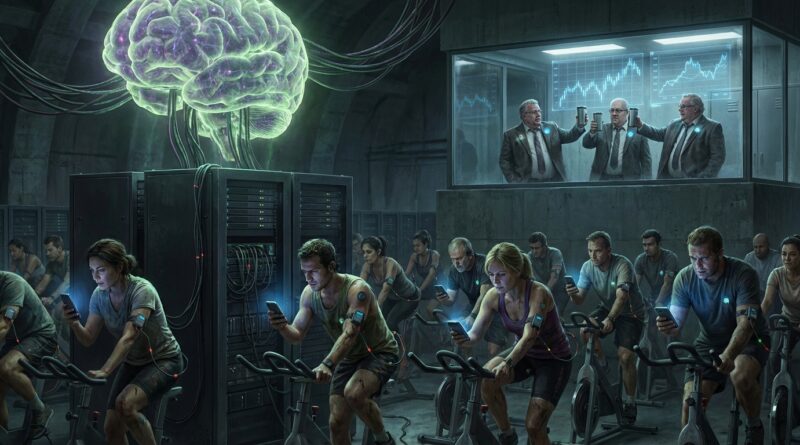
Humans As AA Batteries: Why Tech Keeps Imagining Us on the Treadmill of Evolution
You have probably seen the sketch by now. A glossy future arrives, some smiling founder says AI will change everything, and then the punchline lands. Humans are pedaling bikes, stacked in pods, or plugged into a server rack like discount AA batteries. It is funny because it feels rude and true at the same time. A lot of people are laughing with a knot in their stomach. Jobs feel shakier. “Efficiency” keeps sounding like bad news for the person doing the actual work. And every new tech promise seems to ask your body, your attention, or your paycheck to fill the gap.
⚡ In a Hurry? Key Takeaways
- “Humans used as batteries for AI” satire is popular because it turns real fears about work, energy, and power into one very clear image.
- When a tech pitch claims to “optimize” people, ask who saves time, who loses control, and who carries the physical or mental cost.
- Biology matters. Human bodies are terrible batteries, which is exactly why the joke works. It is less about science and more about exploitation dressed up as progress.
Why this joke keeps coming back
The image is simple. A machine gets smarter, richer, or faster. A human gets reduced to fuel.
That is the whole joke. But it sticks because plenty of modern tech already treats people this way in softer language. Not batteries, exactly. More like unpaid moderators, underpaid click workers, burnt-out drivers, exhausted warehouse staff, and office workers told to “adapt” to tools they did not ask for.
So when satire shows a billionaire forcing people to power AI on exercise bikes, it does not feel random. It feels like the cartoon version of a real trend. The machine is the star. The human is the utility bill.
The biology is nonsense. The social message is not.
If we are being literal, humans make lousy batteries.
Yes, the body produces energy. But not in a neat, plug-and-play way. We eat food, convert chemical energy through metabolism, and use most of it just to stay alive. Breathing. Thinking. Keeping warm. Repairing cells. Moving around. If you tried to power data centers with people on bikes, you would spend absurd amounts on food, cooling, healthcare, sanitation, and space just to get a trickle of electricity out the other side.
A fit person on a stationary bike might produce around 100 watts for a while, maybe more in bursts. A single electric kettle often uses 1,500 watts. A modern AI data center uses vastly more than that, and does it all day.
So no, your spin class is not replacing a power plant.
But satire is not trying to pass a science test. It is asking a sharper question. If a system is built to benefit a small group, how quickly does it start treating everyone else as an input?
Why the “battery” image hits harder than older robot fears
We have had automation anxiety for ages. The old version was, “The robot will take your job.” The newer version is uglier. “The robot will take your job, then ask you to train it, supervise it, rate it, prompt it, fix its mistakes, and smile while doing it.”
That is where the battery image lands. It captures the feeling that humans are not being removed from the system. We are being kept inside it, but downgraded.
You see this in everyday work language:
“Be more productive”
Sometimes this means use a better tool. Fair enough. But often it means one person should now do the work of two because software exists.
“Frictionless experience”
Friction for whom? A smooth app on the front end can hide a lot of strain on the back end.
“Human in the loop”
This can be a safety measure. It can also be a polite way of saying a person is there to absorb the mess when automation falls short.
The real target of the satire is not technology
This is worth saying clearly. Most of these jokes are not anti-computer. They are anti-bad incentives.
People are not mocking electricity, servers, or software. They are mocking a worldview where every advance somehow leads to more convenience for investors and more strain for everyone else.
That is why the “humans used as batteries for AI” meme keeps showing up in the same visual style. Bloated luxury on top. Sweaty labor underneath. It is crude on purpose. It strips away the branding.
That is useful, because branding is usually where bad ideas hide.
How to decode a “future of work” pitch in real time
You do not need a computer science degree to spot when a shiny story is really about shifting burden onto people.
1. Ask where the effort went
If a company says a tool saves time, great. Whose time? Did it remove busywork, or did it move that work onto customers, freelancers, or junior staff?
2. Ask who carries the risk
When something breaks, who cleans it up? The software vendor, or the worker who now has to catch every error?
3. Ask what gets measured
Systems often optimize what is easy to count, not what matters. Speed. Clicks. Output. Response times. The human cost can vanish because it does not fit neatly in a dashboard.
4. Ask whether “empowerment” comes with less control
A tool can promise freedom while increasing surveillance. More autonomy on the brochure. More tracking in practice.
5. Ask what kind of human the system assumes
Does it imagine people as creative, social, and complicated? Or as interchangeable units that can be pushed a little harder each quarter?
Why the body keeps showing up in tech satire
There is a reason these jokes are physical. Pedaling. Plugging in. Sweating. Carrying.
Tech talk often pretends everything is abstract. Cloud services. digital transformation. smart systems. But the costs are usually very physical. Eyestrain. Repetitive stress. Long hours. Stress hormones. Commutes. Warehouses. Mining. Energy use. Heat.
The “battery human” joke drags the body back into view. It says, politely or not, that every so-called seamless system sits on top of real flesh somewhere.
That is part of why the joke feels modern. People are tired of hearing that technology is weightless when their own lives feel heavier.
What to do with that uneasy feeling
You do not have to reject every new tool to reject bad terms.
A healthier response is to get sharper questions. When someone pitches AI or automation in your workplace, school, or daily life, listen for the hidden trade.
Are you being helped, or are you being turned into support infrastructure for a machine that mainly benefits someone else?
That sounds dramatic, but it is the exact question the satire is asking. It just uses a bike generator and a cartoon villain to make the point faster.
You can also use the joke as a filter. If a proposed system only makes sense when people are treated as endlessly adaptable, endlessly available, and oddly cheap compared with the mess it creates, then the plan is probably not as smart as the slide deck says.
At a Glance: Comparison
| Feature/Aspect | Details | Verdict |
|---|---|---|
| Biological reality | Humans can generate small amounts of power, but nowhere near what modern AI systems need. | Bad science, good metaphor. |
| What the satire is really about | It mocks systems that drain human labor, attention, or dignity while calling that drain innovation. | Very relevant to current AI and work anxiety. |
| Practical reader takeaway | Use the meme as a test. Ask who is being optimized, who does more hidden work, and who profits most. | A smart way to cut through hype. |
Conclusion
The reason satire about humans as batteries is spiking right now is not mysterious. People can feel the ground shifting under their jobs, their bodies, and their sense of usefulness. The joke gives that fear a shape. It turns vague dread into a ridiculous image you can point at and say, “Right. That is what this pitch sounds like.” Once you see that, you get some power back. You can test grand claims against basic logic, basic biology, and one simple question. Is this tool helping humans do better work, or is it quietly redesigning humans to serve the tool? If you keep that question handy, you are a lot less likely to end up sweating for a machine that calls it progress.