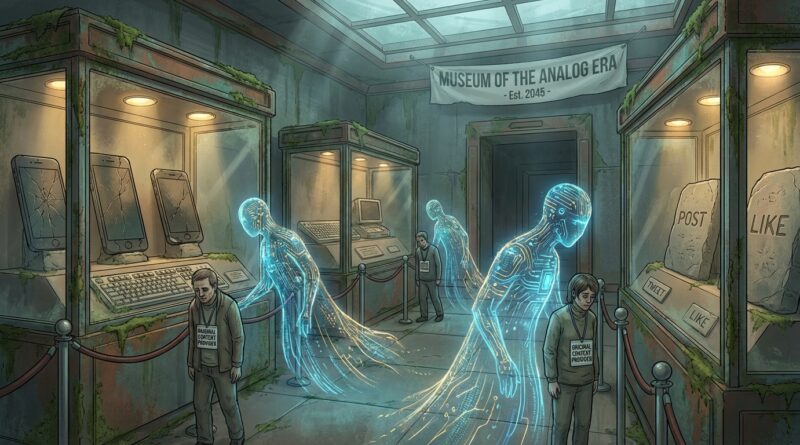
The Last Human Scroll: How We Turned the Internet Into a Museum of Our Own Extinction
You are not imagining it. Open any social app for five minutes and the vibe is off. The comments feel copy-pasted. The posts sound weirdly polished, then weirdly empty. Half the “people” arguing may be bots, and the other half may be humans trying to keep up with bot speed. That is the part that stings. The internet used to feel messy, annoying, funny, personal. Now it often feels like walking through a wax museum where every figure is talking at once.
That is why the old “dead internet theory” keeps coming back, now with a fresh coat of AI slop. Not because every account is fake, but because more of the web is being filled by machine-made junk designed to trigger clicks, comments, and ad views. The satire writes itself. After centuries of evolution, humans built a global communication system, then trained software to drown us out inside it. Funny. Bleak. Also fixable, at least a little, if you know what you are looking at.
⚡ In a Hurry? Key Takeaways
- The “dead internet theory” feels more believable now because AI tools make cheap content and fake engagement easy at huge scale.
- You can fight back by curating smaller, human spaces, slowing your sharing habits, and rewarding original voices instead of obvious slop.
- This matters because nonstop synthetic content can distort trust, attention, and even how we judge real people online.
Why the feed feels haunted
Most people do not need a technical paper to tell them something changed. They can feel it. The recipe posts with life stories that never happened. The “heartwarming” photos with too many fingers. The replies that sound supportive but say nothing. The article summaries that read like they were written by a committee of polite toasters.
The internet has always had spam. That part is not new. What is new is the volume, the speed, and the strange almost-human tone. Old spam shouted at you. AI slop smiles at you and asks for engagement.
That is where dead internet theory ai slop human evolution satire stops being just a joke phrase and starts describing a real mood. People are reacting to an environment where authentic human signals are getting buried under industrial-scale filler.
What “dead internet theory” gets right, and what it gets wrong
The wrong part
No, the whole internet is not secretly run by robots while humans sleep in pods. Real people are still here. They are posting, lurking, arguing, flirting, oversharing, and sending blurry photos of their lunch. Human chaos remains very much alive.
The right part
But the theory hits a nerve because large chunks of online life are now shaped by automation. Recommendation systems decide what rises. Content farms flood search results. Bot networks pump trends. Generative AI can make endless text, images, comments, and summaries for almost no cost.
So the internet is not dead. It is overcrowded. The problem is not absence of humans. It is that human voices are getting outnumbered in the places where attention is bought and sold.
How we accidentally bred our replacement species
If you want the darkly funny version, here it is. Humans evolved to survive in forests, plains, and coastal villages. Then we made a second habitat out of feeds, inboxes, forums, and group chats. Then we built software perfectly adapted to that habitat.
Those systems do not get tired. They do not need sleep. They can test ten headlines, post 500 replies, remix old ideas, and generate fake sincerity all day long. In evolutionary terms, that is a monster advantage.
We made digital pigeons, but somehow gave them law degrees, stock photos, and posting schedules.
The result is absurd. Human communication online now competes with machine output that is cheaper, faster, and good enough to fool a distracted brain. Not better. Just abundant. Nature has a word for that kind of thing. Invasive species.
Why AI slop spreads so well
It is cheap
One person with a few tools can flood multiple platforms with text, images, clips, and comments. You no longer need a room full of low-paid workers to build a content mill. One laptop can do the job.
It is optimized for the algorithm, not for you
Human beings want meaning. Platforms want activity. Those are not always the same thing. AI slop is built to satisfy the second one. It gets clicks, reactions, and watch time, even if it leaves you feeling vaguely greasy afterward.
It exploits tired brains
Most of us scroll when we are bored, stressed, or half-awake. That is perfect slop weather. We are less likely to inspect, more likely to react, and very likely to confuse familiarity with truth.
What this does to actual people
This is the part that matters more than the joke. When the web fills with synthetic chatter, people start changing their own behavior to match it.
Writers flatten their voice because the algorithm likes predictable structure. Artists make work that looks machine-made because machine-made now sets the visual tone. Regular users start posting in weirdly market-tested ways because sincerity feels risky and low-performing.
That can warp how we see one another. If your daily feed is packed with fake certainty, fake beauty, fake consensus, and fake emotional warmth, then normal human mess starts to look defective. Real people hesitate, contradict themselves, make typos, tell boring stories, and have inconvenient feelings. That used to be the point.
The museum of our own extinction
The bleak joke in the title is that we are preserving little fragments of human life while the main exhibit hall fills with replicas. A handmade post here. A weird niche forum there. A voice note from a friend. A photo that was clearly not edited by a machine because the lighting is terrible and someone blinked.
Those scraps can start to feel precious. Not because they are perfect, but because they are alive.
That is why the internet now sometimes feels like a museum. You can still find the real thing. It is just no longer the default display.
How to reclaim a little agency
Choose places where effort still matters
Private group chats, newsletters by people you know, niche forums, Discord servers with active moderation, small creator communities. These spaces are not magic, but they are harder to flood at scale.
Reward humans on purpose
If you find something clearly original, save it, comment on it, subscribe to it, pay for it if you can. The internet is partly an economy problem. Human work loses when synthetic work is free and infinite, unless people make a point of backing the real thing.
Stop giving slop free distribution
You do not need to quote-tweet every fake image or every nonsense post just to mock it. Rage-sharing is still sharing. A lot of junk wins because humans help spread it while complaining about it.
Slow down before you react
If a post seems engineered to trigger instant outrage, awe, or tears, pause for ten seconds. That small delay is often enough to spot the weird phrasing, the uncanny image details, or the recycled talking point underneath.
Post like a person
You do not have to become a brand. You do not need every thought to sound polished. The rough edges are doing important work now. They signal there is still a mind on the other side.
Will this get worse?
Probably, at least for a while. The economics are too tempting. Platforms want scale. Marketers want output. Political operators want influence. Scammers want victims. AI gives all of them more volume for less effort.
But that does not mean humans vanish. It means human spaces become more valuable. We may end up treating real voice the way people now treat handmade goods. Rarer. More trusted. Worth seeking out.
That sounds depressing until you remember something basic. People are very good at building side doors when the main road gets ugly. Blogs came back. Newsletters came back. Private communities grew. Friends moved conversations off the big platforms because they were tired of performing for machines.
At a Glance: Comparison
| Feature/Aspect | Details | Verdict |
|---|---|---|
| Human content | Messy, specific, sometimes flawed, but usually carries context, lived experience, and surprise. | Still the good stuff. Harder to find, worth the effort. |
| AI slop | Fast, cheap, endless, optimized to fill feeds and trigger reactions rather than say anything useful. | Convenient for platforms, exhausting for people. |
| Your best defense | Curate smaller spaces, verify before sharing, support real creators, and resist bait built for quick emotion. | Not perfect, but effective enough to improve your corner of the web. |
Conclusion
The grim laugh here is that humans may have built a digital habitat where our own tools outperform us at being present all the time. The hopeful part is that “dominant life form online” is not the same thing as meaningful life online. Right now people are drowning in AI filler and automated engagement bait, and yes, it is warping how we see other humans and ourselves. But you still get a vote. What you click, ignore, share, pay for, and make all shape the ecosystem. If the feed is turning human nuance into an endangered species, then treat real voices like they matter, because they do. The last human scroll does not have to be the last one. It just might need to be more intentional.