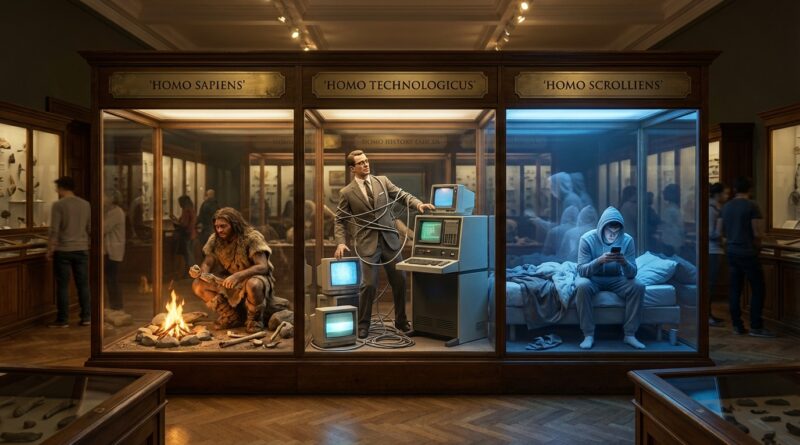
Welcome to Homo Scrolliens: The First Species Evolved Entirely by Infinite Feed
You know that moment. The room is dark, your face is lit like a raccoon in a security camera, and your thumb is still flicking upward as if the next post might finally explain your life. It is funny until it is not. Then it is just tiring. If you have ever wondered why a species smart enough to build satellites can still lose 47 minutes to a video of a man pressure-washing a rug, the answer is not that you are lazy or broken. It is that your brain is old, your phone is new, and the phone is very, very good at pushing ancient buttons. That gap matters. A lot. We keep talking about tech as if it is either ruining civilization or saving it. Meanwhile, most of us are just trying to figure out why checking one message turns into a late-night expedition through outrage, recipes, war footage, celebrity gossip, and an ad for a lamp shaped like a mushroom.
⚡ In a Hurry? Key Takeaways
- Doomscrolling often feels personal, but it is better understood as old survival wiring getting hijacked by endless feeds.
- Run a simple seven-day field experiment. Change one app setting, one physical habit, and one bedtime rule, then watch what happens.
- You do not need perfect discipline. Small friction, like moving apps or turning off autoplay, often works better than shame.
Meet Homo Scrolliens
Allow me to introduce a possible new branch on the family tree: Homo scrolliens. Upright posture, opposable thumbs, weak neck, eyes permanently adjusted to notification glow.
This creature can detect the faint vibration of a phone from three rooms away. It can also open an app without remembering doing so. Scientists call this a habit loop. The rest of us call it, “Wait, why am I on this again?”
The joke works because it is uncomfortably close to the truth. Human beings did not evolve for infinite information. We evolved for scarce information. A rustle in the grass mattered. A strange face mattered. Bad news mattered most of all. If your ancestors ignored possible threats, they did not become your ancestors.
Now take that alert system and plug it into a machine that delivers novelty, social comparison, moral outrage, tribal conflict, sexual cues, gossip, and random rewards every few seconds. Of course your brain sticks to it. It thinks it is doing an important job.
Your Brain Is Not Weak. It Is Just Old Firmware
I do not mean “old” as an insult. I mean ancient in the way a hammer is ancient. Reliable. Powerful. Built for a different kind of world.
The lizard, the labrador, and the office manager
A simple way to picture your mind is this.
Part of your brain is the smoke alarm. Fast, twitchy, always scanning for danger. Part is the labrador. It loves rewards, novelty, snacks, and approval. Then there is the tired office manager up front trying to plan your day, pay your bills, and remember why you opened the fridge.
Infinite feeds are catnip for all three.
The smoke alarm says, “This looks urgent.” The labrador says, “Maybe the next post is even better.” The office manager says, “I just needed to check the weather,” and then vanishes under a pile of reels.
That is why doomscrolling can feel weirdly productive while also making you feel worse. Your system reads it as vigilance. Like staying awake at the mouth of a cave. But the threats never resolve, because the feed never ends.
Why Infinite Feed Feels So Hard to Leave
Casinos get a lot of blame in discussions like this, but your phone has one advantage over a slot machine. It lives in your pocket. It knows your habits. It can reach you while you are bored, lonely, tired, or avoiding laundry.
Variable rewards are rocket fuel
If every post were boring, you would leave. If every post were amazing, you would get full. The hook is the mix. Most posts are forgettable. Every so often, you get something that hits. A joke. A shocking headline. A message from someone you like. A clip so absurd you send it to three friends.
Your brain loves uncertain rewards. It keeps checking because maybe this time.
Negative information sticks harder
Bad news has a VIP lane into your attention. So does conflict. So does anything that suggests your group is under attack, your health is at risk, your money is in danger, or society is about to collapse because a teenager danced near a historical building.
This is not because you are especially gullible. It is because your nervous system treats possible threats as important data.
There is no natural stopping point
A newspaper ends. A magazine ends. Even a terrible meeting eventually ends. An infinite feed removes the old cue that said, “You are done now.”
That matters more than people think. Human habits are shaped by boundaries. Without a stopping cue, your brain has to invent one on the fly. That is hard at 1:47 a.m. when your self-control is already running on fumes.
The Big Misunderstanding: You Think This Is a Moral Failure
This is where people get unnecessarily cruel to themselves.
They say, “I have no discipline.” Or, “Everyone else can handle it.” First, no, not everyone else can handle it. Plenty of people are also losing sleep while watching a stranger restock a vending machine. Second, this is less about character than about design meeting biology.
When tech products are built to remove friction, pile on cues, and keep the next thing coming, your effort is not being measured in a neutral environment. You are not failing a simple test of will. You are walking through a casino where the slot machines know your childhood insecurities.
That does not mean you are powerless. It means your strategy should change. Stop trying to be a hero in the middle of the feed. Start changing the terrain.
Run a Field Experiment on Your Own Brain
This is the practical bit. Not a digital detox fantasy. Not a promise that you will become a serene woodland mammal by Tuesday. Just a small experiment.
For seven days, do three things.
1. Add one layer of friction
Pick the app that turns five minutes into fifty. Move it off your home screen. Log out each night. Turn off autoplay. Switch the display to grayscale after 10 p.m. Any one of these counts.
The point is not punishment. It is interruption. You are giving the office manager a chance to wake up and ask, “Do we actually want this?”
2. Replace the hand motion, not just the app
A lot of scrolling happens because your body wants a tiny task. Thumb moves. Screen changes. Brain gets pellet.
So swap in something that still fits the moment. Put a Kindle app where the social app used to be. Keep a notes app on the dock. Set your phone to open a camera or audiobook instead. If the urge shows up while you are waiting in line or lying in bed, you need a replacement that is close enough to win.
3. Create one hard stop before sleep
Pick a bedtime cutoff that is mildly annoying but realistic. Maybe the phone charges across the room at 11 p.m. Maybe one app is blocked after midnight. Maybe you use an actual alarm clock so the phone does not sleep next to your head like an emotionally needy toaster.
Do not make the rule heroic. Make it boring and repeatable.
What to track
Each day, write down three things. How long you spent on your worst app. How you felt after your longest scroll session. How you slept.
That is enough. You are not gathering evidence for a trial. You are looking for patterns.
What Usually Happens When People Try This
Most people notice one of four things.
The urge is strongest at specific times
Usually late at night, during work avoidance, or in little dead zones like elevators, bathrooms, and supermarket queues. That tells you the problem is not “my whole personality.” It is certain contexts.
The first ten minutes feel good, the next forty feel stale
This is useful. It means the feed is not one single experience. It has a payoff curve. Once you notice where the curve drops, leaving gets easier.
Tiredness makes everything worse
No shock there, but it helps to see it in your own notes. Sleepy brains chase easy stimulation. They also make weak agreements with themselves.
Small changes work better than grand vows
People love to announce a total reset. Then real life happens. The better move is humble. Fewer notifications. More friction. Clear stop times. Better replacements.
The Satirical Part Is Funny Because It Is True
There is something deeply comic about modern life. We have map apps, language models, robot vacuums, and grocery delivery, yet we still end up half-prone on the bed staring at a clip of a raccoon stealing cat food while our nervous system whispers, “Stay alert. This may be vital.”
That is the core joke of satirical human evolution doomscrolling and technology. We imagine evolution as a march toward mastery. In practice, it is often a series of clever adaptations bumping into environments they were never built for.
You are not the final product of progress. You are a very successful mammal trying to use Stone Age instincts inside a carnival run by software teams.
Once you see that, your habits become easier to study without all the shame. Less “Why am I like this?” More “Ah. The monkey saw movement.”
How to Make Peace With Tech Without Pretending It Is Fine
The online argument usually goes one of two ways. Either phones are destroying humanity, or concerns are overblown and everyone should relax because memes are fun. Both miss the daily reality.
The real question is not whether technology is good or evil. It is what it does to attention, mood, sleep, and your sense of control on an ordinary Tuesday.
That is a much more useful frame. It helps you spot the difference between tools that serve you and systems that feed on your idle moments. It also helps you make practical changes without turning into a smug off-grid prophet who churns his own butter.
At a Glance: Comparison
| Feature/Aspect | Details | Verdict |
|---|---|---|
| Why doomscrolling happens | Ancient threat detection and reward-seeking instincts collide with endless novelty, outrage, and no natural stopping point. | Not a character flaw. A design-and-biology mismatch. |
| Best first fix | Add friction. Move apps, turn off autoplay, log out, use grayscale, and keep the phone away from the bed. | Low effort, high payoff for most people. |
| What actually helps long term | Tracking patterns, replacing the habit with something nearby, and setting realistic stop rules. | Better than dramatic detox promises you will abandon by Thursday. |
Conclusion
It helps to stop treating every bad tech habit like a personal defect. Everywhere online the conversation about humans and tech is either apocalyptic or cheerleading, but almost nobody is asking what this stuff is actually doing to our animal hardware day to day. That is the useful question. Once you frame doomscrolling as an evolutionary misfire instead of a moral collapse, you can laugh a little, notice your own wiring, and test changes that fit real life. You do not need to become a monk. You just need to become a slightly better field researcher of your own brain. Less shame, more data. Less “I am weak,” more “interesting, the primate prefers autoplay when tired.” That is not giving up. That is adapting in real time.