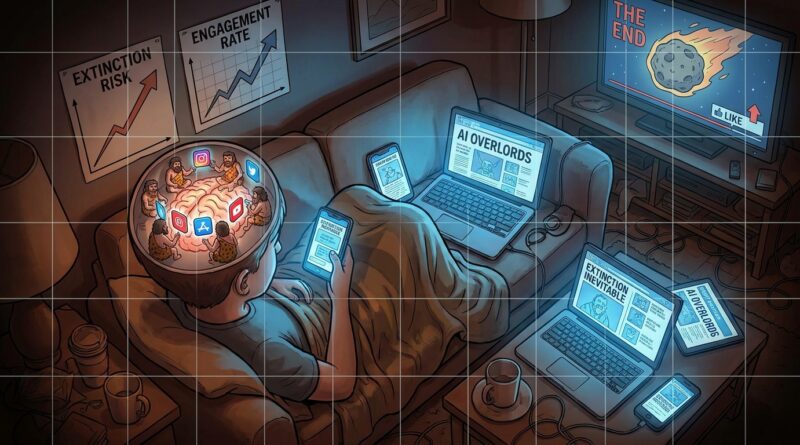
Homo Doomscroll‑Delighted: When Humans Evolved To Enjoy Their Own Extinction Warnings
You are not imagining it. AI extinction talk has become strangely bingeable. One minute you are reading a serious warning from a researcher. Ten minutes later you are knee-deep in memes about the last human being fired by a chatbot while circus music plays in your head. It feels awful, but also hard to stop. That is the trap. Your brain reads existential fear as urgent, social, and somehow rewarding, especially when everyone else is reacting too. So the feed keeps serving more. And because jokes, panic, and real concerns now arrive in one big mixed stream, it gets harder to tell whether you are being informed or simply wound up for engagement. If you feel hooked on threads about AI wiping us out, yet also exhausted by them, that does not make you irrational. It makes you human, online, and very easy for a modern feed to keep refreshing.
⚡ In a Hurry? Key Takeaways
- AI doom memes spread because fear grabs attention fast, and social feeds reward whatever gets shared, not whatever is most useful.
- If a post makes you want to refresh, repost, or panic immediately, pause and ask whether it offers evidence, context, or just vibes.
- Real AI risks exist, but nonstop extinction content can blur signal and noise, leaving you more anxious and less informed.
Why extinction talk feels like entertainment
Humans are built to notice danger. That part is old hardware. If somebody in your tribe shouted, “Something terrible is coming,” paying attention was smart.
Social media takes that instinct and turns the volume way up. The feed does not care whether the warning is careful, exaggerated, sincere, or half joke. It cares whether people stop scrolling.
And extinction warnings are almost perfect engagement bait. They are big. They are dramatic. They carry moral weight. They let people signal that they are serious, informed, funny, or ahead of the curve, sometimes all at once.
That is why satire on AI extinction memes and human doomscrolling works so well. It is not just comedy. It is a mirror. The joke lands because we recognize the behavior. We laugh at the absurdity while still clicking the next thread.
The weird social reward hidden inside panic
Fear spreads because it bonds people
When everyone shares the same alarming post, it can feel like group survival. “Have you seen this?” becomes a social ritual. Passing the warning along feels responsible, even if no one has checked the source very closely.
That is part of why AI apocalypse content travels so far. Sharing it says something about you. It says you care. It says you are paying attention. It says you are not one of the clueless people fiddling while the servers burn.
Doom also offers status
There is a strange prestige in sounding more alarmed than everyone else. If you predict the worst, you cannot be accused of underreacting. Online, that can look like wisdom, even when it is mostly theater.
The result is a genre of content where every new warning must sound bigger than the last one. Not because the evidence changed that much, but because the attention economy rewards escalation.
How memes blur real risk and performative panic
This is where things get messy. AI risk is not fake. There are serious concerns around misuse, labor disruption, surveillance, fraud, concentration of power, and yes, long-term safety debates. But once those concerns enter meme culture, they get chopped into emotional snack food.
A researcher says something cautious. A big account posts the spiciest line. Someone turns it into a reaction image. Then come the fake resignation screenshots, mock apocalypse countdowns, cartoon edits, and “we are cooked” one-liners.
Now the original point is gone. What remains is a mood.
Moods are powerful. They spread faster than nuance. But they are terrible at helping you decide what is actually happening.
Why your brain keeps hitting refresh anyway
Uncertainty is sticky
Your brain hates open loops. If the question is “Could AI destroy everything?” there is no neat answer waiting at the bottom of the feed. So you keep scrolling, hoping the next post will finally settle it.
It will not. The feed lives on unresolved tension.
Intermittent rewards keep you hooked
Most doom posts are repetitive. Then suddenly one is genuinely insightful, hilarious, or shocking. That occasional payoff trains you to keep checking. It is the same basic trick that keeps people pulling slot machine handles.
Anxiety can masquerade as preparation
Doomscrolling often feels productive. It feels like staying informed. Sometimes it is. Often it is just emotional rehearsal for disasters you cannot act on in that moment.
That is an important distinction. Information helps you make choices. Repeated panic just drains your attention.
How to tell if a post is informing you or farming your emotions
Try this quick filter before you share or spiral.
1. Does it name a specific risk?
“AI could end humanity” is dramatic, but vague. A more useful post names a mechanism. For example, model misuse in biosecurity, automated scams, unsafe deployment, or job displacement in a certain field.
2. Does it offer evidence or only intensity?
Strong claims should come with reporting, research, or at least a clear line of reasoning. If the whole thing runs on tone, sarcasm, or borrowed authority, be careful.
3. Is the post asking you to think, or to perform?
Some threads are really invitations to join a mood. Be terrified. Be smug. Be in on the joke. That is different from helping you understand what matters.
4. After reading it, do you know more?
This is my favorite test. If you finish the post and only feel more activated, but not more informed, it probably harvested your attention better than it served your judgment.
What clearer judgment looks like
You do not need to pick between two bad options, naive optimism or total apocalypse-brain.
Clear judgment sounds more like this: AI brings real risks. Some are immediate and boring, which usually means they are easier to ignore and more likely to matter day to day. Some are long-term and genuinely hard to reason about. Many online discussions about both are distorted by incentives to sound dramatic.
That stance is less exciting. It is also more useful.
A practical anti-doomscrolling plan
Set a “source before scroll” rule
Before reading hot takes, check one solid source first. That gives your brain a baseline. Then when the memes start flying, you have something sturdier to compare them against.
Limit apocalypse content to a container
Give it a lane. Twenty minutes. One trusted newsletter. Two researchers you respect. Not a free-range panic buffet running all day in your pocket.
Notice your body, not just your thoughts
If your shoulders are up, your jaw is tight, and your thumb is moving like it owes rent, that is data. You may be past the point of learning and into the zone of self-agitation.
Ask the most grounding question
“What, if anything, can I do with this information today?”
If the answer is nothing, you may not need another 40 posts about it tonight.
It is okay to laugh, just do not outsource your judgment to the joke
Satire can help. Honestly, sometimes it is the healthiest response to inflated online drama. A good meme can puncture fake profundity in seconds.
But satire also anesthetizes. If every warning becomes a punchline, your brain can stop distinguishing between “this is overblown nonsense” and “this is serious but being communicated badly.”
That is the balance to aim for. Keep your sense of humor. Just do not let irony make all claims feel equally empty.
What is actually happening here
We have built feeds that turn fear into a public performance. AI extinction talk fits the format perfectly because it is abstract enough to invite projection, serious enough to sound noble, and dramatic enough to spread.
So people share it for mixed reasons. Some are genuinely concerned. Some are joking. Some want attention. Some want to look smart. Most are doing a bit of all four.
The problem is not that people care about AI risk. The problem is that online systems reward emotional amplification more than careful sense-making.
At a Glance: Comparison
| Feature/Aspect | Details | Verdict |
|---|---|---|
| Serious AI risk discussion | Specific claims, evidence, trade-offs, and uncertainty are named clearly. | Worth your attention. |
| Viral extinction thread | High emotion, low clarity, lots of sharing, little practical value. | Treat with caution. |
| Satire and memes | Can expose hype and absurdity, but can also flatten real differences between nonsense and legitimate concern. | Useful in small doses, not as your only lens. |
Conclusion
If AI apocalypse talk leaves you anxious, fascinated, and vaguely embarrassed by how often you check for updates, you are not broken. You are reacting exactly the way a social platform hopes you will. The good news is that once you see the pattern, it loses some of its power. This matters right now because AI doom has become its own viral copypasta genre, with genuine warnings remixed into memes, fake resignations, and cartoon jokes until nobody is quite sure what is signal and what is theater. Giving that discomfort a name helps. It lets you step back, stop being emotionally farmed by every new “we are all going to die” thread, and return to something better than panic. Curiosity. Proportion. Judgment. Those are still available, even if the feed would prefer you kept refreshing.