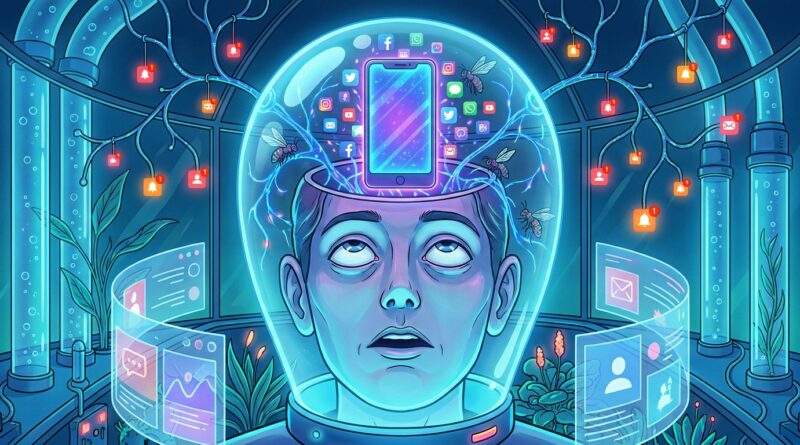
Homo Push‑Notification: When Humans Evolved Into Pavlov’s Favorite Gadget
You are not weak, lazy, or secretly in love with your phone. You are being pecked to death by tiny digital pigeons. A ding here. A banner there. A cheerful red dot screaming, “Look at me now.” You can feel your attention getting tugged around all day, yet it is easy to shrug and call it staying connected. That story is comforting. It is also a little fake. Most apps are not politely waiting for your time. They are competing for it, testing colors, sounds, timing, and wording to see what makes your thumb jump first. That is why this feels personal. Because it is. The good news is that once you see notifications as a weird evolutionary trap instead of a moral failure, the whole thing gets easier to laugh at, and easier to fix. You do not need to move to a cabin. You just need to stop letting every app ring the dinner bell.
⚡ In a Hurry? Key Takeaways
- Phone addiction is not just bad self-control. Notifications are built to trigger old reward and threat systems in your brain.
- Try a 7-day “notification species test.” Turn off all non-human alerts, then add back only the ones that prove useful.
- You do not need a detox retreat or another app. A few phone setting changes can cut stress fast and make your attention feel like yours again.
Welcome to Homo Push-Notification
There was a time when a sudden sound meant something real. A baby crying. A knock at the door. A branch snapping in the woods. Your brain evolved to care about interruptions because interruptions used to matter.
Now the same brain gets hijacked by “Taylor posted for the first time in a while,” “flash sale ends soon,” and “someone liked your comment.” Your nervous system does not always know the difference between a tiger in the bushes and a retail app offering 15 percent off socks.
That is the joke at the center of this whole mess. We built pocket computers, then let hundreds of companies train us like eager little lab ferrets.
If you were looking for satire on phone addiction and notification dopamine, here it is. We did not become more connected. We became highly observable mammals carrying casino lights in our pockets.
Why Notifications Work So Well on Regular Humans
1. Your brain loves variable rewards
Most notifications are not valuable. That is exactly why they work.
If every buzz gave you something amazing, you would get used to it. If every buzz gave you nothing, you would ignore it. But a random mix of boring, useful, flattering, urgent, and weird keeps you checking. It is the same basic trick behind slot machines. Maybe this one matters. Maybe this one is fun. Maybe this one changes everything. Better look.
2. Red dots are tiny fake emergencies
Those unread badges are not neutral design. They create mild tension. A small open loop. A feeling that something is unfinished. Your brain hates loose ends, so it reaches for the easiest relief available, which is tapping the app.
3. Social alerts hit deep
A weather alert and a “someone mentioned you” alert may both light up your screen, but social signals hit harder. Humans are group animals. Being included, praised, watched, or left out matters to us at a very old level. Apps know this. That is why they lead with language like “your friend,” “someone replied,” or “people are waiting.”
4. AI got very good at timing
Recommendation systems are not just picking content. They are getting better at guessing when you are bored, tired, lonely, curious, or easy to hook. The result is not magic. It is pattern matching with a business model attached.
This Is Not You Failing a Willpower Test
This part matters. A lot.
If your attention feels shredded after a day of buzzing devices, that does not mean you are weak. It means you are having a normal human reaction to tools designed to interrupt you at scale. The average person is not sitting in some fair fight with a messaging app, a shopping app, three social platforms, two news apps, and a game all asking for a slice of their nervous system.
Once you stop treating this like a character flaw, you can start treating it like what it is, a settings problem mixed with a business problem.
The Best Way to See the Problem Clearly
Try this mental switch. Imagine every app on your phone as a species competing in the same ecosystem.
Email is the pigeon. Slack is the caffeinated squirrel. Instagram is a raccoon with excellent lighting. Breaking news is a goose that thinks everything is an emergency. Your bank app is a smoke alarm. Useful when needed. Weirdly loud if misused.
Now ask one simple question. Which species actually deserves the right to shriek at you in real time?
That framing helps because it makes the manipulation visible. It also makes it slightly ridiculous, which is good. People change habits better when shame is replaced with clarity and a little humor.
The 7-Day Notification Species Test
Here is the experiment. It is simple, time-boxed, and boring in the best possible way.
Day 1: Put every app into one of three buckets
Bucket A: Human and urgent. Calls, direct messages from real people you care about, calendar reminders you set yourself, security alerts from trusted services.
Bucket B: Useful but not urgent. Delivery updates, banking summaries, work tools, school portals.
Bucket C: Attention bait dressed as information. Social likes, “recommended for you,” sale alerts, “you missed this,” streak reminders, trending topics, game nudges, content suggestions.
Day 2: Turn off Bucket C completely
Not silence. Off.
If an app cannot think of a reason to contact you other than “come back,” it loses speaking privileges.
Day 3: Move Bucket B out of your face
For useful but non-urgent stuff, switch from lock-screen alerts to notification center only if your phone allows it. No banners. No sounds. No badges if possible. The app can leave a note at the front desk. It does not need to kick in the door.
Day 4: Keep Bucket A, but make it specific
Maybe messages from favorite contacts can make sound. Maybe everything else stays quiet. The point is not to go off-grid. The point is to make your phone feel less like a toddler with a whistle.
Day 5: Check in three times, not thirty
Pick set times to look at your notification pile. Morning, lunch, late afternoon. Or whatever fits your life. You are training your brain to expect information in batches instead of random jolts.
Day 6: Notice what changed
Do you feel less twitchy? Less fake urgency? More able to finish a thought? A little bored at first? Good. Boredom is often just your brain thawing out.
Day 7: Add back only proven winners
If you truly missed something important, turn that alert back on. If not, leave it dead.
This is the key. Apps do not get notification rights by default. They earn them.
What Most People Discover by Midweek
First, almost nothing catches fire.
Second, many “urgent” alerts turn out to be theater. You do not need to know instantly that a content creator uploaded a new video, that a store has a weekend sale, or that strangers are discussing a topic your app thinks you should care about.
Third, the stress drop is real. People often notice they stop phantom-checking their phones as much after a few quieter days. Not always right away, but enough to feel the difference.
And fourth, some alerts are worth keeping. That is fine. This is not a purity contest. The goal is not to become a digital monk. The goal is to stop living in a rigged carnival game.
Settings That Help Without Becoming a Whole Lifestyle
Use grayscale if you want a quick reality check
It makes many apps feel less edible. You do not have to keep it on forever. Even trying it for an evening can show you how much of phone attraction is just visual candy.
Remove badges first if full silence feels scary
For many people, the red dots are more stressful than the sounds. If turning everything off at once feels intense, start there.
Keep your home screen boring
Move high-drama apps off page one. Keep tools up front. Put slot-machine apps where they have to work harder to find you.
Use Focus or Do Not Disturb modes
Not because it is trendy. Because it works. One mode for work. One for evenings. One for sleep. Let only a small set of people and apps break through.
Turn off “suggested” notifications everywhere you can
If the app is recommending things to look at, that is usually not for your peace of mind.
But What About Work, Family, and Real Life?
This is where people get nervous. Fair enough. Some alerts matter. Parents, caregivers, people on call, and anyone dealing with health or work emergencies cannot just go full cave mode.
That is why the species test is selective. Keep true human communication easy. Keep safety and account alerts on. Keep calendar reminders you actually need. Trim the rest.
You are not cutting yourself off from life. You are cutting yourself off from marketing disguised as intimacy.
Why the Evolution Angle Helps
When people talk about phones and social feeds, the conversation often gets stuck in two bad places. One is vague anxiety. “I think this is bad for my brain.” The other is full doom mode. “We are all cooked forever.”
The evolutionary framing is more useful. It says, of course this stuff hooks us. It presses buttons that existed long before smartphones did. Novelty. Belonging. Uncertainty. Reward. Threat. Status. We are old hardware running very pushy software.
That idea lowers defensiveness. It also gives you your next move. If the system is using old instincts against you, you do not need to become a better robot. You need to shape the environment so your instincts are not getting poked every six minutes.
At a Glance: Comparison
| Feature/Aspect | Details | Verdict |
|---|---|---|
| All notifications on | Constant pings, badges, banners, and random urgency from apps with mixed motives | High stress, low focus. Great for apps, bad for humans. |
| Selective notifications | Only calls, direct human messages, security alerts, and reminders you chose | Best balance for most people. You stay reachable without living in a pinball machine. |
| Full notification blackout | No alerts at all, manual checking only | Useful short-term reset, but too extreme for many jobs and family situations. |
Conclusion
You do not need another doom post telling you your phone is melting your soul. You probably already know it feels bad when your attention gets yanked around all day. The more helpful move is to make the manipulation visible, a little absurd, and therefore easier to change. Thinking of this as an evolutionary misfire helps. Your brain is not broken. It is simply very old, and your apps are very loud. So try the 7-day experiment this week. Treat notifications like competing organisms. Let the useful ones survive. Mute the clingy raccoons. Then compare notes with other people and tweak from there. No wellness app required. Just a few setting changes, a small dose of skepticism, and the comforting realization that you do not owe every buzzing rectangle access to your nervous system.