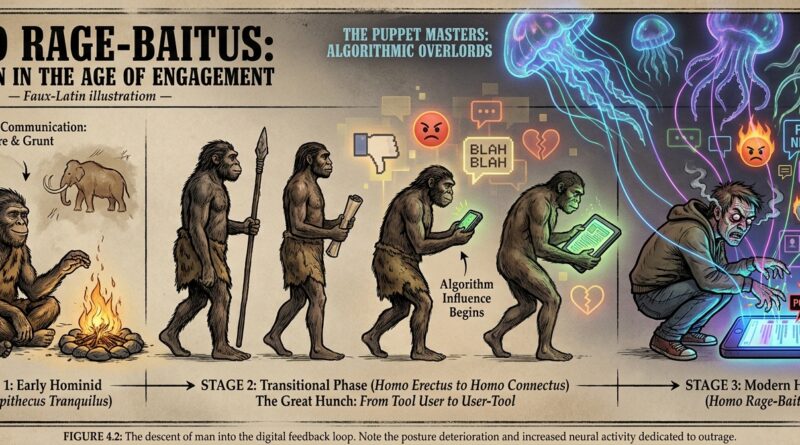
Homo Rage‑Baitus: When Humans Evolved To Feed The Algorithm Their Outrage For Free
You open your phone for one quick check. Ten minutes later, you are furious at a stranger, annoyed at an opinion you never asked for, and somehow reading 400 comments from people who seem legally banned from being normal. If that feels familiar, you are not weak, dramatic, or bad at self-control. You are using products built to keep your eyes locked on the screen, and anger works better than delight. That is the ugly little secret behind the modern feed. What looks like “what’s happening” is often a carefully arranged buffet of conflict, insult, and outrage. The joke is that we act like we are browsing. The truth is closer to unpaid lab work. You poke the feed, the feed pokes back, and the platform takes notes. That is why this whole ragebait social media evolution satire hits so hard. It feels funny because it is painfully close to real life.
⚡ In a Hurry? Key Takeaways
- Ragebait works because social platforms often reward posts that trigger strong emotions, especially anger and disgust.
- If your feed feels worse lately, start using “not interested,” mute functions, and time limits to retrain what the algorithm shows you.
- Your doomscroll habit is not just a personal flaw. It is a predictable reaction to systems designed to test what keeps you engaged.
Meet Homo Rage-Baitus
Picture a new branch on the human family tree.
Not Homo sapiens. Not Homo economicus. Homo Rage-Baitus.
This modern creature survives by spotting the most annoying take in the room, reacting instantly, and then checking back every six minutes to see if a stranger has replied with something even worse. It is satire, sure. But it also explains a real shift in online behavior.
We used to adapt to villages, workplaces, and friend groups. Now a lot of us adapt to recommendation engines. We learn, often without noticing, what gets attention. Sharp opinions. Mockery. Tribal language. Certainty. Outrage with a side of smugness.
The platform does not need you to be happy. It needs you to stay.
Why Anger Travels Faster Than Joy
Most people would prefer a feed full of useful, funny, or heartwarming things. But “prefer” and “keep scrolling” are not always the same thing.
Anger has stickiness. It creates tension in the brain. You want to resolve it. You want context. You want to see the replies. You want to know if other people agree that this person is wildly wrong. So you pause longer, click more, and come back later.
To a platform, that can look like success.
The algorithm is not evil. It is literal.
Most recommendation systems are not sitting there thinking, “How do we ruin Greg’s afternoon?” They are measuring signals. Watch time. Comments. Shares. Replays. Reply chains. If inflammatory content creates stronger signals, the system may push more of it.
That is how you end up with a feed that feels less like a newspaper and more like a bar fight with autoplay.
The divisive stuff rises because people react to it
This is the part that stings. The machine is not doing it alone. We train it. Every hate-watch, every furious reply, every “this is so stupid” comment feeds the model. You think you are resisting bad content. The system may read it as interest.
That is the unpaid labor part. You bring the emotion. The platform collects the data.
Why this feels personal, even when it is not
When your feed gets nasty, it is easy to think something is wrong with you. Maybe your attention span is broken. Maybe you are too online. Maybe you are just bad at boundaries.
Some of that can be true. But it is not the whole story.
Feeds are engineered environments. They are built to test, sort, and optimize. If you put humans inside a system that rewards emotional reaction, many humans will react emotionally. That is not a character defect. That is basic cause and effect.
This matters because shame keeps people stuck. Understanding gives you options.
How platforms quietly turn comment sections into gladiator pits
Notice how often the most extreme reply seems to float to the top. That is not always random.
Comments that spark dogpiles, arguments, and back-and-forth activity can get more visibility. A reasonable comment often ends the conversation. An obnoxious one keeps it going. Guess which one creates more engagement.
The result is a warped sense of reality. You start to think everyone is angrier, dumber, and more cruel than they really are. Sometimes you are not seeing “the public.” You are seeing the comments most likely to keep people poking each other with sticks.
The fake evolution story that explains a real problem
Calling this a new stage of human evolution is obviously a joke. Nobody is growing a special thumb for doomscrolling. Yet the metaphor works because behavior really does adapt.
Online, people learn what survives.
Creators learn that calm nuance dies quietly while conflict gets oxygen. Users learn that outrage earns likes, replies, and social reinforcement. Even lurkers learn that the internet feels “alive” when something is going wrong.
So the tribe changes. Not your family tribe or your local tribe. Your algorithmic tribe. The group of people, posts, and provocations the platform decides belong together because they reliably produce engagement.
That is why ragebait social media evolution satire lands with such force. It sounds absurd. It also sounds like Tuesday.
How to take back some control without deleting the internet
You do not need to move to a cabin and communicate by carrier pigeon. A few boring, practical steps can make a real difference.
1. Stop feeding the posts you hate
This is the hardest one. If something is obvious bait, do not quote-post it, argue under it, or send it to five friends with “look at this idiot.” Even negative attention can teach the system that this content works.
2. Use the tools platforms hope you ignore
Hit “not interested.” Mute keywords. Unfollow accounts that make your pulse jump for bad reasons. Turn off autoplay where possible. These tools are not perfect, but they are one of the few ways to push back on what the system thinks you want.
3. Build friction on purpose
Move the app off your home screen. Log out after use. Set a timer for ten minutes. Make doomscrolling slightly annoying. Tiny bits of friction can break the automatic loop.
4. Curate for people, not just topics
Follow accounts that consistently inform, entertain, or calm you. A topic can become toxic fast. A trustworthy person is usually a better filter.
5. Notice your body before your opinion
If your shoulders tense up and your breathing changes, that is useful information. The body often knows you are being baited before the brain catches up. Put the phone down first. Form the opinion later.
What a healthier feed actually looks like
A better feed is not one where nothing upsetting ever appears. News matters. Criticism matters. Real disagreement matters.
A healthier feed is one where every post is not trying to hook your nervous system like a fish.
You should be able to learn something without being provoked into a small emotional emergency. You should be able to disagree without being recruited into a digital blood sport. And you should be able to leave the app without feeling like your brain just spent an hour in a casino built by argument goblins.
At a Glance: Comparison
| Feature/Aspect | Details | Verdict |
|---|---|---|
| Why ragebait spreads | Angry content often gets more comments, longer watch time, and more repeat visits. | Bad for your mood, great for engagement metrics. |
| What users think they are doing | Browsing, staying informed, or checking in for a minute. | Often turns into emotional unpaid labor for the feed. |
| Best way to push back | Mute, block, mark “not interested,” limit time, and stop interacting with obvious bait. | Small habits can noticeably improve your feed over time. |
Conclusion
The current spike in complaints about ragebait feeds is not people being oversensitive. It is people noticing the machine. They are seeing how divisive comments get pushed upward, how the worst takes seem to win the most oxygen, and how attention starts to feel like a survival game for bad ideas. Thinking about this as a weird new stage in human evolution helps because it removes some of the guilt. You are not failing a simple test of willpower. You are reacting in a very normal way to an engineered environment built to measure and use your emotional responses. Once you see that clearly, the spell weakens. You can change what you click, what you follow, and how often you hand over your nerves for free. That is the first real step toward taking your feed, and your brain, back.