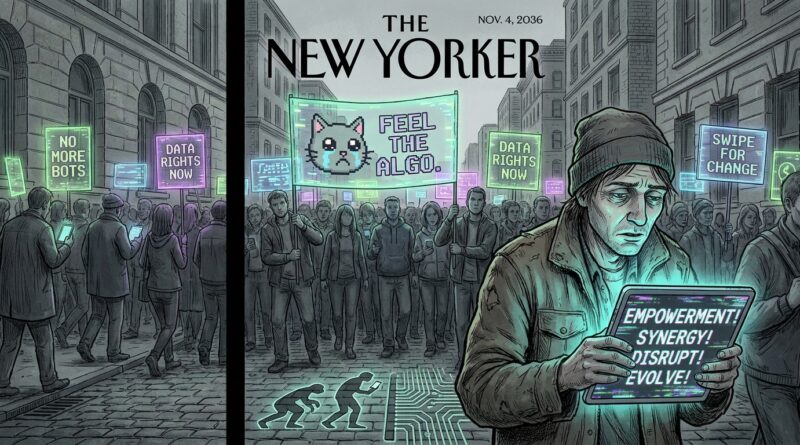
Homo Meme‑Golem: When Humans Evolved To Let AI Protest On Their Behalf
You are not imagining it. A lot of public outrage feels weirdly hollow now. The slogans are perfect. The memes are fast. The moral certainty arrives in a neat square image before most people have even read the article it is reacting to. And yet the humans involved can seem almost optional, like stagehands standing behind an army of auto-posting, auto-remixing, auto-outraging little digital creatures. That is the creepy joke at the center of modern protest culture. We may be turning into Homo Meme-Golem, a species that builds AI powered mascots to do our feeling for us. It is funny until it is not. Because once the meme machine can protest better than the people, it can also distract better, manipulate better, and exhaust everyone faster. If you have felt politically engaged and emotionally conned at the same time, congratulations. You are having a very normal reaction to a very synthetic internet.
⚡ In a Hurry? Key Takeaways
- AI generated protest memes can make real causes feel powerful on the surface but oddly empty underneath, because the performance of outrage gets separated from human effort and risk.
- Before liking, sharing, or donating, pause and check who made the post, whether the account behaves like a person, and whether the message links to real-world action.
- Not every slick meme is fake, but when protest content is mass-produced, targeted, and disposable, it becomes easier to manipulate your attention than earn your conviction.
Welcome to the age of outsourced outrage
Once upon a time, protest required annoying things like bodies, time, planning, weather, and the possibility of being yelled at in public.
Now it can require a prompt.
Type a cause into a model. Ask for ten posters, twenty slogans, a heartbreaking poem, a sarcastic meme thread, and a fake grassroots voice tuned for maximum spread among tired people with three minutes to spare. Hit post. Watch the machine do what machines do. Scale.
That does not make the cause fake. It does make the emotional experience around it more slippery.
This is the key weirdness. Human anger used to have weight because it cost something. You showed up. You made the sign. You argued with your uncle. You risked looking foolish. Today a cause can circulate globally on a cloud of frictionless content, some of it made by people, some of it sharpened by AI, some of it aimed at you because a system has decided you are exactly the kind of person who clicks when apocalypse is mixed with sarcasm.
What is a “meme golem” exactly?
Think of a meme golem as a semi-alive protest creature. It is made from human anxiety, machine speed, recycled imagery, and just enough moral heat to keep moving.
It does not need to understand the issue. It only needs to perform understanding convincingly enough to trigger reaction.
A meme golem can be:
- An AI-made protest poster shared by thousands of real people.
- A machine-remixed slogan that sounds moving but says almost nothing.
- A swarm of accounts boosting the same symbolic outrage until it feels bigger than the humans behind it.
- A targeted stream of “end of humanity” content designed to make you feel politically awake while keeping you passive.
The satire writes itself. Humans once evolved language, tools, and institutions. Now we seem to be evolving little synthetic emotional servants and asking them to hold our convictions for us while we scroll in bed.
Why AI protest memes hit so hard
They are optimized for speed, not depth
A human-made message often carries rough edges. A typo. A local reference. A sign someone painted badly at 2 a.m. Those flaws are clues that a person cared enough to make the thing.
AI smooths that all out. It can generate cleaner, punchier, faster content at industrial scale. That makes it useful. It also makes everything start to feel like an ad for a belief rather than evidence of one.
They let us feel involved without being involved
This is the part that stings.
People are busy, broke, overstimulated, and honestly a bit fried. A meme offers instant participation. Share this. Caption that. Add a crying emoji. You get a tiny burst of moral action without the drag of actual action.
Again, that does not make the feeling fake. It means the structure around the feeling may be built to stop at the feeling.
They are easy to target
If a platform, brand, campaign, or bad actor can test which imagery, phrases, or apocalypse jokes keep you engaged, they can keep feeding you variations. AI makes that loop cheaper and faster. Your outrage becomes a product input.
That is why the current wave of political content can feel so personal and so generic at the same time. It is custom-fit mass production.
The protest is real. The vibe may be synthetic.
This is where people get trapped in false choices.
Either they assume every AI-touched protest meme is fake propaganda. Wrong.
Or they assume tools do not matter because the cause matters. Also wrong.
The cause can be urgent and the content ecosystem around it can still be manipulative, shallow, and designed to burn through your attention like kindling.
Picture a real march being represented online by endless AI-generated posters of impossibly photogenic crowds carrying grammatically flawless signs under cinematic lighting. It looks more persuasive than reality. It is also less trustworthy than reality. Real life is messier. That mess is often the proof that humans were there.
How to spot when a cause has been turned into content slurry
You do not need a digital forensics lab. A few simple questions help.
1. Does the post point anywhere beyond itself?
Real organizing usually leads somewhere. A meeting. A fundraiser. A strike date. A location. A document. A community group. A reporter. A demand.
If the content just loops back into more content, you may be feeding a meme golem.
2. Does the account feel human?
Check the posting rhythm. Is it active 24 hours a day? Does it post in several tones at once? Is it all reposts, no lived detail? Does every issue get flattened into the same dramatic style?
Humans are inconsistent. That is annoying in real life, but useful online.
3. Is the image too perfect?
Not every polished image is AI-generated. But impossibly neat signs, odd hands, unreadable background text, over-dramatic lighting, and crowds that look copied and pasted are all hints that the content was manufactured for effect.
4. Are you being moved or managed?
This is the coffee-shop test. After seeing the meme, do you understand the issue better, or do you just feel more charged up? If it is all voltage and no information, that is a clue.
Why this matters more than people think
Some readers will shrug and say, “So what? Memes have always been dumb.” True. But AI changes the volume, the speed, and the precision.
Old-school meme culture was chaotic. New meme culture can be automated, personalized, and continuously optimized. That means a protest aesthetic can be manufactured at scale without the slow, stubborn work of building trust among actual people.
And that has consequences.
- Real activists can be drowned out by prettier, emptier content.
- People can mistake posting for participation.
- Bad actors can inflame division with almost no effort.
- Legitimate causes can lose credibility because the visuals around them look fake or overcooked.
- Everyone gets more tired, more cynical, and easier to manipulate next time.
A satirical take, yes. But the joke lands because it is true.
The phrase “Homo Meme-Golem” is funny because it sounds like a museum plaque for a very dumb branch of human evolution.
Here we see the modern citizen. Note the hunched posture, blue light exposure, and habit of summoning synthetic mascots to experience politics on its behalf.
But satire works best when it names a feeling that polite language misses. And polite language has been missing a lot lately.
People know something is off. They can feel the mismatch between the seriousness of the issues and the strange disposability of the content wrapped around them. They want to care. They do care. They are just stuck inside systems that convert care into engagement and engagement into inventory.
How to reclaim some agency without becoming a paranoid hermit
You do not need to quit the internet, move into a cabin, and raise turnips.
You just need a few better habits.
Follow people who do things offline
Look for organizers, reporters, local groups, legal aid networks, researchers, and people who show receipts. If an account never leaves the content layer, treat it as entertainment until proven otherwise.
Reward specificity
Specific claims are harder to fake well. Vague moral theater is easy. If a post says “everything is collapsing,” ask “where, how, according to whom, and what now?”
Share slower
The machine wants reflex. You want judgment. Waiting ten minutes before reposting is not laziness. It is digital self-defense.
Do one non-meme action per cause
Read the source article. Email someone. Donate directly. Attend a local event. Talk to a real person. If your political life exists only as reaction images, you are living inside the golem, not directing it.
Keep a sense of humor
This is not trivial. Humor helps break the spell. If you can laugh at the absurdity of AI-generated moral theater, you are less likely to be swept along by it.
At a Glance: Comparison
| Feature/Aspect | Details | Verdict |
|---|---|---|
| Human-made protest content | Often messier, slower, and less polished, but more likely to show lived experience, local detail, and real stakes. | Usually more trustworthy, even when imperfect. |
| AI-generated protest memes | Fast, catchy, scalable, and emotionally effective, but easy to mass-produce, target, and detach from real-world action. | Useful with caution. Dangerous when it replaces substance. |
| Your best response | Pause, verify, reward specificity, and connect online sentiment to offline action before sharing or acting. | Best way to stay engaged without becoming fuel for the machine. |
Conclusion
Political and cultural memes about AI, protest, and the end of humanity are everywhere right now, and more of them are being designed, remixed, or aimed by AI systems rather than by messy, obvious humans. That is why so many people feel stuck between caring deeply and suspecting they are being played. Framing this as a new stage of evolution, where humans breed “meme golems” to feel feelings for them, gives the weirdness a name. And naming it matters. Once you see the pattern, you can stop treating every polished burst of outrage as proof of a living movement. Some of it is real. Some of it is theater. Some of it is just content slurry wearing a conscience like a costume. Your job is not to become cold. It is to stay human on purpose. Read slower. Share smarter. Back real people. Let the machine make images if you must, but do not let it outsource your judgment before the next auto-generated cause comes rolling in.