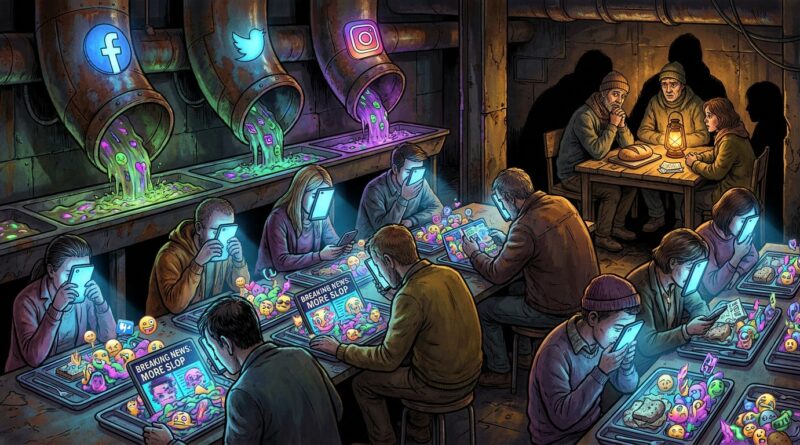
Homo Slop‑Sapiens: When Humans Evolved To Eat AI Junk Content Like It Was Food
You know the feeling. You open one app for a quick check, and suddenly you are knee-deep in AI slop. A fake celebrity quote. A weirdly smooth “photo” of something that never happened. A post with perfect grammar and zero pulse. It all kind of looks like content, but it lands like packing peanuts. You are not crazy for feeling tired after scrolling through it. A lot of people are starting to notice the same thing. We are getting fed a nonstop diet of synthetic junk, and our attention is paying the price.
The hard part is that AI slop and human attention now fit together a little too well. The slop is cheap to make, easy to remix, and built to trigger the tiny reflex that says, “well, maybe one more swipe.” You do not have to be fooled by it for it to still work on you. You just have to keep looking. That is the trick. The machine does not need your belief. It needs your time.
⚡ In a Hurry? Key Takeaways
- AI slop is low-effort synthetic content designed to capture attention, not inform or connect.
- You can push back by curating your feeds, slowing your sharing habits, and spending more time with trusted human sources.
- The real risk is not just misinformation. It is a gradual dulling of attention, judgment, and trust.
What “AI slop” actually is
AI slop is the digital version of empty calories. It is cheap, fast, engineered to be appealing, and bad at nourishing anything useful in you.
It can be AI-written posts that say a lot without saying anything. It can be fake images built to spark outrage or awe. It can be videos stitched together from stolen clips, robotic narration, and captions that sound confident while being flat-out wrong.
The common thread is not just that a machine helped make it. The common thread is that the content exists mainly to game attention. Not to teach. Not to entertain in any lasting way. Not to connect one person to another. Just to get the click, the share, the watch time, the tiny little signal that tells the platform, “yes, give me more of this sludge.”
Why it feels bad even when you know it is fake
This is the sneaky part. People often think the danger is being fooled. That is part of it, sure. But AI slop and human attention have a deeper problem.
Even when you know something is junk, your brain still has to process it. You still spend energy sorting, rejecting, comparing, and recovering. It is like walking through a room where every person is shouting nonsense at you. You may not believe any of it, but you still leave drained.
That “oddly full and totally undernourished” feeling is real. You consumed a lot, but very little of it helped you think better, feel better, or understand anything more clearly.
It trains your habits
If your feed keeps rewarding quick reactions over real thought, you start adapting to the feed. Shorter patience. More scanning. Less reading. More emotional twitching. Less reflection.
That does not mean you are broken. It means your environment is shaping you, which is what environments do.
It blurs what human voice sounds like
When synthetic content gets everywhere, real writing starts to sound almost suspiciously human. Messy, specific, odd, heartfelt, slow, imperfect. In other words, alive.
That is one reason the internet can feel so eerie right now. We are getting used to language that is technically fine and spiritually vacant.
Why platforms keep serving it
Because it is cheap, endless, and good at producing engagement crumbs.
One person with a few tools can flood a platform with hundreds of posts, images, videos, or fake news snippets. The systems ranking that content often do not care whether it was made with care. They care whether people paused, clicked, commented, or rage-shared it.
This is where the whole thing stops being just annoying and starts becoming structural. The internet is being filled with content that is faster to make than to evaluate. That is a nasty trade for users.
If you have read Homo Trojan‑Horsus: When Humans Evolved To Pretend They Don’t See The AI Inside The Horse, you already know the pattern. The AI is not always arriving with a trumpet blast. Sometimes it sneaks in as convenience, volume, and plausible junk that everyone agrees to treat as normal.
The real cost of AI slop and human attention
The cost is not just bad posts. It is a worse attention environment.
Your attention gets fragmented
Constant low-quality stimulation teaches your brain to expect novelty without depth. That makes books feel slower. Good essays feel harder. Real conversations feel less sparkly at first.
Your trust gets shaken
When fake photos, fake summaries, fake quotes, and fake “hot takes” are everywhere, trust starts to leak out of everything. People become cynical. Sometimes that looks like wisdom, but often it is just exhaustion wearing a clever hat.
Your relationships get thinner
If your online time is packed with synthetic bait, there is less room for actual people. Less room to read a friend’s long post. Less room to sit with a thoughtful message. Less room to notice someone trying, imperfectly, to say something real.
How to push back without moving to a cabin
You do not need to quit the internet and start carving your own spoons. You just need better friction.
1. Start labeling it in your own head
When you see it, call it what it is. AI slop. Synthetic filler. Content packing foam. Having language matters. It helps break the spell.
If you just feel vaguely gross after scrolling, you are more likely to blame yourself. If you can say, “ah, I just spent 20 minutes eating digital junk food,” you can actually do something about it.
2. Stop rewarding it with hate-clicks
Rage is still engagement. Mocking a fake image by quote-tweeting it to 10,000 people may feel satisfying, but it still gives the machine what it wants. If the content is truly useless, starving it is often smarter than fighting it in public.
3. Curate like a gardener, not a hoarder
Unfollow accounts that post too often with too little substance. Mute pages that feel weirdly generic. Spend more time with creators, writers, and communities that have a point of view and a track record.
If an account could be replaced by a prompt and nobody would notice, ask yourself why it is still in your feed.
4. Add more “high-protein” media
Yes, that is a silly phrase. It is also useful.
Read one good article before opening a short-video app. Listen to a podcast with actual reporting. Subscribe to one writer you trust. Watch something made by a person who clearly knows the subject and cares about getting it right.
The goal is not purity. It is balance. If your media diet is all sugar, your attention will feel like it.
5. Slow down before sharing
A lot of synthetic garbage spreads because people react first and inspect later. Before you pass something along, ask three boring but powerful questions.
Who made this?
Can I verify it?
Would I still share it if there were no likes attached?
6. Make room for boredom again
This sounds unrelated. It is not.
When your brain gets a little silence, it resets. The urge to snack on nonsense gets weaker. You become less reactive. More selective. Better at noticing when a feed is trying to hustle you into consuming filler.
What better looks like
Better does not mean every post is deep and every video is handmade by a wise artisan in a candlelit studio.
Better means there is still room online for real voices, real reporting, real humor, real mistakes, real style, and real disagreement. It means the default is not endless synthetic mush optimized for reaction.
It also means being honest with ourselves. A lot of this content exists because it works. Not brilliantly. Not beautifully. But enough. That is why resisting it has to become a habit, not just a complaint.
At a Glance: Comparison
| Feature/Aspect | Details | Verdict |
|---|---|---|
| AI slop | Cheap, fast, generic content made to grab clicks and watch time with minimal effort. | Easy to consume, bad for attention. |
| Human-made thoughtful content | More specific, more original, often slower, and usually tied to real experience or expertise. | Takes more effort, gives more value. |
| Your best defense | Curate feeds, verify before sharing, and spend more time with trusted sources and real people. | Practical, boring, effective. |
Conclusion
It is not silly to worry that all this synthetic noise is doing something to your brain. It probably is. Right now every platform is being flooded with low-effort AI content that looks intelligent but is really just static wearing a nice shirt. The good news is that you do not have to accept the menu. Once you have language for the problem, a little satire to puncture its fake glamour, and a few concrete habits to protect your feed, you are in much better shape. You can guard your attention, keep your relationships from being flattened into engagement metrics, and hold on to your sense of reality while the rest of the internet sleepwalks toward an all-you-can-eat buffet of digital empty calories.