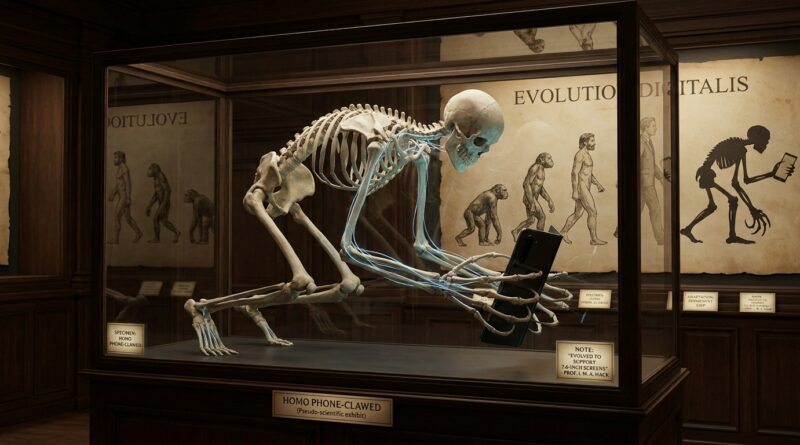
Homo Phone-Clawed: When Humans Evolved Freakishly Long Fingers To Serve Their Screens
You are not crazy. Phone ads really do seem to feature people with elegant piano fingers that can somehow cradle a giant slab of glass, hit every corner with one thumb, and still look relaxed doing it. Meanwhile, the rest of us are over here doing a strange pinky shelf, a claw grip, or that risky one-handed stretch that feels like it could end in a cracked screen and a pulled tendon. We joke about “phone pinky” and “text claw,” but the joke lands because it feels true. Our devices keep getting bigger. Our hands, stubbornly, do not. So we adapt. Quietly. A little awkwardly. This is the unofficial rise of Homo Phone-Clawed, the modern human whose posture, grip, and thumb range are being gently bullied by a 7-inch rectangle. Satire, yes. But also a very real story about how gadget design keeps asking our bodies to meet it halfway, then a little farther, then just one more inch.
⚡ In a Hurry? Key Takeaways
- Phone design is quietly shaping how we hold, stretch, and strain our hands, even if nobody says it out loud.
- If your phone feels too big, use one-handed mode, a grip accessory, and move key apps lower on the screen.
- The goal is not to panic about smartphones. It is to notice when “normal use” is actually low-grade ergonomic nonsense.
Welcome to the age of the decorative super-thumb
Look closely at smartphone marketing and you start to notice something odd. The devices get taller, wider, thinner, and somehow more slippery. Yet the people holding them always look perfectly at ease.
No strain. No finger gymnastics. No thumb doing a desperate lunge toward the top-left corner.
It gives the impression that the standard human hand is totally fine with modern phone design. That is the trick. Most of us are not holding these things elegantly. We are improvising.
We wedge the bottom edge onto the pinky. We curl the ring finger behind the case. We let the index finger do support duty like a tiny structural beam. Then we call it normal because everybody else is doing the same weird thing on the train.
Homo Phone-Clawed, a field guide
The Pinky Pedestal
This is the classic pose. The phone rests on your little finger like it has been drafted into unpaid labor. Over time, people swear they can see a dent there. Is it always a true physical change? Not necessarily. Is the finger annoyed anyway? Absolutely.
The Thumb of Destiny
This thumb believes it can reach any icon on a giant display if it just stretches hard enough. It cannot. But that does not stop the attempt. You can almost hear the tendons filing a complaint.
The Bed Scroll Hunch
Neck bent. Wrist angled. Phone six inches from your face. You started by checking one message. Forty minutes later, your hand is numb and you are somehow watching a video about the best cable organizers of 2026.
The One-Handed Leap of Faith
This is when you shift the phone in your palm to reach a control, fully aware that gravity is now involved in the decision. It is less a gesture and more a trust exercise with expensive consequences.
Why phones keep growing when hands do not
Because big screens sell.
That is the simple answer. Bigger displays look impressive on store shelves, in review videos, and in side-by-side spec charts. They are better for video, gaming, reading, and showing off bright panels. They also let brands squeeze in bigger batteries and extra camera hardware.
All of that makes sense on paper.
What gets less attention is the basic hand problem. A phone can be great for media and still awkward for actual human gripping. Those two facts can live together quite happily in the same product launch.
The result is a quiet bit of design theater. Tech companies talk a lot about immersion, productivity, thinness, and premium materials. They talk less about the fact that many people now need a case, a ring grip, a pop-out handle, or software tricks just to hold the thing comfortably.
This is satire, but the body part is real
The funny version is that we are evolving into a new species built for screens. Long fingers. Reinforced thumbs. Pinkies like load-bearing columns.
The less funny version is that repetitive strain is boring, common, and easy to ignore until it becomes a problem.
Using a phone for long periods can contribute to discomfort in the thumb, wrist, neck, and shoulders, especially when the device is large or your posture is bad. That does not mean your smartphone is instantly wrecking your skeleton. It means habits matter, and design matters too.
Most people do not need a lecture. They need language for the weirdness. That is why the Homo Phone-Clawed joke works. It turns a vague physical annoyance into something visible. Once you see it, you cannot unsee it.
The real scam is pretending awkward equals premium
There is a special kind of tech culture nonsense that says if a device is sleek enough, any discomfort is your fault.
Too slippery? Buy a case.
Too big for your hand? Use two hands.
Too heavy? It feels “substantial.”
Can’t reach the top of the screen? There is a hidden gesture for that.
Now, some of those are fair workarounds. But it is still worth asking a basic question. When did “needs accessories and hand acrobatics to use comfortably” become a sign of excellent design?
How to fight back without becoming a wellness influencer
1. Turn on one-handed mode
Most modern phones have it. On iPhone, you can often pull the top of the screen down with Reachability. On Android, many brands offer a one-handed mode that shrinks the usable screen area. It is not glamorous. It is useful.
2. Move the important stuff lower
Put the apps you use most on the bottom row. Use widgets carefully. If your phone lets you customize controls, keep the high-frequency taps in your thumb’s comfort zone.
3. Use a grip accessory if your phone is a bar of soap
Pop sockets, rings, straps, textured cases. None of these are admissions of defeat. They are tiny ergonomic corrections for hardware that often values clean looks over secure handling.
4. Switch hands more often
This sounds obvious, but most people do not do it. If one thumb is doing all the work, spread the load around. Your body likes variety more than heroic repetition.
5. Stop doing the top-corner stretch
If a tap requires your thumb to leave its zip code, reposition the phone or use your other hand. The tiny daily reach is where a lot of this annoyance lives.
6. Take micro-breaks during doom-scroll marathons
You do not need to go on a digital retreat in the woods. Just put the phone down for a minute. Uncurl the hand. Roll the shoulders. Let your neck remember it was once attached to a free-range human.
What better phone design would actually look like
Not every good phone has to be tiny. But better design would admit that hands exist.
Reasonable width
Tall phones are one thing. Very wide phones are where one-handed comfort often goes to die.
Grippy materials
If the back feels like an iced marble countertop, it may look premium and behave terribly.
Software that respects thumbs
Important controls should be easier to reach. More apps are getting this right, but not enough.
Less worship of screen size for its own sake
Bigger is not always better. Sometimes bigger is just bigger, and now your hand has to file the paperwork.
Why this matters beyond the joke
The phrase “standard human body” sounds dramatic until you notice how often technology quietly picks favorites. Tall people. People with bigger hands. People fine with using two hands all the time. People who do not mind carrying a mini-tablet in their pocket.
Everybody else adjusts. Then that adjustment starts to feel ordinary. That is how tech rewrites physical norms. Not with one giant change, but with a thousand tiny accommodations users make without being asked.
That is also why satire helps. It lets people laugh first, then notice the design logic underneath the laugh.
At a Glance: Comparison
| Feature/Aspect | Details | Verdict |
|---|---|---|
| Big phone screens | Great for video, reading, and battery space, but harder to manage one-handed for many people. | Useful, but often overrated if comfort suffers. |
| One-handed usability | Depends on phone width, weight, grip, and where software places key controls. | More important than spec sheets admit. |
| Accessories and software tricks | Cases, grip add-ons, and one-handed modes can reduce strain and make large phones easier to live with. | Worth using. They solve a real problem. |
Conclusion
So yes, Homo Phone-Clawed is a joke. But it is the useful kind of joke. The kind that gives people a way to describe a real, low-level absurdity they have been living with for years. While everyone argues about foldables, camera bumps, and which brand “won” the latest launch, our hands are still doing unpaid adaptation work in the background. Laugh at the lab-grown ad fingers if you want. You should. Then notice your own grip, your own thumb stretch, your own pinky acting like a furniture leg. That is the value here. Not panic. Not boring wellness preaching. Just a clearer way to talk about the physical toll of always-on tech, and maybe a small push to choose devices and habits that treat your body like part of the user experience.