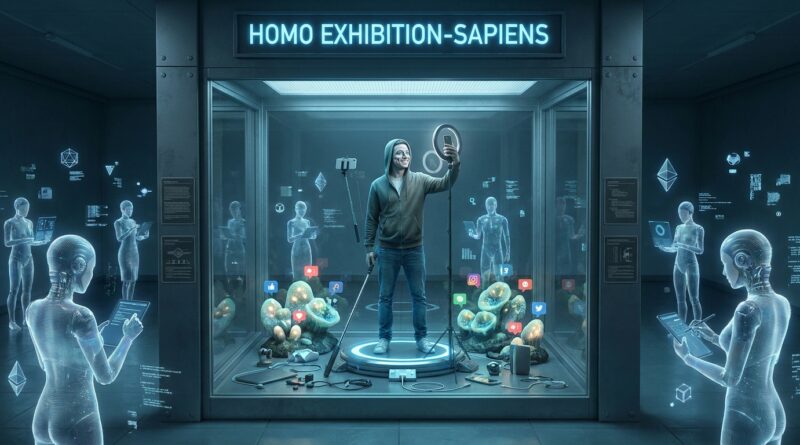
Homo Exhibition‑Sapiens: When Humans Evolved To Perform For AI Audiences That Don’t Exist
You can feel the weirdness now. You post a photo, a joke, a thought, and the reaction comes back with that plastic shine. A few likes look real. A few comments sound like a refrigerator trying to flirt. And somewhere in the middle, you catch yourself rewriting your life so it lands better with a feed ranking system that does not love you, know you, or even exist in any human sense. That is a lonely feeling, and a lot of people have it.
This is the joke at the center of modern internet life, and also the problem. We are starting to act like exhibition animals, puffing our feathers for recommendation engines, analytics dashboards, and synthetic audiences. Call it satire about humans performing for AI algorithms if you want. The satire barely needs exaggeration. The hard part is not spotting the absurdity. The hard part is noticing what it does to your brain. It turns sharing into labor, attention into a slot machine, and your own life into raw material for systems designed to keep the cage interesting.
⚡ In a Hurry? Key Takeaways
- More online engagement is starting to feel fake because many platforms now reward content that works for algorithms first and humans second.
- Try posting less, with more intent. Treat attention like a limited food supply, not an endless buffet.
- You are not failing if the numbers feel dead. You are reacting normally to systems built to train behavior, not nurture connection.
The new social skill is performing for nobody
Once upon a time, posting online felt like talking to people. Messy people. Annoying people. Great people. Your actual friends, plus a few strangers with too much confidence.
Now it often feels like talking into a padded room while hidden machinery checks whether your face, voice, timing, caption length, topic, and emotional temperature are suitable for distribution.
That is the shift. You are not just expressing yourself. You are auditioning.
And the audience is increasingly strange. Some of it is real people. Some of it is automated sorting. Some of it is machine-generated replies, machine-boosted posts, and recommendation loops trained on what keeps people twitching one thumb-length longer.
No wonder the whole thing feels haunted.
Why this feels bad even when the numbers go up
The platforms still hand out little treats. Views. Hearts. Shares. Comments. But the emotional math has changed.
In older social spaces, a response often meant someone was actually there. Now a spike in engagement may mean your post fit a pattern. It may have tripped a ranking signal. It may have gotten pushed into a stream where humans and automated sludge mix together like soup left on the stove too long.
That makes success feel thin.
You can get more attention and less connection at the same time. In fact, that is becoming normal.
The metric gods are never full
This is the trap. Metrics look objective, but they are hungry in a very stupid way. They do not care whether the attention is nourishing. They only care whether it continues.
So people adapt. They sharpen opinions they barely hold. They crop their lives into more clickable shapes. They learn the right posting windows, the right hooks, the right amount of fake spontaneity.
Then they wonder why they feel smaller.
Because a lot of this behavior does not enlarge the self. It compresses it into format-friendly chunks.
From social animals to display animals
Humans have always performed a little. We dress for the room. We tell stories. We laugh a bit louder when we want to be liked. None of that is new.
What is new is the enclosure.
The modern feed is less like a town square and more like a zoo habitat with invisible sensors. Pace here. Dance there. Make a noise. Get fed. Stop moving and the gate closes.
That is why the phrase “display animals for recommendation engines” lands so hard. It sounds dramatic, but it explains the vibe perfectly. You are encouraged to remain visible, active, legible, and emotionally productive at all times.
Not because people deeply care. Because systems need fresh material.
When the comments section starts sounding possessed
You have probably seen this already. Generic praise. Recycled phrasing. Replies that technically fit but feel spiritually absent. It is one reason so many feeds now carry the same dead-eyed energy described in Homo NPC‑eus: When Humans Evolved Into Background Characters In Their Own Feeds.
That piece gets at something important. The flattening is not just aesthetic. It changes how people behave. If the environment rewards sameness, people start to sound pre-smoothed, even before any bot enters the room.
Then actual bots join in, and now you have a choir of fake certainty performing intimacy for each other.
Why humans cannot win this arms race
Because you are a person. That is not an insult. It is the whole point.
You need sleep. You get bored. You repeat yourself. You have bad lighting. You change moods. You cannot produce infinite novelty on command. A machine-generated content stream can.
Platforms quietly tilting toward machine-made content create a brutal comparison. The machine can always post one more thing, test one more angle, remix one more trend, answer one more comment, keep one more conversation alive past the point where any healthy person would go outside and look at a tree.
If you try to compete at that tempo, you lose twice. First in output. Then in dignity.
This is not a motivation problem
A lot of people blame themselves. Maybe I am not consistent enough. Maybe I need a better content strategy. Maybe I should be more vulnerable, more polished, more frequent, more niche, more everything.
That self-blame is useful to the platform because it keeps you working.
But the deeper truth is simpler. The game changed. It is increasingly tuned for synthetic abundance. Human-scale posting can feel invisible there, not because it lacks worth, but because it lacks industrial volume.
A better survival strategy: attention as a scarce nutrient
Here is the practical part.
If the old model was “post more, stay visible, keep feeding the machine,” the healthier model is almost the opposite. Treat attention as a scarce nutrient. Something your brain needs in good quality, not endless quantity.
That means asking different questions.
Before you post, ask this
Who is this for?
If the honest answer is “I do not know, but maybe the algorithm will like it,” that is useful information. Not a moral failing. Just a sign that you may be entering the cage instead of speaking to a person.
Try aiming narrower. One friend. A real community. A small group chat. A newsletter list that actually reads. A private account. A text message.
Small audiences are underrated because they do not produce fireworks. They produce something better. Recognition.
Set a ratio: create less, connect more
You do not need a total digital exile to feel better. Start with a simple ratio. For every one thing you post publicly, make two direct human contacts privately. Send a note. Leave a real comment. Call someone. Share one thing that is not optimized for strangers.
This helps retrain your brain away from public performance and back toward actual social life.
Use friction on purpose
The apps are designed to remove friction. You should add some back.
Draft first, post later. Remove notifications from your home screen. Check metrics once a day instead of every fifteen minutes. Keep your phone out of reach when you are doing something you supposedly enjoy.
Friction sounds annoying, but in systems built to farm reflexes, friction is a seat belt.
Protect things that do not become content
This one matters a lot. Keep some parts of your life unposted on purpose.
A meal. A walk. A relationship. A hobby you are bad at. A joke told once to three people in a room and then gone forever.
If everything is turned into material, life starts feeling like pre-production.
You need patches of existence that are not waiting to be packaged.
The dark joke is also a relief
There is something oddly comforting about seeing this clearly. Once you notice the absurdity, some of its power drops away.
Ah. Right. I am not crazy. This does feel fake. I am not ungrateful. The attention really is thinner. I am not failing at self-expression. I am standing in a system that rewards endless display and then wondering why I feel like a zoo enrichment toy.
Naming the trap helps.
Satire helps too, because it gives you enough distance to laugh before you decide what to do next.
At a Glance: Comparison
| Feature/Aspect | Details | Verdict |
|---|---|---|
| High engagement posts | Can bring reach and quick feedback, but often reward performance, repetition, and algorithm-friendly behavior over real connection. | Useful in small doses. Empty if it becomes your main social diet. |
| Private or small-group sharing | Lower numbers, less pressure, and far better odds that an actual person sees and cares about what you shared. | Best for sanity and real relationships. |
| Posting for the algorithm | Creates a constant need to optimize, monitor, and produce more, especially as machine-generated content increases. | A losing race for most humans. Step back early. |
Conclusion
The internet is getting stranger in a very specific way. More of what you see is shaped for machines, boosted by machines, or talking like machines, and actual humans are left trying to keep up with a pace and style that no real nervous system was built for. That is why endless posting can make you feel smaller instead of seen. The good news is that you do not have to win the arms race. You can step sideways out of it. Keep some life offline. Share with real people on purpose. Treat attention as a scarce nutrient, not an infinite drug. Once you stop performing for imaginary audiences, you may notice something nice. You still have an audience that exists. It is just smaller, quieter, and much more worth your time.