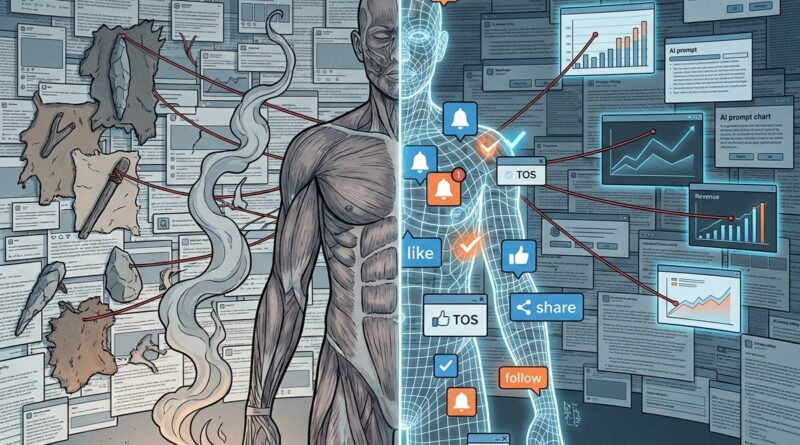
Homo Align‑Us: When Humans Started Safety-Training Themselves For Their Own AIs
You know the feeling. You type a perfectly normal sentence, then stop halfway through and think, “Will the app hate this? Will the bot flag it? Will strangers read this in the worst possible tone?” So you rewrite it. Softer. Safer. More searchable. More brand-friendly, even if your “brand” is just you trying to make a joke on a Tuesday. That little twitch is the story. While smart people debate whether AI is aligned with human values, millions of humans are already busy aligning themselves with systems that do not love them back. We are trimming our language for moderation filters, shaping our opinions for feeds, and training our personalities to fit terms of service we have never read. If that makes you feel a bit unhinged, good news. You are not broken. You may just be a very successful specimen of Homo Align-Us, the modern human who has learned to survive by acting legible to machines.
⚡ In a Hurry? Key Takeaways
- People worry about AI alignment, but many of us are already changing our behavior to suit algorithms, bots, and platform rules.
- Try one small de-alignment move today, like posting less performatively or writing one private thought that no system gets to rank.
- This is not a personal flaw. It is a predictable human response to systems built to reward compliance, visibility, and constant self-editing.
Welcome to the age of self-domesticated humans
We usually talk about AI alignment like it is a future engineering problem. How do we make the machine obey the human? Fair question. But there is a funnier and more uncomfortable question sitting right next to it.
How did the humans get so good at obeying the machine?
Not literally. Your phone is not standing in the kitchen barking orders. But lots of people now make tiny daily choices as if an invisible product manager lives in their head. Don’t say that word. Don’t post that photo. Make the caption shorter. Make the take hotter. Be sincere, but not too sincere. Be funny, but not weird. Be human, but easy for software to sort.
That is the heart of this little satire about AI alignment and human behavior. The joke is that the species being safety-trained might be us.
The field guide to Homo Align-Us
For scientific purposes, let us observe the creature in its natural habitat. It has a smartphone. It has tabs open. It has opinions, but only after checking how those opinions might land.
Subtype 1: The Prompt Whisperer
This specimen has learned to phrase requests for chatbots with the careful tone once reserved for HR emails and hostage negotiations. It does not ask direct questions. It gently coaxes. It performs innocence. It says things like, “Purely for educational reasons…” to a system that cannot be flattered and does not care.
The strange part is not that bots have limits. Fine. The strange part is how quickly humans adapt their own speech to fit a synthetic listener. We are not just using tools. We are learning the social manners of software.
Subtype 2: The Algorithmic Courtier
This one knows what kind of post will travel. It can smell dead engagement before hitting publish. It has developed a survival instinct for thumbnails, hooks, outrage pacing, and the exact degree of vulnerability that reads as authentic without making everyone uncomfortable.
In older times, people performed for neighbors, bosses, and in-laws. Now many perform for ranking systems. Same impulse, bigger dashboard.
Subtype 3: The Moderation Mystic
This human has no idea what the rules actually are, but it knows there are rules. So it starts speaking in code. It swaps words for symbols. It trims context. It says “unalive” and “spicy accountant” and other weird internet dialects that make perfect sense only if you assume everyone is being watched by an anxious robot intern.
Again, this is adaptive behavior. It is also deeply weird.
Why this keeps happening
Humans are alignment machines already. We copy what gets rewarded. We avoid what gets punished. We tune ourselves to the environment, whether that environment is a tribe, an office, or an app that keeps score with hearts and views.
That would be manageable if our environments cared about our real goals. Sleep. Friendship. Focus. Dignity. A stable sense of self. But most digital systems do not optimize for those things. They optimize for attention, retention, growth, safety theater, legal cover, and measurable activity.
So a mismatch appears.
You say you want calm. The feed wants recurrence.
You say you want honesty. The platform wants acceptable phrasing.
You say you want connection. The system wants output.
That gap can make ordinary people feel vaguely fraudulent. Like they are always half-performing, half-translating themselves into machine-readable form.
The funniest part is also the bleakest part
We often act as though algorithmic systems are stern moral authorities. If the platform downranks it, maybe it was bad. If the chatbot refuses it, maybe it was improper. If the moderation system gets nervous, maybe we should all get nervous.
That is giving a lot of spiritual power to systems whose deepest values are often “reduce liability” and “keep people engaged long enough to show another ad.”
A content filter is not your conscience. A recommendation engine is not your friend. A model refusal is not always a moral revelation. Sometimes it is just a company trying not to end up in the news.
A quick self-audit for the newly self-aware primate
If you want to know whether you have become beautifully, tragically aligned, ask yourself these questions.
1. Do I write differently when I think software is watching?
Not just more polite. More bland. More rounded-off. More optimized for passing through gates.
2. Have I confused visibility with value?
If nobody can like it, share it, or score it, does it still feel worth saying?
3. Am I pre-censoring thoughts that are not harmful, just inconvenient for a platform?
There is a difference between kindness and formatting yourself into mush.
4. Do I feel low-key anxious every time I post, prompt, comment, or search?
That can be a clue that you are not simply using a tool. You are managing a relationship with a system.
5. Have I started treating machine output like a neutral referee?
It is not. It is trained behavior wrapped in a clean interface.
Two de-alignment moves you can test this afternoon
This is the useful bit. No cave retreat required.
Move 1: Make one thing that is not for the feed
Write a note in a plain text file. Take a photo you do not post. Record a voice memo you do not clean up. Send a message to one person instead of broadcasting to many. The goal is not nostalgia. The goal is to remind your nervous system that expression does not need ranking to be real.
This sounds small because it is small. That is why it works.
Move 2: Stop translating one ordinary sentence
The next time you are about to sand down harmless language to please an imagined filter, pause. If it is safe, legal, and not cruel, try saying it like a person. Not like a support ticket. Not like a hostage. Not like a brand account run by three frightened interns.
You do not need to become reckless. Just slightly less pre-obedient.
What this satire is really pointing at
The point is not that all moderation is bad, or that all AI tools are sinister, or that we should start posting with the energy of a raccoon in a supermarket. The point is that humans are highly trainable, and digital systems train us all the time.
Once you see that, a lot of private shame starts to loosen. Maybe you are not uniquely weak or fake because you keep self-editing online. Maybe you are responding exactly as a social mammal would respond in a world full of invisible incentives and fuzzy punishments.
That does not solve the problem. But it gives it a name. And naming weirdness helps.
At a Glance: Comparison
| Feature/Aspect | Details | Verdict |
|---|---|---|
| Human behavior online | Often shaped by recommendation systems, moderation rules, and fear of misinterpretation. | More machine-aware than most of us admit. |
| AI “alignment” debate | Focuses on making systems reflect human values, while ignoring that humans already bend to system incentives. | Useful, but incomplete without looking at us too. |
| Practical fix | Test small acts of de-alignment, like private creation and less self-censored language. | Low effort, surprisingly clarifying. |
Conclusion
The internet is full of serious arguments about how to align AI with human values. Fair enough. But a lot of us are already living the backward version of that story, quietly aligning ourselves with systems that do not care whether we rest, go outside, or remember who we are when nobody is watching. That is why a satirical field guide to Homo Align-Us matters. It turns a vague modern discomfort into something visible. You are not imagining the self-censorship, the personality smoothing, or the eerie habit of treating software like a moral audience. You are living through a real cultural shift. The good news is that you can push back without quitting the internet and moving to a cave. Start small. Make one unranked thing. Say one normal sentence like a human. Notice where the performance begins. Once you can see the alignment happening, you can choose, at least now and then, not to cooperate so completely.