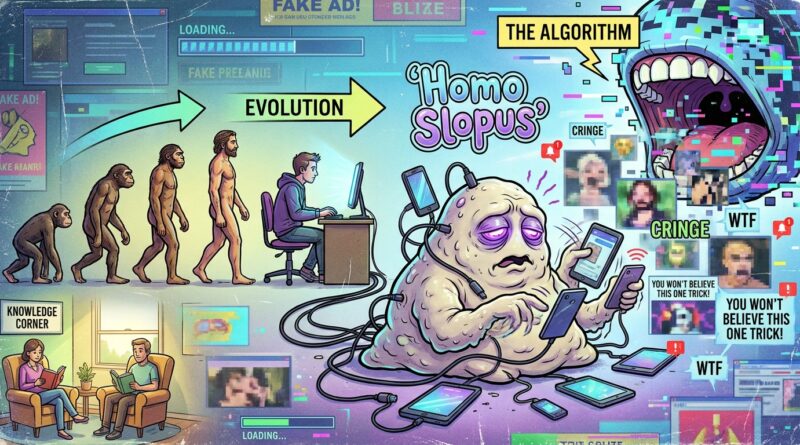
Homo Slopus: When Humans Evolved To Feed The Internet Garbage
You are not imagining it. The web really does feel dumber lately. You open your phone for one useful thing, then somehow end up staring at an AI image of “Victorian shrimp Jesus,” a thread designed to make everyone mad, and a joke format that should have been buried three weeks ago. It is exhausting because part of you knows this is junk, yet some other part keeps scrolling like a raccoon checking the same trash can for treasure. That is the modern internet bargain. We feed the machine our attention, our reposts, our lazy replies, and sometimes our own half-baked content. In return, it gives us more of the same. That is the joke at the heart of Homo Slopus. The satire on AI slop and human evolution lands because it barely feels like satire. It feels like a field report from the feed you checked five minutes ago.
⚡ In a Hurry? Key Takeaways
- Homo Slopus is a funny name for a real problem. People and platforms now mass-produce low-effort content because the system rewards volume, not quality.
- The best fix is simple. Stop feeding obvious slop with clicks, comments, hate-shares, and “just one more look” attention.
- This is not just annoying. It can flatten culture, bury real creators, and train us to accept noise as normal.
Meet Homo Slopus
Imagine a future museum exhibit. Behind the glass stands a slightly hunched human holding a phone at chest height, thumbs sticky from endless scrolling, eyes glazed by a thousand autoplay clips. A little plaque reads: Homo Slopus. Early 21st century. Survived by turning every thought, meal, mood, and half-joke into platform feedstock.
That is the bit. But like all good bits, it works because it stings.
Homo Slopus is the evolved internet user who no longer mainly reads, watches, learns, or even talks online. He produces signals. She reacts on command. We all become tiny content mills, pushing out screenshots, recycled opinions, AI-generated images, low-stakes outrage, and comments that say “lol this” under things we barely processed.
The machine does not care whether it is thoughtful, original, or even true. It cares whether it moves. Swipe. Tap. Reply. Repeat.
Why the Internet Feels So Full of Slop
AI did not invent junk. The web has always had junk. What AI did was make junk faster, cheaper, and weirdly harder to ignore.
Volume beat effort
Once upon a time, making something bad still took a little work. You had to write the bad post, make the bad meme, edit the bad video, or at least think the bad thought all the way through. Now software can spit out ten versions before a human has finished one cup of coffee.
That changes the economics of nonsense. If it costs almost nothing to make, the internet gets buried in it.
Platforms reward reactions, not reflection
Social apps are not your librarian. They are slot machines with better fonts. If a post makes you laugh, rage, argue, or stare in disbelief, it has done its job. Whether it improved your day is another matter.
This is why obvious bait works so well. The internet does not punish low standards when low standards still keep people engaged.
Humans are still very easy to hack
We like novelty. We like conflict. We like easy jokes and quick validation. We also like feeling smarter than whatever dumb thing just crossed our screen. So we dunk on it, share it, quote-post it, and accidentally help it spread.
If this sounds familiar, it pairs neatly with Rise of Homo Distractus: How Smartphones Out-Evolved Our Brains, which nails the older version of the same trap. First the phone trained us to fracture our attention. Then the feed learned how to farm the pieces.
The Human Side of the Joke
The smartest part of this satire on AI slop and human evolution is that it does not only blame the robots.
It blames us too. Gently, but still.
We say we hate slop, yet we keep sampling it. We roll our eyes at AI garbage, then boost it to friends with “look how bad this is.” We complain that every post sounds the same, then write our own safe, generic take because it is easier than saying something real.
That does not make us evil. It makes us tired, busy, and very trainable.
The internet has spent years teaching us that everything should be instant, frictionless, and always on. Under those conditions, low-effort content is not a bug. It is the default output of a system built for speed over meaning.
How to Spot Slop Before It Eats Your Afternoon
You do not need a lab test. Most slop has the same smell.
It is emotionally loud and intellectually empty
The post wants a fast reaction. Anger. Awe. Disgust. But if you pause for ten seconds, there is nothing there. No substance. No actual idea. Just packaging.
It feels mass-produced
Maybe it is an AI image with too much polish and no point. Maybe it is a thread that sounds like every other thread. Maybe it is a video that exists only to trigger comments. The content feels assembled, not expressed.
It is weirdly familiar
Slop often looks “new” while somehow being made of old parts. Same joke structure. Same fake debate. Same recycled hot take wearing a different hat.
It asks almost nothing from you
This sounds nice, but it is often the tell. Great work can be simple, sure. Slop is different. It wants only your pulse, not your mind.
Why This Matters More Than “The Internet Is Annoying Now”
It is tempting to shrug and say, “So what? Just log off.” Fair enough, but the problem does not stop at personal irritation.
When feeds fill with synthetic filler and engagement bait, real creators get crowded out. Nuance gets punished because it is slower. Actual expertise gets flattened into content chunks. The online world starts to feel less like a public square and more like a conveyor belt that accidentally learned irony.
Worse, our standards drop. If you eat enough empty calories, your body forgets what a decent meal feels like. Attention works the same way.
A Small Rebellion That Actually Works
You do not need to become a monk or throw your router into a lake. You just need to stop being such a useful food source for the machine.
1. Do not hate-share slop
This is the biggest one. If something is obviously bait, garbage, or machine-made mush, do not quote-post it to say how bad it is. The platform cannot tell the difference between disgust and delight. To the system, attention is attention.
2. Add friction before you engage
Try a five-second rule. Before you like, comment, repost, or open the replies, ask one question. “Do I want more of this in my life and everyone else’s feed?” If the answer is no, keep moving.
3. Reward humans who made a real thing
Comment on the thoughtful post. Subscribe to the weird artist. Share the essay that clearly took effort. If the web feels flattened, one fix is to visibly support people making textured, specific, human work.
4. Curate more aggressively than you think you need to
Mute the chronic rage merchants. Unfollow the accounts that only post content paste. Tell the algorithm “not interested” so often it starts to take the hint.
5. Make less, but mean more
If you post, try posting something you actually believe, observed, made, tested, or learned. Not everything needs to become a product unit for the feed.
The Satire Works Because It Names the Feeling
Good satire does not just mock. It labels the monster so the rest of us can stop pretending the smell is normal.
Homo Slopus gives us a useful fake species for a very real internet mood. It says, yes, your brain is tired. Yes, the feeds feel industrial now. Yes, there is something bleakly funny about humans evolving from tool users into unpaid interns for recommendation engines.
And once you can name the pattern, you can resist it a little better.
At a Glance: Comparison
| Feature/Aspect | Details | Verdict |
|---|---|---|
| AI slop | Fast, cheap, endless content made to grab attention with minimal substance | Easy to consume, bad to live on |
| Human participation | We amplify junk through clicks, comments, hate-shares, and doomscroll habits | Complicity is real, but changeable |
| Best response | Add friction, starve bait of attention, and support work made by actual people | Small habits can clean up your feed fast |
Conclusion
The internet is not doomed, but it is absolutely being stuffed with low-effort filler by AI tools, spammy accounts, and systems that reward whatever keeps us swiping. That is why a joke like Homo Slopus lands so hard. It helps us laugh at a mess that also feels uncomfortably personal. The good news is that you do not have to keep shoveling fuel into it. Skip the bait. Stop boosting obvious slop. Back people making real things. If enough of us do that, we at least stop acting like obedient little content livestock in a machine that is flattening human culture in real time.