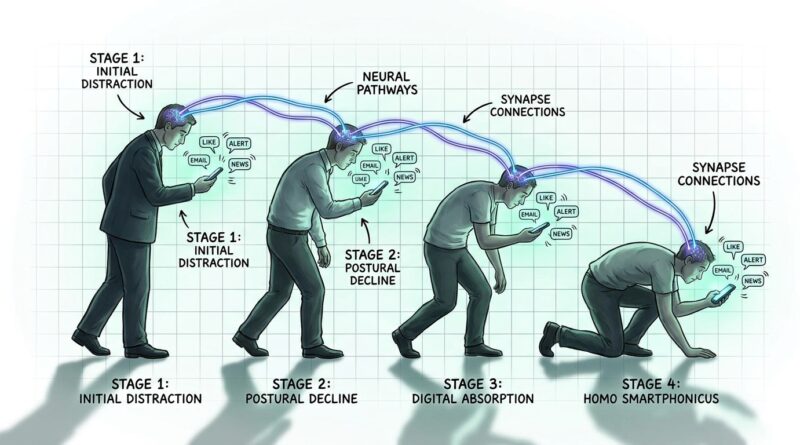
Homo Notificationis: How Humans Evolved Into Nervous System Plug‑ins For Their Phones
You are not weak. You are not lazy. You are not uniquely bad at “having discipline.” You are a human with a nervous system that has been trained, very carefully, to perk up every time a pocket computer chirps, flashes, buzzes, or lights up like a tiny casino. That is the maddening part. You know most notifications are nonsense. A sale you do not need. A group chat reacting to a meme. An app reminding you that you have not opened the app. And yet your thumb moves before your better judgment even gets its shoes on. If that feels ridiculous, good. It is ridiculous. But it is also predictable. Human evolution and phone notifications are colliding in a very modern way. We are not becoming obsolete. We are becoming exquisitely interruptible, and once you see that, you can start changing the setup instead of blaming your character.
⚡ In a Hurry? Key Takeaways
- Phone notifications work because they hook ancient attention systems, not because you “lack willpower.”
- Turn off non-human, non-urgent alerts first. Keep calls, direct messages from key people, and true essentials.
- The goal is not to smash your phone with a rock. It is to stop letting random apps use your nervous system as office space.
Meet Homo Notificationis
Picture a future museum exhibit.
“Here we see Homo Notificationis, a late-stage human known for eating lunch while checking six alerts, forgetting why they opened the phone, and feeling vaguely hunted by a rectangle.”
Satirical? Yes. Fake? Not really.
Your brain evolved to notice changes in the environment. A rustle in the grass might be lunch. Or a tiger. Either way, paying attention mattered. Fast. A sudden buzz on a nightstand is not a tiger, but your brain does not do a philosophical review before it reacts. It goes, “New thing. Check now.”
That is why human evolution and phone notifications make such a potent pair. One side is ancient biology. The other side is a polished industry built to trigger it on schedule.
Why Notifications Feel So Personal
Because they borrow the language of survival
Notifications are tiny social and environmental cues. Someone wants you. Something changed. You might be missing out. You might need to act. That is powerful stuff for a social species.
Most alerts are dressed up as urgent, even when they are about as urgent as a coupon for socks.
Because unpredictability is sticky
If every notification were boring, you would ignore them. But sometimes it is useful. Sometimes it is funny. Sometimes it is emotionally charged. That random reward pattern keeps people checking. It is the same basic reason slot machines are so good at keeping folks planted in front of blinking lights.
Your phone is not evil. But parts of it are absolutely auditioning for the role.
Because your brain loves unfinished business
A half-seen preview is often worse than no preview at all. “Can you call me?” “Did you see what happened?” “Your order…” Great. Now your mind has an open loop. You were making pasta. Now you are mentally suspended between doom, curiosity, and package tracking.
This Is Not a Moral Failure
This is the part many people need to hear most.
If you keep reaching for your phone, it does not mean you are broken. It means the system is working as designed. Your habits are not random. They are learned responses. Learned responses can be changed.
That is a lot more hopeful than the usual “just have better boundaries” sermon. Telling people to use more self-control around engineered interruption is like telling them to relax while a smoke alarm goes off every seven minutes.
If this sounds familiar, it pairs nicely with Rise of Homo Doomscrollus: What Happens When Paleolithic Brains Meet Infinite Feeds, which gets at the same basic mismatch from the scrolling side of the problem.
How Your Day Gets Chopped Into Tiny Bits
We tend to think interruption costs us only the few seconds it takes to glance at the screen. If only.
A notification steals attention twice. First when it arrives. Then again when your brain tries to get back to what it was doing. That second tax is the sneaky one.
You stop writing the email. You check the ping. You answer half of it. You notice another badge. You hop to weather. Then messages. Then a headline. Three minutes later you are reading about a celebrity bunker and have no idea why your coffee is in the microwave.
This is not just “distraction.” It is fragmentation. Your day stops feeling like a sequence of chosen actions and starts feeling like you are being remotely operated by little electric taps.
The Real Evolution Story Happening Right Now
People are busy worrying that machines will replace humans. Fair enough. Big topic.
But the quieter change is that many humans are adapting themselves to machines first. We are training our nervous systems to stay on standby for incoming signals. We are becoming highly responsive, low-level reactive creatures. Less like tool users. More like attendants to the tool.
That is the darkly funny part of Homo Notificationis. We invented the device, then slowly rearranged our reflexes around it.
The good news is evolution at this scale is not destiny. It is habit plus environment. Change the environment and the habit starts to loosen.
How to Rewire the Relationship Without Going Full Cabin-in-the-Woods
1. Do a notification audit
Open your phone settings and look at every app that is allowed to interrupt you. Be ruthless.
Ask one simple question: “Would I pay this app money for the right to break my concentration?”
If the answer is no, turn it off.
Good candidates to keep on:
- Calls from important people
- Direct messages from family or core work contacts
- Calendar reminders you actually set on purpose
- Security, banking, delivery, or travel alerts that matter in real time
Good candidates to mute into the sun:
- Marketing alerts
- News “breaking” updates that are not actually breaking your house
- Social media engagement pings
- Game nudges
- Shopping app temptations
- Any app that says “we miss you”
2. Remove the casino cues
Sound, vibration, badges, lock screen previews. These are not neutral design choices. They are little bait flags.
Try this:
- Turn off badges for distracting apps
- Use silent delivery for most alerts
- Hide notification previews on the lock screen
- Put the phone screen-down when working
You are not missing life. You are reducing bait.
3. Create pull instead of push
Push means the phone decides when you look. Pull means you decide.
This one change helps a lot. Instead of being alerted every time something happens, check messages at chosen times. Same information. Much less twitching.
Think of it like email. Most things can wait 20 minutes. A shocking amount can wait two hours.
4. Make the home screen boring
If your most attention-hijacking apps are on page one, your thumb will find them before your frontal lobe files an objection.
Move the noisy stuff off the home screen. Put useful tools up front. Maps. Notes. Camera. Calendar. Things that help you do a task and leave.
Some people even switch the display to grayscale. It sounds silly until you try it. Turns out candy-colored app icons are candy for a reason.
5. Use modes, not willpower
Focus modes, Do Not Disturb, scheduled summaries, app limits. These tools exist because raw self-control is overrated.
Set a work mode. Set a sleep mode. Set a weekend mode if you want. Let the phone be one device at 10 a.m. and a different device at 11 p.m.
Good systems beat good intentions.
6. Charge the phone outside arm’s reach
Especially at night.
If the phone sleeps next to your head, it is not really sleeping. It is keeping watch over your nervous system like a hyperactive lighthouse. A cheap alarm clock can buy back a surprising amount of sanity.
What If You Need Your Phone for Work?
Lots of people do. That does not mean every app gets diplomatic immunity.
Split the signal from the sludge.
Use custom notification settings for your boss, team, partner, kids, school, or whoever truly matters. Everything else can wait in line like civilized software.
You are not rejecting technology. You are sorting priorities. That is an adult skill, not a Luddite phase.
Signs You May Be More Plug-in Than Person Right Now
- You check your phone during tiny pauses, elevator rides, microwaving, brushing teeth
- You feel phantom vibrations
- You unlock your phone without knowing why
- You get annoyed by interruptions, then create them for yourself anyway
- You feel oddly uneasy when the phone is not nearby
- You pick up the phone to do one thing and emerge 15 minutes later with weather knowledge and no memory
If you nodded at several of those, welcome. You are a normal modern mammal.
Small Experiments That Work Better Than Grand Declarations
Do not start by vowing to become a serene digital monk by Tuesday.
Try smaller experiments:
- One notification-free morning each week
- No social app alerts for seven days
- Phone parked in another room during meals
- Two scheduled message-check windows in the evening
- A one-screen rule, no phone while TV is on
These are easy to test because they are specific. You can feel the difference quickly. Less twitch. More continuity. More thoughts that finish the trip.
At a Glance: Comparison
| Feature/Aspect | Details | Verdict |
|---|---|---|
| All notifications on | Constant pings, fractured focus, more checking, more stress, lots of low-value interruptions | Great for apps. Bad for your brain. |
| Essential alerts only | Calls, core messages, true time-sensitive updates still come through, while junk stays quiet | Best balance for most people. |
| Scheduled checking | You pull information at chosen times instead of reacting all day | Excellent if you want focus without going off-grid. |
Conclusion
The useful way to think about human evolution and phone notifications is not “I am failing at self-control.” It is “my nervous system has adapted to a noisy tool, and I can retune the tool.” That is a much kinder and more practical story. While feeds are stuffed with grand panic about AI replacing humans, a quieter shift is already here. We are teaching ourselves to twitch on command. The fix is not shame. It is design. Fewer pings. Fewer cues. More deliberate checks. Homo Notificationis does not need to be your final form. You can still use the phone without renting out your reflexes to every app that wants a piece of your attention.