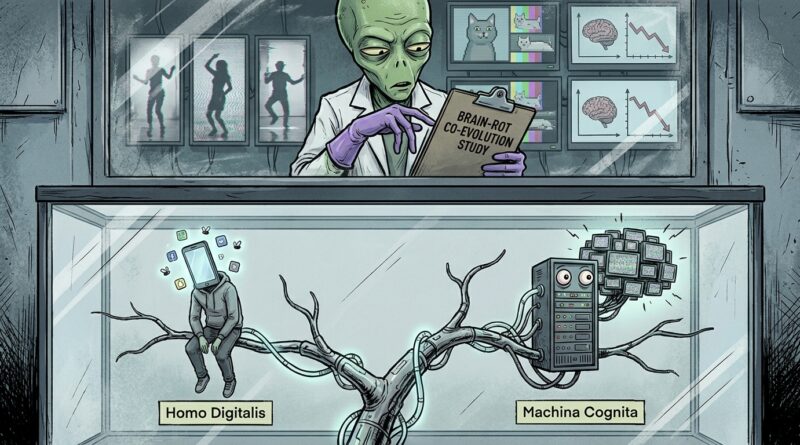
Homo Brain-Rotus vs. The Algorithm: How AI And Humans Are Making Each Other Dumber On Purpose
You are not imagining it. Your brain really can feel different after twenty minutes of scrolling past AI junk, recycled memes, fake movie clips, and those weird hyper-edited “Italian brainrot” posts that seem designed to melt language itself. The frustrating part is that every app acts like this is normal. Just harmless fun. Just how the internet works now. But a lot of people can feel the cost. Focus gets thinner. Patience drops. Reading anything longer than a caption starts to feel like lifting furniture. What makes this worse is that the system is not broken. It is working exactly as designed. Platforms reward whatever grabs your eyes fastest, and AI tools now mass-produce that stuff at industrial scale. Humans train the machine on low-effort content, then the machine floods humans with even more of it. That loop has a name now, even if it sounds like a joke. AI brain rot human attention is becoming a real problem.
⚡ In a Hurry? Key Takeaways
- AI brain rot is not just silly internet culture. It is a feedback loop where platforms, users, and AI systems all reward low-effort attention traps.
- You do not need a full digital detox. Small changes like slowing your feed, muting short-form autoplay, and protecting one daily block of deep focus help a lot.
- The goal is not to quit the internet. It is to notice when the algorithm is farming your attention and stop giving it free labor.
Why this feels worse than regular internet stupidity
The internet has always had nonsense. That part is not new. What is new is the speed, volume, and weird dead-eyed sameness of it.
Short-form platforms learned that confusion, novelty, outrage, and repetition keep people watching. AI then made it cheap to produce endless versions of the same bait. So instead of one bad meme, you get ten thousand variations before lunch.
That changes the texture of your attention. You stop expecting ideas to go anywhere. You start scanning for stimulation instead of meaning. Your brain gets trained to ask, “What is the next hit?” instead of, “What is this saying?”
That is why “brainrot” landed as a joke and then quickly stopped feeling like one.
What “brainrot” actually means in plain English
Brainrot is a sloppy word for a real experience. It describes what happens when your mental diet gets dominated by content that is fast, shallow, repetitive, and emotionally sticky.
Not all short videos are bad. Not all memes are dumb. The issue is ratio.
If most of what you consume is built to interrupt thought instead of support it, your mind adapts. It gets better at fast switching and worse at staying with one thing. That can show up as:
- Struggling to finish articles or videos longer than a few minutes
- Feeling bored almost instantly when something is not stimulating
- Needing background noise for everything
- Reaching for your phone the second a task gets slightly hard
- Remembering the vibe of content, but not the content itself
That last one matters. Brainrot content often leaves an emotional stain without leaving useful memory behind.
The AI part makes the loop much uglier
Humans are feeding the machine junk
AI models learn from human-made material. If the web gets flooded with spammy, low-quality, engagement-chasing sludge, that sludge becomes part of the training soup.
Then the model starts producing more content with the same shape. Generic captions. Flat jokes. fake confidence. Reheated clichés. Stuff that sounds like content without actually saying much.
The machine is feeding humans junk right back
Now that generation is cheap, feeds can fill every empty second with synthetic nonsense. Fake podcasts. Fake experts. Fake trailers. AI voiceovers reading garbage over stolen clips. It all keeps the scroll moving.
That means humans and machines are not just making each other smarter through collaboration. They are also making each other dumber through optimization.
It is a polluted attention ecosystem. Everybody is adapting to the wrong incentives.
Why platforms love this stuff
Because it works.
Not “works” in the sense of making your life better. Works in the sense of keeping you there. If a piece of content gets quick reactions, repeat views, comments, stitches, duets, rage, confusion, or ironic shares, the system treats it as valuable.
That is how you end up with feeds full of content no sane person would call good, yet millions of people still watch.
The platform does not care whether you leave enlightened, informed, or slightly less able to read a paragraph. It cares whether you stay.
If this sounds familiar, it overlaps with the haunted feeling of online repetition I talked about in Homo Nostalgicus: When Humans Reboot Their Memes Instead Of Their Brains. The feed does not just show you new things. It often keeps reviving old, proven bait in new packaging.
Italian brainrot and the rise of deliberate nonsense
Some brainrot is accidental. Some of it is very much on purpose.
Italian brainrot memes, surreal AI voice clips, broken-language joke edits, and absurdist mashups are not always trying to communicate a clear idea. They are often engineered to trigger a kind of amused disorientation. You watch because your brain wants to resolve the nonsense. But before it can, the clip ends and the next one starts.
That unresolved feeling is powerful. It keeps you hooked.
There is nothing morally wrong with absurd humor. The problem starts when absurdity becomes the default communication layer of the feed. Then everything begins to feel equally disposable. Joke, ad, fake fact, actual news, AI-generated nonsense. It all arrives in the same voice and at the same speed.
How this affects AI too
Here is the twist. The same sludge that erodes human attention can also weaken AI outputs over time.
If more of the public internet becomes AI-generated filler, future models risk training on synthetic copies of synthetic copies. Think of it like making a photocopy of a photocopy until the page turns gray and the words blur.
Researchers have worried about this for a while. Garbage in, garbage out is still true. If the input pool gets cheaper, thinner, and more repetitive, the output often follows.
So this is not a story where smart machines are lowering the standards for weak humans. It is more embarrassing than that. Humans built a reward system for junk, AI scaled it, and now both sides are marinating in the same soup.
Signs the algorithm is farming your cognition
You do not need a neuroscience lab to notice when something is off. A few common warning signs show up fast.
1. You feel full, but not nourished
You spent an hour consuming media and somehow learned nothing.
2. Everything starts sounding the same
The same cadence. The same “hot take” structure. The same fake urgency. A lot of AI slop has a strangely textureless feel.
3. You cannot tell what you actually chose
The feed becomes your default activity, not a decision. You opened your phone for one thing and woke up on clip 47.
4. Boredom becomes unbearable
This is a big one. When your brain gets overused to novelty spikes, normal life can feel broken by comparison.
5. Real thinking starts to feel slow and annoying
That is the moment to pay attention. Difficulty is not a bug in your mind. It is often the feeling of your brain doing actual work.
What to do without becoming a cave hermit
You do not need to throw your phone in a lake. Most people will not do that, and honestly, most people do not need to.
What helps is friction. Small barriers. Tiny redesigns of your digital environment so the easiest thing is not always the worst thing.
Put speed bumps in front of the worst apps
Move short-form apps off your home screen. Turn off autoplay where you can. Log out after each session if you are serious. Make the bad habit slightly annoying.
Create one protected focus block every day
Twenty minutes is enough to start. Read something longer than a post. Write without switching tabs. Do one task with your phone in another room. Your attention span needs reps, not motivational speeches.
Curate for depth, not just comfort
Follow people who explain things, not just react to them. Pick creators who leave you with ideas, not just residue.
Use AI as a tool, not a drip feed
AI can help summarize, brainstorm, translate, and organize. Fine. But if you use it mainly to avoid thinking, that habit has a cost. Convenience is great until it starts replacing judgment.
Notice your “just one more” triggers
For some people it is late-night scrolling. For others it is lunch breaks, bathroom breaks, or the moment a work task gets difficult. Learn your pattern. That is where the fix starts.
A simple test for better content
Ask three questions after you consume something.
- Did this teach me anything?
- Did this make me think, not just react?
- Do I remember any of it five minutes later?
If the answer is no, no, and no, your attention was probably harvested more than served.
At a Glance: Comparison
| Feature/Aspect | Details | Verdict |
|---|---|---|
| Human attention | Short-form AI slop trains constant switching, low patience, and weak recall. | Needs protection through small daily habits and less autoplay. |
| AI content quality | Models trained on repetitive, low-value material tend to produce more repetitive, low-value material. | Quality drops when the internet becomes a landfill of synthetic filler. |
| Platform incentives | Apps reward whatever gets quick engagement, even if it leaves users mentally worse off. | The system is efficient for retention, not for human flourishing. |
Conclusion
Brainrot used to sound like a punchline. Now it sounds more like a diagnosis for life inside the modern feed. TikTok and Instagram are packed with low-effort AI mashups, recycled meme formats, and short-form sludge that can wear down both human attention and AI quality at the same time. The useful thing is naming the loop for what it is. Once you can see when the algorithm is farming your cognition, you can start pushing back. Not with a dramatic digital exile. Just with realistic, boring, effective habits. A little more friction. A little less autoplay. A little more time spent reading, thinking, and choosing instead of getting chosen for. Your attention span is not dead. It is just being outnumbered. You can still train it back.