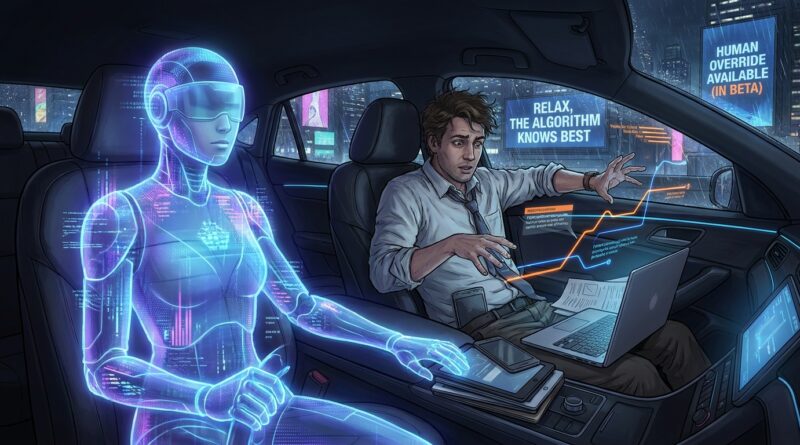
Homo Co‑Pilotus: When Humans Evolved Into Backseat Drivers For Their Own AI
You know the feeling. Your calendar app tells you when to breathe. Your watch tells you when to stand. Your map tells you to turn left into a lake. Then, somehow, when the machine gets it wrong, you still feel like the idiot in the room. That is the new human job description. We are no longer just using smart tools. We are hovering over them like nervous driving instructors, correcting, checking, and quietly wondering why our “helpful” software has made us more tired instead of less. If that leaves you feeling tense, distracted, and a little absurd, good news. You are not failing at the future. You are just living through a weird stage of it. Call it Homo Co-Pilotus. A species that built systems to think, then discovered the full-time work of supervising those systems without fully understanding how they think in the first place.
⚡ In a Hurry? Key Takeaways
- Most people are not being replaced by AI today. They are being turned into anxious supervisors of tools that still make strange mistakes.
- Set rules for when you trust automation and when you stop, check, and take over.
- Your frustration is not a personal weakness. It is a normal response to black-box systems making real decisions with unclear logic.
Welcome to the age of the backseat human
For years, the sales pitch was simple. Apps would help you get organized. Smart assistants would save time. Algorithms would remove friction from daily life.
Lovely idea. Tiny problem. The friction did not go away. It changed shape.
Now the stress comes from watching software do something on your behalf, then feeling compelled to monitor it like a toddler holding scissors. You let autocorrect finish a message, then reread it in fear. You let a navigation app choose the route, then second-guess every turn. You ask an AI tool to summarize a document, then spend ten minutes checking whether it invented a paragraph from thin air.
This is why satire about humans supervising AI evolution lands so well right now. It is funny because it is true. We are becoming the backseat drivers of systems that are technically driving for us, but emotionally still feel one software update away from heading into a ditch.
Homo Co-Pilotus, a brief field guide
If biologists were studying us in the wild, they might note a few traits.
Trait 1: Constant override reflex
We say we trust the machine, but our hand is always near the button. We keep one eye on the output and one on the escape hatch.
You see this everywhere. Customer service workers checking AI-drafted replies. Designers fixing “helpful” image suggestions. Office staff reviewing automated meeting notes that somehow turned “budget review” into “Buddhist revue.”
Trait 2: Responsibility without control
This is the maddening part. The system makes a recommendation. The human approves it. If it works, the software gets the credit. If it fails, the human gets the blame.
That is not partnership. That is managerial liability with extra clicking.
Trait 3: Learned helplessness, with notifications
The more tools tell us what to do, the less certain we feel without them. Miss one GPS instruction and suddenly you forget your own town. Let an app schedule every hour of your day and five unscripted minutes can feel like a system outage.
Why this feels so exhausting
People often assume automation reduces mental load. Sometimes it does. A dishwasher is wonderful because it washes dishes and does not ask you to verify every plate.
AI systems are often different. They offload the task, but keep the anxiety attached.
Instead of doing the whole job yourself, you do a stranger version of the job. You inspect. You validate. You compare. You wonder if the machine is confidently wrong. Then you do the task anyway, because checking bad work can take almost as much energy as doing good work from scratch.
That is why so many “smart” tools feel weirdly unsatisfying. They promise relief but deliver supervision.
The black-box problem in plain English
Part of the stress comes from not knowing how the tool reached its answer.
If a friend gives you terrible directions, you can ask, “Why did you think that route was faster?” If a navigation app does it, you get a blue line and a vibe. If an AI writing tool changes your sentence, you may get no clear reason at all. The output appears. You approve it or fix it.
That lack of visibility matters. Humans are usually calmer when they can inspect the logic. We can accept mistakes if we can understand them. But black-box systems skip that social contract. They make choices first and explanations, if any, later.
So yes, of course people feel twitchy. You are being asked to supervise a process you cannot fully see, yet remain accountable for the result. That would make anyone tense.
How we got here
We spent years trying to optimize ourselves.
Track your sleep. Track your focus. Track your steps. Track your mood. Track your food. Soon every part of life had a dashboard. Then came tools that did not just measure behavior, but started nudging it. Then tools that started deciding. Then tools that started drafting, ranking, filtering, and predicting.
At each step, the promise sounded reasonable. A little support. A little convenience. A little help.
Stack enough “little helps” together and you wake up one day arguing with a navigation voice that is technically your employee.
The near future is not robot overlords. It is paperwork for robot interns.
A lot of public debate swings between two extremes. Either AI is magical and will fix everything, or AI is coming to steal every job by Tuesday.
The more immediate reality is much less cinematic and much more annoying.
Many people are becoming editors, checkers, and exception-handlers for automated systems. Not fully replaced. Not fully empowered either. Just stuck in the middle, doing the unglamorous work of catching edge cases and cleaning up machine confusion.
Think of it as hiring an intern who is very fast, never sleeps, sometimes brilliant, and occasionally writes complete nonsense with tremendous confidence. That can be useful. It can also age you.
So what should ordinary people actually do?
Mocking the absurdity helps, but you also need a few practical rules. Otherwise every tool becomes a tiny source of low-grade panic.
1. Separate high-stakes from low-stakes tasks
Let automation help more when the consequences are small. Playlist suggestions. Rough first drafts. Basic sorting. Travel time estimates.
Use more caution when the stakes are high. Money. Health. Legal documents. Important work messages. Anything where a subtle error can create a real mess.
If the cost of being wrong is big, do not treat AI output like finished work. Treat it like a suggestion.
2. Decide your override points in advance
The stressful part is often not knowing when to trust the system and when to step in.
Make that choice before the moment of pressure. For example:
- If GPS reroutes through an area that looks obviously wrong, stop and check.
- If AI summarizes a contract, read the original before agreeing to anything.
- If an app pushes extreme productivity routines, ignore it when your body says no.
Pre-set rules reduce decision fatigue. You stop renegotiating with the machine every five minutes.
3. Keep a few skills delightfully manual
This is not nostalgia. It is resilience.
Know how to get to a few regular places without maps. Keep a simple personal to-do method that works without an app. Write an email from scratch now and then. Use a calculator less often for easy sums. Not because technology is bad, but because total dependence feels awful the minute the tool acts weird.
4. Do not confuse speed with trustworthiness
Fast answers feel persuasive. Clean interfaces feel competent. Confident wording feels smart.
None of those are proof.
A system can produce polished nonsense in seconds. That is not intelligence in the way most people mean it. That is efficient output. Useful sometimes. Dangerous if you stop checking.
5. Give yourself permission to use less
This one matters. You do not need to automate every corner of your life just because a company can build a dashboard for it.
If a tool makes you more self-conscious, more distracted, or more dependent without giving much back, stop using it. Not every feature deserves a place in your head.
The emotional part nobody says out loud
There is a quiet identity problem here too.
People were told that smart tools would make them smarter, freer, and more effective. So when the experience turns out to be “I spend my day checking robot homework,” it can feel disappointing in a weirdly personal way.
You start to wonder if you are using the tools wrong. Or if everyone else has adapted better. Or if you are simply behind.
You are not behind. The setup is genuinely strange.
We taught our tools to generate answers before we taught ourselves how to live well with answer-generating tools. That gap creates confusion. It also creates guilt, because users end up doing emotional repair work for systems that were sold as stress-saving devices.
Why naming the problem helps
Once you have a phrase for it, the whole thing gets easier to see.
Homo Co-Pilotus. The backseat human. The reluctant supervisor. Pick your favorite.
Naming the role helps because it turns a vague personal unease into a shared social condition. You are not uniquely bad at modern life. You are adapting to tools that ask for trust and skepticism at the exact same time.
That contradiction would make anybody tired.
At a Glance: Comparison
| Feature/Aspect | Details | Verdict |
|---|---|---|
| AI as assistant | Useful for drafts, suggestions, sorting, and routine help when mistakes are easy to catch. | Good servant. Bad unquestioned authority. |
| Human supervision | Still needed for judgment, context, ethics, nuance, and spotting bizarre errors. | Necessary, but mentally draining if overused. |
| Blind trust in automation | Feels efficient at first, but can create larger mistakes and more stress later. | Convenient until it suddenly is not. |
Conclusion
The big question is not just whether AI will replace humans. For most ordinary people, the more immediate question is how to stay sane while supervising systems they barely understand. That is the real comedy of this moment. We are evolving into full-time monitors of black-box tools, trusted to approve their decisions but not always equipped to inspect them. If that makes you feel confused, fatigued, or quietly worried, that is not a personal flaw. It is a predictable side effect of a species that taught its tools to think before it taught itself how to supervise. The good news is that once you can see the absurdity, you can start setting boundaries. Use the tools that truly help. Double-check the ones that matter. Ignore the ones that just add noise. And when your digital co-pilot confidently suggests nonsense, laugh a little. Homo sapiens is still in there. It is just riding shotgun more often than expected.