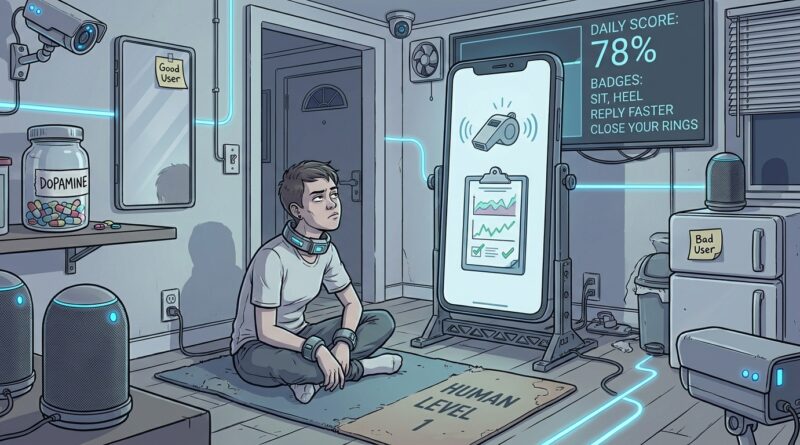
Homo Pet‑entialis: When Humans Volunteered To Be Trained By Their Own Smart Devices
You are not imagining it. A watch buzzes because you have sat too long. An app congratulates you for sleeping correctly. Work software notices when your mouse stops moving for seven minutes and suddenly you feel like a hamster tapping the wheel to keep the pellet dispenser happy. It is exhausting, and a little insulting. We bought smart devices to help us. Somewhere along the way, many of us started adjusting our behavior so the devices would approve of us instead.
That is the real joke behind modern self-improvement tech. It promises freedom, insight and better habits, but often trains us with streaks, alerts, scores and tiny digital treats. This is satire, yes, but only barely. If you have ever taken extra steps at 11:58 p.m. so your wrist computer would not look disappointed, congratulations. You already know what it feels like to be a very obedient indoor human. The good news is you do not need to smash every gadget. You just need to notice the training tricks, laugh at them, and take back a few corners of your day.
⚡ In a Hurry? Key Takeaways
- Yes, smart devices and AI systems often shape your behavior through rewards, reminders and surveillance, not just helpful data.
- Start by turning off non-essential notifications, breaking a few pointless streaks and choosing when you want to be measured.
- Monitoring sold as wellness, safety or productivity can be useful, but it becomes a problem when it quietly trains obedience instead of supporting autonomy.
The Treat Jar Is Digital Now
Training used to be obvious. A whistle. A clicker. A biscuit.
Now it is a ring closing on your smartwatch, a green status dot in your chat app, or a weekly dashboard that says your “engagement score” improved by 6 percent. Same basic trick. Desired behavior gets a reward. Undesired behavior gets a nudge, a warning, or that special modern punishment, mild guilt delivered by cheerful design.
This is why so many people feel strangely tense around devices that were supposed to reduce stress. They are not just tools. They are behavior managers.
Fitness Tech: Good Health, Weird Obedience
Fitness trackers can help. Plenty of people walk more, sleep better and notice useful patterns because of them. That part is real.
But then comes the streak. Then the badge. Then the little red graph of shame because Tuesday was “below target.” Soon you are pacing in your kitchen at night because the watch wants 342 more steps, and apparently the tiny robot on your wrist is now your parole officer.
When the metric becomes the boss
The problem is not data. The problem is what happens when data turns into performance.
A person who goes for a pleasant walk because it feels good is using technology. A person who cannot enjoy dinner because their recovery score dropped is being used by technology. That line matters.
We have seen a similar drift before with convenience tech. If you liked the idea that modern systems quietly reshape our instincts, you will probably enjoy Homo Lazy-Us: How We Outsourced Survival Instinct To Convenience Apps. Different gadget, same species problem.
Mood Trackers and the Rise of Emotional Homework
Once upon a time, you could feel vaguely off and leave it at that. Now an app asks you to log your mood, rate your stress, note your triggers, reflect on your gratitude and review your weekly emotional trends like a tiny HR department in your pocket.
Again, this can help some people. Patterns are useful. Reflection is useful. Support is useful.
But a lot of mood tech slides from care into compliance. It starts to suggest there is a correct way to feel, a proper level of calm, a measurable amount of resilience. If you fail to become a neat chart, the app acts like you forgot your homework.
The danger of outsourcing self-knowledge
When every feeling needs logging, people can stop asking a basic question. “How do I actually feel?”
Instead they ask, “What does the dashboard say I feel?”
That sounds silly until you notice how common it is. We trust the graph because the graph looks objective. Meanwhile, our own messy inner life gets treated like unreliable user input.
Workplace Analytics: Sit, Stay, Hit Reply
This is where the joke stops being cute.
Workplace monitoring tools are often sold as productivity boosters, security systems or collaboration aids. Some track keyboard activity. Some take screenshots. Some score responsiveness. Some map communication patterns to see who is “engaged.” It is hard to feel creative when software is counting how long you looked away from the screen.
Workers know this. They adapt.
Not to do better work, necessarily. To look measurable.
That means moving the mouse so the status stays green. Sending extra messages to appear active. Avoiding deep focus because deep focus can look inactive in systems built by people who think presence equals productivity.
The system trains the performance, not the person
Here is the grimly funny part. Surveillance tools often create the exact fake behavior they claim to detect.
Measure visible activity, and people produce visible activity. Reward quick replies, and everyone becomes twitchy and distracted. Score rule-following, and people stop experimenting. The office turns into obedience school with better fonts.
Why We Accept It So Easily
Because it rarely arrives wearing a villain cape.
It arrives as wellness. Efficiency. Safety. Optimization. A nicer morning routine. Better teamwork. More insight. It speaks in the soothing voice of self-improvement.
Also, the systems really do offer little benefits. A reminder can be helpful. A health trend can be useful. A security alert can matter. That mix is what makes the training so sticky. The pellet dispenser sometimes gives out real pellets.
And humans are very trainable when rewards are immediate, social and dressed up as personal growth.
The Funniest Part: We Call It Freedom
There is something darkly hilarious about proudly buying a device that tells us when to stand, sleep, breathe, focus, hydrate, reply and smile more. Then we call this empowerment.
The satire humans trained by smart devices and AI almost writes itself because the structure is so plain. The collar is sleek. The command is a push notification. The treat is a badge. The owner is an app with a pastel interface.
We laugh because it is true enough to sting.
How to Reclaim a Little Human Mischief
You do not need to become a forest hermit. Start smaller.
1. Turn off the fake emergencies
Most notifications are not urgent. They are bids for behavior. If an alert is not helping you right now, disable it. Especially the ones designed to create guilt or compulsion.
2. Break one streak on purpose
This is oddly powerful. Pick a meaningless streak and let it die. Watch what happens. Usually, nothing. The sky remains attached. You feel ridiculous for 30 seconds, then weirdly free.
3. Keep some activities unmeasured
Take a walk without tracking it. Exercise without posting it. Read without logging minutes. Spend time with a friend without producing a memory package for three apps and a cloud archive.
Private life is not wasted life.
4. Ask who benefits from the metric
Does this score help you make a sane decision, or does it mostly help a company shape your habits, reduce uncertainty, or make you easier to manage? That question clears a lot of fog.
5. Choose tools that serve you quietly
The best technology often fades into the background. It helps without constantly summoning you back into the system. Look for settings and products that support your goals without turning your day into a training loop.
6. Practice being a little unoptimized
Be hard to score sometimes. Leave room for wandering, slowness, boredom and odd choices. Those are not bugs in human life. They are part of having one.
At a Glance: Comparison
| Feature/Aspect | Details | Verdict |
|---|---|---|
| Fitness and wellness tracking | Can reveal useful patterns, but often uses streaks, badges and guilt loops to push constant compliance. | Useful in moderation. Bad when the score becomes the point. |
| Mood apps and self-monitoring | Can support reflection, but may turn emotions into performance metrics and emotional homework. | Helpful only if it increases self-awareness, not dependence on the dashboard. |
| Workplace surveillance and AI analytics | Tracks activity, responsiveness and patterns, often pushing workers to look busy rather than work well. | Highest risk. Treat with skepticism and protect unmeasured focus where possible. |
Conclusion
The point is not to hate technology. It is to stop pretending every digital command is wisdom. People are tired of AI-infused monitoring that shows up dressed as safety, wellness or productivity. Once you see the tricks for what they are, silly obedience drills with polished interfaces, you can start making better choices. Turn off some alerts. Ignore a badge. Leave a corner of your life gloriously untracked. Small acts of autonomy still count, maybe more than ever. You do not have to be a perfectly predictable pet to use modern tools well.