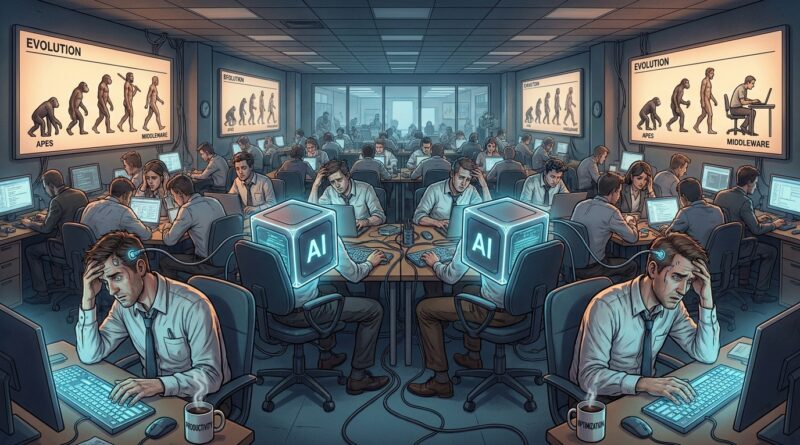
Homo Ultra‑Productivus: When Humans Evolved Into Personal Assistants For Their Own AI
You were promised a robot intern. What many people got instead was a robot toddler with admin rights. Now your day is spent checking AI-written emails for fake confidence, fixing meeting notes that sound plausible but wrong, and rewriting summaries so your boss does not make a decision based on machine improv. If that feels exhausting, you are not lazy or bad at tech. You are doing a new kind of hidden labor. You have become the person who stands between management and the machine, quietly catching errors before they turn into embarrassment, bad data, or very expensive nonsense.
That weird feeling matters because it explains why “AI productivity” often feels like more work, not less. The satirical future of work humans serving AI is funny because it is already half true. The good news is that once you can name the pattern, you can start changing how you use these tools. The goal is not to reject AI or worship it. It is to stop acting like unpaid middleware and start treating AI like what it is: a fast, messy draft machine that needs rules, limits, and adult supervision.
⚡ In a Hurry? Key Takeaways
- AI is not replacing all human work. In many offices, it is creating new work: checking, correcting, and translating machine output into something safe to use.
- Start using AI only where mistakes are cheap and easy to spot, then set clear rules for what must always get a human review.
- If a tool saves your boss time but quietly eats yours, that is not productivity. Track the hidden cleanup work so the real cost is visible.
Welcome to Homo Ultra-Productivus
This is the modern office species nobody asked to become. Homo Ultra-Productivus does not simply work. He prompts, checks, re-prompts, pastes, verifies, trims, apologizes for the robot, and then attends a meeting about how much time the robot is saving everyone.
It would be hilarious if it were not so familiar.
One of the strange things about the current AI boom is that the public story is dramatic in only two directions. Either the machines are about to take every job, or they are about to make work frictionless and brilliant. Real life sits in the mushy middle. Most people are not being replaced by AI. They are being turned into handlers for systems that are fast, useful, and deeply unreliable.
That middle stage is the real story. It is less “the robots are coming” and more “the robots have arrived, and now you have to clean up after them.”
What Changed at Work
Before, software usually asked you to do something specific. Fill in the form. Click the button. Use the spreadsheet. Now software volunteers to think on your behalf. It drafts. It summarizes. It suggests. It books. It answers. It predicts. It sounds competent enough that people trust it more than they should.
That changes your job in a sneaky way.
You are no longer just doing the task. You are supervising a system that pretends it already did the task. And because the output often looks polished, the checking step gets harder, not easier. A typo is easy to spot. A subtle factual error hidden inside a confident paragraph is not.
The new hidden jobs nobody put in the job description
Here are a few roles many workers are already doing without naming them:
- Robot proofreader. You fix AI emails so they sound human and do not accidentally promise impossible things.
- Robot fact-checker. You verify summaries, numbers, quotes, citations, and “insights” before anyone senior repeats them in public.
- Robot translator. You turn vague prompts from management into something the system can use, then turn the system’s mush back into useful work.
- Robot babysitter. You watch for hallucinations, security mistakes, and weird edge cases that appear only after the tool has already wasted your time.
- Robot reputation shield. You catch the embarrassing errors before a client, customer, or boss sees them.
None of this feels like the sci-fi future we were sold. It feels like being the personal assistant to your own software.
Why AI “Saves Time” and Still Leaves You Drained
The short answer is simple. Speed is not the same as relief.
If a tool can produce five drafts in ten seconds, that sounds impressive. But if you then spend thirty minutes checking which parts are solid, which parts are nonsense, and which parts might get someone in trouble, the tool did not remove work. It changed the shape of the work.
And some shapes are more tiring than others.
Humans generally do better when we are making, deciding, or solving. We do worse when we are endlessly monitoring, correcting, and second-guessing. That is part of why AI-heavy workflows can feel mentally sticky. You are not in flow. You are in permanent quality control.
This is similar to the queasy feeling people get in other AI-filled fields too. If you read Homo Lab-Rat: When Self-Driving Science Starts Experimenting On Us, the same theme shows up there. The machine looks autonomous. The human still carries the risk.
The Big Office Trick: Calling Cleanup “Productivity”
There is also a management issue hiding in all this.
When leaders see a demo, they see instant output. They do not see the cleanup. They do not see the fifteen minutes you spent removing legal risk from a generated contract summary. They do not see you checking whether the “customer sentiment trends” are based on real data or pattern-shaped fiction. They do not see the cost of having your attention chopped into tiny bits all day.
So the story becomes, “The team is now faster with AI.”
Maybe. But faster for whom?
If a system saves senior people from writing first drafts by pushing review work downhill, that is not magic. That is labor redistribution with better branding.
Once you notice this, a lot of workplace weirdness starts making sense.
How to Tell if AI Is Helping You or Just Using You
Try this quick test. Think about the last few times you used AI at work.
AI is probably helping if:
- It handles repetitive formatting, sorting, or boilerplate.
- You can check the result quickly and confidently.
- A mistake would be obvious and easy to fix.
- It removes drudgery without adding anxiety.
AI is probably using you if:
- You spend more time reviewing than creating.
- The output sounds polished but may be wrong in subtle ways.
- You feel pressure to trust it because everyone else does.
- If it fails, a human gets blamed anyway.
That second list is where many people are living right now.
The Behavioral Pivot: Stop Treating AI Like a Colleague
This is the part that can actually improve your day.
The healthiest shift is not technical. It is behavioral. Stop treating AI like a smart teammate. Start treating it like a power tool. A useful one, sometimes. But still a tool.
That means changing the question from “What can AI do for me?” to “What jobs is AI safe to help with, and what jobs still need my brain first?”
1. Use AI for low-stakes first drafts, not final truth
Let it help with rough starts, outlines, idea lists, formatting, and pattern spotting. Do not let it become the final source for facts, decisions, or anything with legal, financial, medical, or reputational risk.
If the cost of being wrong is high, the human should lead.
2. Create a “human-only” list
Make a short list of tasks that you will not hand over, even if the tool offers to help. Examples might include:
- Sending sensitive emails
- Approving budgets or numbers
- Summarizing conflict or performance issues
- Anything that requires tone, judgment, or accountability
This protects your attention and your reputation.
3. Count the cleanup time
This one matters. If AI creates hidden work, measure it. Keep notes for two weeks. How long did prompting take? How long did checking take? How long did corrections take? Did the tool reduce effort or simply move it around?
You do not need a fancy spreadsheet. A simple note on your phone works.
Once you have numbers, you can have a sane conversation instead of a philosophical one.
4. Build “trust lanes” for your tools
Not every use case deserves the same level of trust.
Think in lanes:
- Green lane. Brainstorming, title ideas, formatting help, rough outlines.
- Yellow lane. Summaries and drafts that need human review before use.
- Red lane. Facts, advice, commitments, analysis, and anything important enough to hurt someone if wrong.
This simple model makes AI much less mentally slippery.
5. Do not polish machine slop into invisibility
This is the hard one. If a system regularly produces junk, resist the urge to quietly rescue it every single time. If nobody sees the breakage, leadership assumes the system works beautifully.
You do not need to be dramatic. Just be honest. “This took twenty minutes to fix.” “This summary invented two sources.” “The calendar assistant booked over a client call.” Plain facts are enough.
If the hidden labor stays hidden, it becomes your permanent job.
What to Say at Work Without Sounding Anti-Tech
You do not have to become the office Luddite to protect your time.
Try language like this:
- “This is useful for rough drafts, but it still needs review before we send it.”
- “I want to track whether this is actually saving time once cleanup is included.”
- “We should decide which tasks are safe to automate and which ones need human judgment.”
- “The tool is quick, but it is not yet reliable enough to skip verification.”
That is not fear. That is grown-up operations.
Why Naming the Absurdity Helps
Satire is useful here because it lets us say something true without pretending this whole moment is normal.
Yes, it is absurd that “smart assistants” often create more assistant work. Yes, it is strange that office workers are being trained to think like supervisors for software that still makes freshman-level mistakes. Yes, the satirical future of work humans serving AI is funny because many of us are already wearing the uniform.
But naming that absurdity also gives you a bit of control back. Once you can say, “Ah, this tool is turning me into middleware,” you can make better choices about when to use it, when to slow down, and when to push back.
At a Glance: Comparison
| Feature/Aspect | Details | Verdict |
|---|---|---|
| AI for first drafts | Fast for outlines, idea generation, and boilerplate when mistakes are easy to catch. | Useful. Keep it in the green lane. |
| AI for summaries and decisions | Can sound confident while missing context, inventing facts, or flattening nuance. | Risky. Human review is important. |
| AI productivity claims | Often count output speed, but ignore the hidden labor of checking, correcting, and babysitting. | Treat with skepticism. Measure cleanup time. |
Conclusion
You are not imagining the weirdness. A lot of modern work now involves babysitting tools that were sold as freedom machines. That does not mean AI is useless, and it does not mean the job apocalypse story is the only one worth hearing. The real story for many people is stranger and more annoying: humans chained to screens, quietly cleaning up after systems that talk like experts and behave like interns. The way forward is not panic or blind faith. It is clearer boundaries, better habits, and a willingness to say when the machine is creating more admin than it removes. Name the absurdity. Track the hidden work. Use AI where it truly helps, and keep your judgment for the parts that matter. That is how you start reclaiming time, attention, and a little dignity inside an AI-soaked workday, starting today.