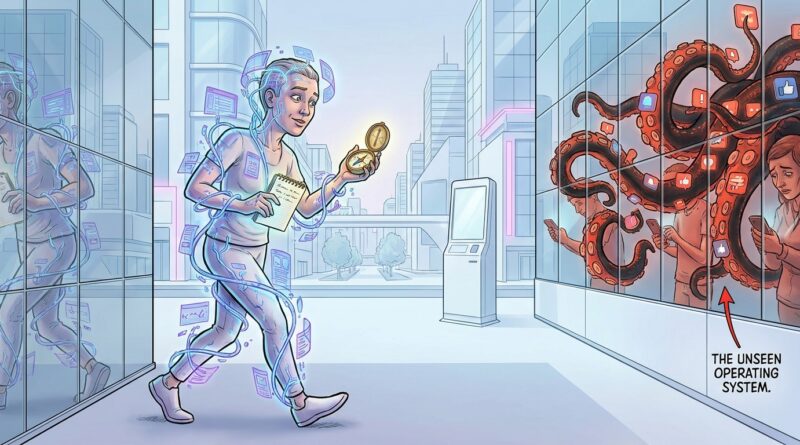
Homo Invisibilis: When Humans Evolved To Worship Tech They Can No Longer See
You are not crazy if modern tech feels less visible and more controlling at the exact same time. A few years ago, we could at least point at the problem. The phone. The screen. The app we could not stop opening. Now the systems shaping your day are often hidden in rankings, auto-sorts, nudges, smart replies, silent scores, and feeds that insist they are simply showing “what matters most.” That sounds smooth. It often feels awful. You miss a message because an app buried it. You forget a fact because search will remember it for you. You drift into an opinion because the next clip kept playing. Then the product language tells you this is convenience. Frictionless. Seamless. Effortless. Meanwhile your actual life feels more confusing, more crowded, and strangely harder to steer. That gap matters. It is not just bad design. It is a new way of living with tools that no longer sit in your hand. They sit in your habitat.
⚡ In a Hurry? Key Takeaways
- Invisible technology is not neutral. When tools disappear from view, they can shape your choices more deeply, not less.
- Run small tests. Turn off autoplay, switch one feed to chronological order, and do one task a day without recommendations.
- If an app makes life feel harder while calling itself frictionless, trust your experience. Confusion is often the product, not a bug.
We used to fear screens. Now we should fear scenery.
The old argument was simple. Too much screen time was bad for us. Fair enough. At least that fight had an object. You could hold it up and say, “This thing is eating my evening.”
The new problem is slipperier. The tech shaping memory, attention, relationships, work, health, and politics increasingly hides in the background. It is built into defaults, rankings, prompts, smart suggestions, moderation systems, reputation scores, and invisible handoffs between apps and databases.
This is where the satire in “Homo Invisibilis” comes in. We are supposed to clap because the tools have become so advanced that we no longer notice them. As if human progress means being trained by systems we cannot see clearly enough to question.
That would be funny if it were not already normal.
The sales pitch for invisible technology
Tech companies love the word “friction.” Friction is anything that slows you down. A confirmation step. A choice screen. A moment to think. A pause before buying, posting, or agreeing.
From the company side, friction is bad because it lowers engagement, clicks, and conversions. From the human side, friction is often where judgment lives.
If you have ever stopped yourself from sending a rude message because you had to reread it, congratulations. Friction just saved a relationship.
Why “seamless” can feel sinister
When everything becomes automatic, you stop seeing the little forks in the road. You do not notice why one friend’s post shows up and another’s does not. You do not know why one job application vanishes into a portal. You cannot tell why one news topic follows you for a week.
The system looks clean because the complexity has been pushed behind the curtain. But hidden complexity does not disappear. It just becomes your problem later, after the decision has already been made.
This is bigger than user experience
Calling this a design trend makes it sound harmless. A nice new interface. Fewer buttons. A cleaner screen.
It is bigger than that. Invisible systems do not just help you use a tool. They shape the environment where your choices happen. That is why “human evolution” is the right joke and the right warning.
Humans adapt to habitats. If the habitat is full of unseen ranking systems, predictive nudges, auto-completions, and machine guesses about what you want, then your habits adapt around those systems. You begin to outsource recall. You wait to be prompted. You skim instead of decide. You trust the top result because being the top result starts to feel like proof.
That is not a gadget issue. That is a behavior issue.
Helpful extension versus covert habitat engineer
Here is the line to watch:
A helpful extension helps you do what you already meant to do.
A covert habitat engineer changes what feels easy, normal, memorable, urgent, visible, or even thinkable.
Maps are a helpful extension when they help you find the café.
They become habitat engineers when you stop building any mental map at all and feel helpless without being routed.
Calendars are a helpful extension when they remind you of dinner.
They become habitat engineers when you no longer trust yourself to remember a loved one unless a system pings you first.
Recommendation engines are a helpful extension when they save you time finding a film.
They become habitat engineers when your taste quietly narrows to whatever is easiest to serve next.
How invisible systems mess with memory, attention, and relationships
Memory
When search, notes, and summaries are always available, your brain makes a reasonable deal. “Why store this? The machine has it.” The trouble is that memory is not just storage. It is how we connect ideas, form judgment, and build a sense of self.
If every half-remembered fact gets outsourced, you may become more informed in tiny bursts and less rooted overall. You know where to look, but not what you know.
Attention
Invisible tech is excellent at slicing attention into small, manageable pieces that happen to be very profitable. Auto-play. Suggested replies. Smart headlines. Notification bundles. The point is not just to grab your attention. It is to train your attention into a shape the system can use.
That is why so many people feel mentally crowded. They are not only distracted. They are being continuously prepared for the next prompt.
Relationships
This part gets less attention, but it may be the most important. Your relationships now pass through ranking systems, read receipts, typing indicators, relevance sorting, safety filters, memory features, and suggestion engines. Some of that is useful. Some of it is social weather control.
If a platform decides who appears first, who gets surfaced, which message is “priority,” and what counts as an interaction, it is not just carrying your relationships. It is subtly editing them.
The gaslit feeling has a cause
People often struggle to explain why modern digital life feels bad in a vague but persistent way. Part of the reason is that the old warning signs are gone. Fewer obvious buttons. Cleaner screens. More automation. Less visible effort.
So when the experience gets worse, you blame yourself.
Maybe I am disorganized.
Maybe I missed that email.
Maybe I am bad at focusing.
Maybe everyone else understands how this works.
Often, no. You are dealing with a system that is intentionally hard to see. A frictionless interface can hide a very high-friction life.
Five experiments to prove it to yourself
You do not need to move to a cabin or throw your phone in a river. Just run a few tests. Think of them as field research on your own habitat.
1. Turn one feed back into a list
If any service still offers chronological order, use it for a week. Social posts. Videos. News. Anything.
Notice what changes. Do you feel calmer? More bored? More in control? Do you see different people? That difference is the algorithm showing its outline.
2. Remove one prediction layer
Turn off auto-play, suggested replies, or smart recommendations in one place.
The first thing you will feel is not freedom. It will probably be emptiness or mild irritation. That is useful data. It means the system had been filling your attention for you.
3. Practice one act of manual memory
Memorize three phone numbers. Navigate one familiar route without maps. Keep a shopping list in your head until you reach the store. Not because machines are evil, but because retained skill is a kind of independence.
4. Add intentional friction
Move one distracting app off the home screen. Log out after use. Delete saved payment details from one shopping app. Make yourself type the name instead of tapping the icon.
That little pause is not punishment. It is a vote for choice.
5. Ask “who benefits from this being invisible?”
Every time a feature feels magically easy, ask that question. If the answer is mostly “the company gets more data, more time, or more control,” you have found the business model hiding under the convenience.
Small rebellions that actually help
You do not need a grand anti-tech identity. Tiny acts are enough.
- Use playlists instead of endless recommendation loops.
- Text people first instead of waiting for a platform to remind you they exist.
- Keep some notes on paper.
- Choose tools with visible settings over tools that promise magic.
- Ask for human review when a score or filter clearly got something wrong.
- Let yourself be a little inefficient when efficiency is clearly making you duller.
This last one matters. A fully optimized life is often a heavily managed life. Human beings need a bit of mess. Wandering. Forgetting. Choosing badly, then fixing it. That is not failure. That is agency.
Why the satire works
The phrase “invisible technology human evolution satire” lands because it pokes at something real. We are being sold a future where the best tools are the ones we no longer notice. But if a system trains your habits, filters your world, and changes your sense of what is normal, noticing it is not optional. It is basic self-defense.
The joke is that we are treated like the final stage of progress when we are really becoming easier to steer.
Homo sapiens used tools.
Homo invisibilis lives inside them.
At a Glance: Comparison
| Feature/Aspect | Details | Verdict |
|---|---|---|
| Visible tools | You can see the interface, understand the choices, and decide when to use it. | Usually healthier for agency, even if less sleek. |
| Invisible automation | Rankings, recommendations, filters, and prompts quietly shape what you notice and do. | Useful in small doses, risky when it becomes the default environment. |
| Added friction | Extra steps like manual search, logout barriers, and chronological views create space to think. | Often the simplest way to get control back. |
Conclusion
The current fashion for “disappearing” tech sounds elegant until you notice what else disappears with it. Clear choices. Visible causes. The feeling that your day belongs to you. That is why it helps to name this not as a quirky app trend, but as a habitat shift. Once you see recommendation engines, scoring systems, and silent automations as forces that shape your environment, your frustration starts to make sense. Better still, you can do something about it. Run small experiments. Add friction where it protects judgment. Keep a few stubbornly human habits alive. A little chaos is good for you. Big tech blogs will not say that, because mess does not scale well. But people do. And if a tool wants to disappear completely into the background of your life, that is exactly when you should look at it the hardest.