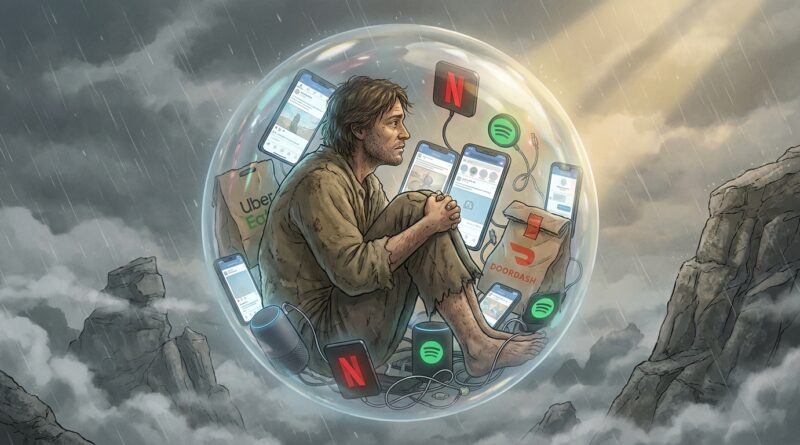
Homo Comfort‑Cocooned: When Humans Evolved To Treat Inconvenience Like a Biohazard
You are not imagining it. A lot of people feel tired, brittle and weirdly overloaded, even while their lives are full of tiny conveniences that previous generations would have called luxury. Groceries arrive without a trip. Maps prevent us from getting lost. Thermostats fix the room before we feel hot or cold. Streaming saves us from boredom. And yet one delayed package, one Wi-Fi hiccup, one app outage, and suddenly daily life feels like a survival test. That is the strange joke of modern comfort. The more friction technology removes, the less practice we get at handling friction at all. We are becoming a species I can only describe as Homo Comfort-Cocooned. Not lazy, exactly. Just underexposed to ordinary hardship. The result is a person who can manage twelve passwords, three subscriptions and a smart doorbell, but feels emotionally sideswiped by standing in line for seven minutes.
⚡ In a Hurry? Key Takeaways
- Technology has made life easier, but it has also lowered our tolerance for normal effort, delay and discomfort.
- Start small. Pick one daily task to do the harder way on purpose, like walking to the store or waiting before opening an app.
- You do not need to reject modern tech. The goal is to rebuild resilience, not cosplay as a 19th-century farmer.
When convenience starts to feel like oxygen
There is a darkly funny form of satire on human evolution and comfort addiction to technology that writes itself now. We built tools to save time and energy. Fair enough. Then we built systems to save us from minor uncertainty, mild boredom, slight hunger, brief silence and the inconvenience of having to remember anything.
Now many of us move through the day inside a padded tunnel of alerts, automation and on-demand services. Need dinner. Tap. Need a ride. Tap. Need a dopamine pellet because your brain hit one boring patch between meetings. Tap again.
The absurd part is not that these tools exist. The absurd part is that once they become normal, their absence feels less like inconvenience and more like injury. The elevator is out, and we react like mountaineers caught in a blizzard. The app logs us out, and suddenly civilization has collapsed.
This is not weakness. It is deconditioning.
It helps to use the right word here. Most people are not failing because they are uniquely soft or morally broken. They are deconditioned.
If a machine lifts every box for you, your muscles do less. If software remembers every phone number, route and birthday for you, your memory does less. If delivery apps erase every small logistical hurdle, your patience and planning do less. Human beings adapt to what they repeat. That is great when we are learning piano. It is less great when we are training ourselves to treat every delay like a threat.
Our ancestors had plenty of problems, many of them terrible. I am not selling a fantasy that older life was better. It was harder in ways nobody should romanticize. But one thing older life did provide was constant low-level practice in coping. Waiting, carrying, fixing, tolerating weather, asking strangers for help, being briefly lost, being bored without dying from it.
The comfort cocoon has side effects
1. Tiny problems feel huge
When daily life is optimized to remove every pebble from the road, one pebble starts to feel like a boulder. That is why a delayed text can feel emotionally loud, or why a closed checkout lane can trigger a full internal monologue about societal collapse.
2. Your brain stays “on” while your body does less
This is one of the nastier trade-offs of modern tech. We have outsourced physical effort while increasing mental clutter. So you might not be chopping wood or hauling water, but you are juggling notifications, calendars, passwords, updates, feeds, warnings and tiny administrative chores all day long.
That can leave you feeling both underused and overcooked. Your body did not struggle enough. Your mind struggled too much.
3. Convenience can quietly shrink competence
If software always picks the route, you stop noticing where you are. If autocomplete finishes every thought, your writing gets flabbier. If an app solves every small inconvenience, your confidence in solving things yourself can slowly drop, even when you are perfectly capable.
Why this feels so personal
Tech convenience does not just change behavior. It changes expectations.
That matters because expectation is half the battle. Cold weather is one thing. Cold weather when your smart heating failed and your house was “supposed” to be perfect is another. A slow trip home is annoying. A slow trip home after years of algorithmic route perfection feels almost insulting.
We do not just want comfort now. We expect it as the default operating system. So when life behaves like life, messy, delayed, inconsistent, we feel ambushed.
The weird status game of modern ease
There is also a cultural piece to this. Convenience has become a badge of progress. The less effort required, the more advanced a system seems. Frictionless is treated like the highest form of intelligence.
But a totally frictionless life can make a person less sturdy. If every rough edge gets sanded off, you do not become a god. You become very surprised by rough edges.
That is the satirical heart of the whole thing. We picture evolution as becoming tougher, smarter and more adapted. Instead, in many corners of modern life, we have evolved into highly optimized indoor mammals who can summon Thai food, control the lights by voice and still feel challenged by printer settings.
How to reclaim resilience without becoming a tech monk
The answer is not to throw your phone in a lake, move to a cabin or hand-wash your socks to build character. Most people are not going to live like that, and they do not need to.
The better fix is something smaller and more realistic. Add a little healthy friction back into your day on purpose.
Try the “one inconvenience” rule
Pick one task each day and do it the slightly harder way.
- Walk to pick up one item instead of having it delivered.
- Use your memory before checking the app.
- Wait ten minutes before fixing a moment of boredom with your phone.
- Take the stairs when the elevator is available.
- Drive or walk without navigation on a route you mostly know.
- Cook one simple meal instead of outsourcing dinner.
This is not punishment. It is cross-training for being a person.
Build tolerance, not misery
The key is dosage. You are not trying to make life harder in a grand, heroic way. You are trying to remind your nervous system that minor discomfort is survivable, normal and often even useful.
A little waiting can rebuild patience. A little uncertainty can rebuild confidence. A little physical effort can wake your body back up.
Protect a few zones from automation
It helps to choose parts of life where convenience does not automatically win. Maybe your mornings start without checking messages. Maybe one errand per week is done in person. Maybe Sunday dinner is cooked, not ordered. Maybe one walk happens without headphones.
That is not anti-tech. It is anti-total-dependence.
What technology is actually good at
To be clear, none of this means technology is bad. It is often wonderful. It reduces pointless drudgery. It helps disabled people live more freely. It saves time, expands access and smooths out many parts of life that used to be genuinely miserable.
The problem starts when convenience stops being a tool and becomes a habitat. Tools help you act. Habitats shape what kind of creature you become.
And if your habitat removes every chance to practice adaptation, then adaptation gets rusty.
The quiet irony of the AI panic era
A lot of public conversation is pointed at giant questions. Will AI replace jobs. Become conscious. Go rogue. End civilization. Those are real debates. But while everyone stares at the horizon, there is a smaller, more intimate shift happening in the living room.
We are handing more of our daily coping to systems that predict, cushion and pre-chew life for us. The thermostat decides comfort. The algorithm decides attention. The grocery app decides whether we ever need to deal with a crowded aisle or a forgotten ingredient. Bit by bit, the human tolerance for ordinary inconvenience gets weaker.
That is not extinction-level drama. It is subtler than that. But it may explain why so many people feel less capable than they should in a world built to be easier.
At a Glance: Comparison
| Feature/Aspect | Details | Verdict |
|---|---|---|
| App-driven convenience | Saves time and removes friction, but can reduce patience, planning and problem-solving practice. | Useful in moderation. Risky as your default for everything. |
| Small daily discomfort | Walking, waiting, remembering, navigating and doing basic tasks yourself rebuild tolerance and confidence. | Worth adding back on purpose. |
| Going fully off-grid | Dramatic, unrealistic for most people, and usually unnecessary. | Not the goal. Keep the tech, lose the overdependence. |
Conclusion
The point is not to feel guilty because modern life got easier. The point is to notice the trade. Right now everyone is arguing about AI safety, consciousness and extinction while quietly living in a personal bubble where the thermostat, algorithm and grocery app do most of their coping for them. That bubble feels nice, until it becomes the only way you know how to function. If you have been feeling oddly weak, overclocked or easily knocked off balance, that does not mean you are broken. It may just mean your comfort cocoon got a little too good at its job. The fix can be very small. Choose one ordinary inconvenience and meet it without outsourcing it. Do that often enough, and you start to get something back that no app can deliver in ten minutes or less. Your own resilience.