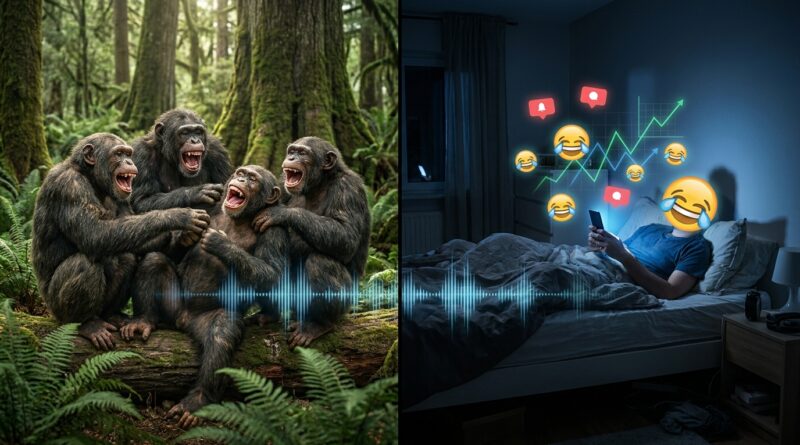
Homo Gigglus: When 15 Million Years Of Laughter Got Trapped In The Group Chat
You can feel it, right? Everyone is meant to be optimising, tracking, automating and panic-reading charts about AI, layoffs and the heat death of attention spans. Yet the group chat still lights up because someone posted a blurry raccoon falling off a bin and ten adults answered with crying-laughing emojis. That is not a bug. It is probably the oldest software still running in your body. A new study suggests humans and great apes have been giggling with the same basic rhythm for around 15 million years. Long before speeches, status updates or “circle back” emails, there was breathy, messy, social laughter. So if modern life feels absurd, that may be because your nervous system is using Stone Age tools to survive app-era nonsense. Seen that way, meme culture is less a sign of collapse and more a reminder that shared stupidity has always been one of our most reliable support systems.
⚡ In a Hurry? Key Takeaways
- Humans laugh in patterns that go back millions of years, so our love of memes and silly jokes is older than language and far older than the internet.
- If your feed is making you numb, start choosing humor on purpose. Talk to funny people, save jokes you actually enjoy, and spend less time letting algorithms pick your mood.
- AI can copy joke formats, but it cannot replace the social safety function of real shared laughter, especially when people are stressed or scared.
The study says your group chat is basically prehistory with Wi-Fi
The core finding is simple and weirdly comforting. Humans and great apes appear to share a basic laughter rhythm that dates back to a common ancestor from roughly 15 million years ago. Not language. Not debate. Not productivity software. Laughter.
That matters because it reframes a lot of modern behavior that looks embarrassing on the surface. The endless reaction GIFs. The badly timed joke in the work Slack. The friend who answers every crisis with “lol” and a skull emoji. We tend to treat all of that as moral decline, internet poisoning or proof civilization is one push notification away from collapse.
Sometimes it is. But sometimes it is also a mammal trying to regulate fear with noise.
Why laughter keeps showing up when everything feels awful
People often think laughter is the reward for understanding a joke. Nice idea. Very tidy. Real life is messier. Laughter is also social glue, stress relief, group bonding and a fast way to say, “I see the danger too, but I am still here with you.”
That is why people crack jokes at funerals, in hospital waiting rooms and during office restructures. It is not because they do not care. It is because the body sometimes reaches for absurdity before the brain has prepared a statement.
Crying-laughing emojis are not evidence of emotional shallowness
They can be lazy, sure. They can also be a tiny distress flare with glitter on it. A lot of digital humor works because it compresses panic into something shareable. You send a meme that says, “I have read three articles about AI replacing me, and my chosen response is this possum in sunglasses.”
That is not deep analysis. It is emotional first aid.
The satirical part we should probably admit out loud
We built supercomputers, recommendation engines and predictive models, then used them to mass-deliver jokes about frogs, raccoons and men who cannot assemble flat-pack furniture. That is the satirical take on human evolution laughter and technology in one sentence. We are an allegedly advanced species running ancient group-bonding code through ad-funded dopamine plumbing.
Platforms know this. They do not need to understand joy in some philosophical sense. They just need to notice what keeps you tapping, sharing and making the little face that says, “Fine, that got me.” Once humor is measurable, it becomes steerable.
When humor gets hacked by platforms
This is where things turn from funny to useful. If laughter is old survival software, then feeds and recommendation systems are trying to sit between your reflex and your relationships. They are not just showing you jokes. They are shaping your sense of what counts as funny, normal, edgy or worth repeating.
That can flatten your taste. It can also make you confuse familiarity with fun. The joke format repeats. The same sound clip appears. The same face. The same beat. Eventually your laugh is less a spark and more a software prompt.
That does not mean all internet humor is fake. It means convenience is very good at dressing itself up as personality.
Why AI comedy still feels slightly off
AI can write punchlines, remix formats and produce endless “content” that resembles humor from a distance. But comedy is not only word order. A lot of it is timing, shared history, risk, context and the tiny shock of hearing someone reveal they were weird in the exact same way you are weird.
A generated joke may be technically fine and still feel dead on arrival. It has structure but not stakes. It knows the setup. It does not know what your friend sounded like when they said it after missing a train and spilling coffee on themselves.
In other words, AI can imitate the wrapper. It struggles with the social electricity inside it.
The difference between pattern matching and actual relief
Real laughter often arrives as a body event. You snort. You wheeze. You have to sit down. Someone else starts laughing because your laugh is ridiculous. That is shared regulation, not just entertainment. It is one reason the ancient rhythm matters. Our systems are tuned to one another, not merely to content objects on a screen.
So yes, AI can help write a gag. It can help brainstorm a script. It cannot fully replace the oldest reason laughter exists, which is that another creature near you made a sound that told your body, for one second, you were safe enough to loosen your grip.
How to reclaim your sense of humor from the feed
This is the practical bit. If you feel like your taste has been assembled by apps, you can push back without moving to a cave and communicating only through hand drums.
1. Notice what makes you laugh, not just what makes you react
A snort is different from a bored exhale through the nose. Keep the stuff that truly lands. Ignore the rest. Your attention is a vote.
2. Spend more time with people who are funny in person
The internet is good at distribution. It is less good at warmth. A friend telling a bad story well will often beat a perfectly tuned viral clip.
3. Stop treating every joke as content
Some jokes are better when they stay in the room. Not every laugh needs to become a clip, a meme or a post with metrics attached.
4. Use AI as a tool, not a replacement personality
If you use AI to draft an idea, fine. If you let it define your comic voice, that is like asking predictive text to become your best friend. It can help. It should not run the show.
5. Protect low-stakes silliness
Not all humor has to be clever. Sometimes the most human thing you can do is laugh at something dumb with someone you trust.
What this says about us, honestly
It says we are less polished than our gadgets suggest. Good. That may be healthy. Beneath all the dashboards and personal branding, we are still creatures whose brains calm down when another familiar animal makes a ridiculous noise at the right moment.
That does not make us primitive in a bad way. It makes us continuous. The same species worrying about machine intelligence is also sending a banana peel meme to six friends because one of them had a terrible Monday. Both things are true. Only one of them reliably lowers blood pressure in under five seconds.
At a Glance: Comparison
| Feature/Aspect | Details | Verdict |
|---|---|---|
| Ancient laughter vs modern memes | The social rhythm of laughter appears to be millions of years old, while memes are just the latest delivery format. | The impulse is ancient. The packaging is new. |
| Human humor vs AI-generated jokes | AI can copy structure and style, but shared context, vulnerability and real-time timing still matter most. | Useful assistant, weak substitute. |
| Platform-driven comedy vs chosen joy | Feeds optimize for engagement, not your emotional well-being or actual taste. | Choose your funny on purpose. |
Conclusion
The nice part of this study is that it gives us a less dramatic, more human way to read the moment. Yes, people are anxious about AI, metrics and the strange feeling that software keeps trying to become their social life. But a brand-new study suggests humans and great apes have been giggling with the same basic rhythm since long before speech or smartphones existed. That makes today’s meme wars and AI comedy tools look like a clumsy patch on ancient firmware. If that sounds satirical, good. It should. We are easier to hack than we like to think, especially when platforms learn how to farm our reflexes. But the flip side is hopeful. You can still reclaim your own sense of humor. Laugh with actual people. Keep the jokes that make you feel more alive, not just more scrollable. Do not outsource joy to recommendation engines when your species has been doing the real thing for 15 million years.