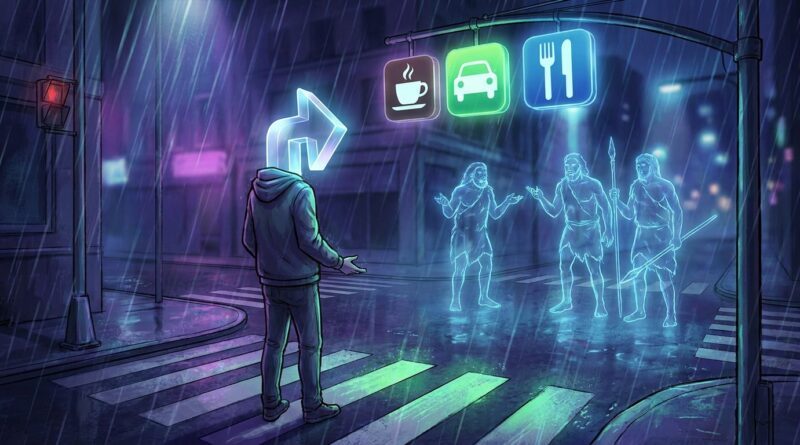
Homo GPS‑Dependus: When Humans Outsourced Their Sense Of Direction To The Cloud
You are not broken if your pulse jumps the moment the map app stalls. Plenty of smart, fully functional adults can still remember their childhood phone number, but cannot drive to the grocery store without a calm electronic voice saying, “In 800 feet, turn right.” That is not personal failure. It is what happens when a very convenient tool slowly turns your brain’s internal compass into an unpaid intern. We used to carry rough mental maps of our towns. Now many of us carry faith. Faith in the blue dot, the battery percentage, and a cloud-connected stack of satellites, software, and mystery outages run by companies we do not control. The joke is that we talk nonstop about robots replacing humanity, while the quieter swap already happened. Humans outsourced basic wayfinding, then acted surprised when a frozen screen made the species look helpless in a parking garage.
⚡ In a Hurry? Key Takeaways
- GPS is incredibly useful, but heavy smartphone navigation use can weaken your attention to landmarks and your own mental map.
- Try one small fix: for one familiar trip each week, navigate by memory first and use GPS only as backup.
- This is not about rejecting tech. It is about keeping a basic human skill alive in case the app, signal, or battery lets you down.
The Blue Dot Became Our Emotional Support Animal
There was a time when “knowing the city” meant something. A cab driver had it. Your aunt had it. Your friend who always took the weird shortcut behind the post office definitely had it. Now “knowing the city” often means knowing which app is less likely to send you into a lake.
That sounds harsh, but it is also funny because it is true. Modern navigation is such a miracle that we barely notice the trade. We gained convenience. We lost some awareness. Instead of learning, “The bakery is two blocks past the park,” we learn, “The route recalculates if I miss this light.” One of those lives in your head. The other lives on a server farm.
What Actually Changed in Our Brains
Your brain likes efficiency. If a tool handles a task well enough, the brain stops spending as much effort on that task. This is normal. It is why calculators changed how people do arithmetic and why contact lists erased half the phone numbers we once knew by heart.
Navigation apps do the same thing with space. When software gives turn-by-turn instructions, you can follow commands without building a strong mental map. You arrive. Mission accomplished. But often you do not really know where you are in relation to anything else.
From map-maker to instruction-follower
Old-school navigation asked your brain to do a few jobs at once. Notice landmarks. Track direction. Estimate distance. Connect places together. Build a little model of the world.
Turn-by-turn GPS asks for much less. Mostly it asks for obedience. Turn here. Merge there. Continue for 2.3 miles. The app does not care whether you understand the neighborhood. It cares whether you hit the next step.
Why the panic feels so real
When the app freezes, your brain suddenly has to resume a job it has not been practicing. That jolt feels bigger than it should. You are not merely “lost.” You are abruptly promoted from passenger back to navigator, with no warning and 14 percent battery.
The Satirical Evolutionary Picture
Imagine an alien biologist studying us.
“Fascinating species,” the alien writes. “Highly adaptable. Can cross oceans, split atoms, and order soup from a moving car. However, if glowing rectangle stops updating for three seconds, subject circles same block four times and whispers, ‘Why is it doing this to me?’”
That is the comedy of Homo GPS-Dependus. We did not lose the ability to orient ourselves in one dramatic moment. We gently rented it out for convenience. Piece by piece. Trip by trip. Notification by notification.
And to be fair, the deal was attractive. GPS is fantastic. It saves time, lowers stress in unfamiliar places, helps with traffic, and prevents plenty of wrong turns. The issue is not the tool. The issue is total dependence on the tool.
How Entire Cities Became Abstract Lines on a Screen
One quiet side effect of constant smartphone navigation is that real places start to feel less real. Neighborhoods become route segments. Landmarks become icons. A river is not a river. It is the blue shape you cross before the app tells you to stay left.
This matters because familiarity is built from context. When you pay attention to the world itself, you start to know it. You remember the mural near the pharmacy. The road that curves by the school. The steep hill that means you went too far. That information creates confidence.
When you only follow the screen, the city stays flat. Functional, yes. Known, no.
The Hidden Costs of Perfect Convenience
Most tech tradeoffs are boring until they fail. GPS dependence is one of those. Everything is smooth until your phone overheats on the dashboard, the signal goes weird downtown, the battery dies, or the app sends you through a construction zone last updated sometime during the Bronze Age.
Cost 1: Lower attention
If the app is “handling it,” you naturally stop scanning your surroundings as carefully. That means fewer landmarks, weaker recall, and more dependence next time.
Cost 2: False confidence
People often feel secure because they have navigation open. But that confidence belongs to the system, not to them. If the system goes away, the confidence goes with it.
Cost 3: Fragility
Any skill you stop practicing gets rusty. Not gone, just rusty. Spatial awareness is no different.
The Good News: You Do Not Need to Become a Wilderness Hermit
This is not an argument for throwing your phone into a river and navigating by moss. Please do not do that. GPS is one of the best consumer technologies ever made. It is useful, safe, and often the right tool.
The goal is smaller and saner. Keep the convenience. Reclaim a little competence.
One Concrete Practice to Become Slightly Less Software-Dependent
Use “memory first, GPS second” on one familiar trip a week
Pick a trip you already kind of know. Work, the gym, a friend’s house, your favorite coffee place. Before you start the car or leave the train station, pause for ten seconds and say the route out loud in simple chunks.
For example: “Main Street, left at the library, straight past the gas station, right at the big church.”
Then do the trip from memory. Keep GPS available, but do not open it unless you genuinely need help.
That is it. One trip a week.
This works because it rebuilds the habit that GPS replaced. You are not trying to prove anything. You are teaching your brain to pay attention again. Over time, you start noticing anchors. North and south make more sense. Distances feel less random. The city becomes a place again, not just a route.
If You Want to Go One Step Further
If the weekly trip gets easy, add one extra layer.
Notice three landmarks
Pick three physical markers on the route. A school, a mural, a weirdly shaped building, a park entrance. The brain loves distinct objects. They make navigation stick.
Check the overview before starting
Even if you use GPS, look at the whole route for five seconds before hitting start. Not the step-by-step. The shape. Are you heading east? Crossing the river? Staying on one major road? That small preview helps build an actual mental map.
Turn the voice off sometimes
On easy trips, visual guidance alone can be enough. The voice tends to turn you into a command sponge. Silence makes you observe more.
When Full GPS Use Is Still the Smart Move
Let us also be adults about this. There are plenty of times when using full navigation is exactly correct.
Use it in unfamiliar cities. Use it when traffic matters. Use it at night. Use it when you are tired. Use it when missing a turn would create real stress or safety problems. The point is not purity. The point is resilience.
Why This Matters More Than Some Grand Futurist Debate
There is endless noise about machine superintelligence, digital destiny, and whether technology is saving civilization or melting it. Fine. Those are big conversations.
But ordinary dependence is where tech really changes us. Quietly. Daily. Without press releases. The map app does not need to conquer humanity. It just needs to become the part of your life you stop questioning.
That is why this subject lands so well as satire. It is not doom. It is recognition. We can laugh because we have all stared at a frozen blue dot like medieval sailors praying over a broken compass.
At a Glance: Comparison
| Feature/Aspect | Details | Verdict |
|---|---|---|
| Turn-by-turn GPS | Fast, convenient, low stress, great for unfamiliar places, but easy to follow passively. | Excellent tool. Best used with some awareness, not blind trust. |
| Mental mapping | Builds spatial memory, confidence, and backup skills, but takes attention and practice. | Worth keeping alive, especially for places you visit often. |
| Hybrid approach | Use GPS as backup, preview routes, notice landmarks, and practice on familiar trips. | Best balance for normal people who like convenience and competence. |
Conclusion
The real joke is not some distant robot uprising. It is that a species that once crossed continents by stars now gets nervous in a Target parking lot when the map app hiccups. That is funny, but it is also useful to notice. GPS is wonderful. Keep using it. Just do not let it fully repossess your sense of place. If you take one familiar trip a week from memory, with the app as backup instead of boss, you can keep the convenience without becoming completely software-dependent. No cabin in the woods required. Just a little more attention, a little less panic, and maybe a city that feels like a real place again.