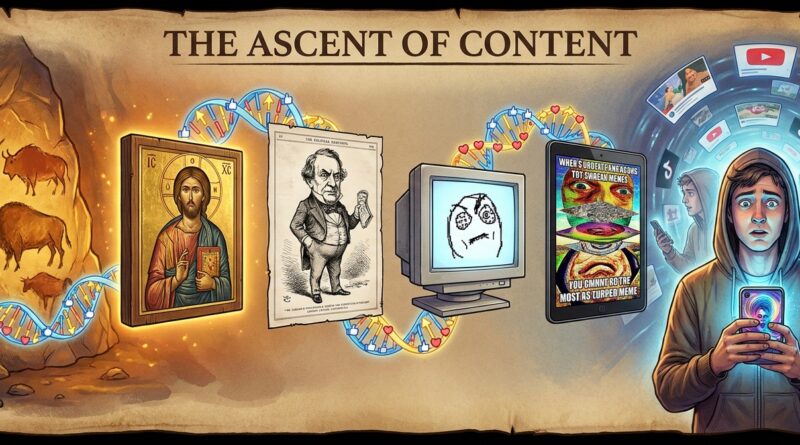
Homo Meme‑plexus: When Human Evolution Outsourced Itself To Viral Content
You are not crazy if “the future” feels suspiciously like a stale group chat with better graphics. We keep getting told humanity is evolving at startup speed, boosted by AI, social feeds and endless content. Meanwhile, most of us are waking up, checking the same apps, reacting to the same outrage, and laughing at the same joke template that was already tired three weeks ago. That gap is the real story. Cultural evolution is absolutely speeding up. It is just not moving in a straight line toward wisdom. A lot of it looks more like copy, paste, panic, repeat. If human evolution once depended on who survived winter, it now often depends on which idea survives the scroll. The useful question is not whether memes are changing us. They are. The useful question is which ones are driving your behavior, and whether you want them behind the wheel.
⚡ In a Hurry? Key Takeaways
- Humans are not just evolving biologically. We are being shaped daily by viral ideas, jokes, outrage cycles and algorithm-fed habits.
- Start by tracking the memes you repeat, reward and react to for one week. Then choose which to starve, which to remix and which to pass on.
- This is less about blaming technology and more about getting some agency back before synthetic content starts steering your attention full time.
So what is “Homo Meme-plexus”?
It is a joke, but not only a joke.
Think of it as the modern human whose survival depends less on hunting mammoths and more on navigating a blizzard of signals. Trends. Hot takes. Status games. AI slop. Influencer wisdom. Emotional bait dressed up as news.
We used to inherit genes. Now we also inherit formats.
A reaction face. A catchphrase. A political script. A wellness routine. A way of sounding informed without actually being informed. These things spread, mutate and compete for space in your head. That is the meme part.
The “plexus” part is the mess of connections. Your brain, your phone, your group chat, your feed, your recommended videos, your office Slack, your family text chain. One big nervous system with push notifications.
Why the “evolution” feels fake
Because a lot of what gets called progress is just acceleration.
Faster is not always better. A microwave is faster than a slow cooker. Nobody confuses the two.
AI can generate ten thousand images in minutes. That does not mean culture got ten thousand times smarter. It may just mean the landfill got bigger. Hyper-targeted feeds can learn exactly what keeps you watching. That does not mean they are helping you grow. It often means they found the psychological equivalent of a loose floorboard and keep stomping on it.
This is why the future can feel oddly repetitive. The system rewards whatever spreads. And what spreads is not always what is true, useful or beautiful. Often it is what is easy to copy and hard to ignore.
The meme fitness test
In biology, traits stick around if they help reproduction. Online, ideas stick around if they help repetition.
That is a very different test.
What tends to win online
Short beats nuanced.
Emotional beats careful.
Identity beats curiosity.
Certainty beats honesty.
Outrage beats repair.
So the memes that survive are often the ones best adapted to platform life, not human flourishing. They are the digital equivalent of junk food that figured out how to advertise itself.
You are probably running more memes than you think
Not just internet memes with captions and bad crops. I mean repeatable social programs.
Examples:
- “If I am not optimizing every hour, I am failing.”
- “If something annoys me, I should post about it immediately.”
- “If a video looks polished, it must know what it is talking about.”
- “If everybody in my feed agrees, that counts as reality.”
- “If I can turn a personality into content, I should.”
These are memes with jobs. They shape your spending, your mood, your relationships and your sense of self.
That is partly why articles like Beta-Testing Humanity: Why We Treat Our Own Species Like a Glitchy Software Update hit a nerve. We increasingly talk about people as if they are buggy products that need patches, upgrades and better settings. Funny, yes. Also a little too real.
A field guide to the memes currently colonizing your life
If you want a practical, almost anthropological way to make sense of this, start here.
1. Status memes
These tell you what kind of person gets rewarded. Maybe it is the person who is busiest. Or most ironic. Or most informed. Or most detached. Or most publicly caring.
Ask: What personality type does my feed keep treating as the winner?
2. Fear memes
These spread by making you feel one click away from disaster. Economic collapse. Social humiliation. Brain rot. Civilization ending before lunch.
Ask: Which accounts make me feel permanently under attack, and who benefits from that?
3. Desire memes
These shape what you want. Not what you need. What you suddenly feel incomplete without.
Ask: Which desires appeared in my life only after repeated exposure?
4. Identity memes
These give you a prefab self. “People like us believe this.” “People like us dress like this.” “People like us mock those people.”
Ask: Which opinions now feel like part of my personality mainly because my tribe repeats them?
5. Productivity memes
These turn every human activity into a benchmark. Sleep score. Step count. Side hustle. Reading challenge. Personal brand.
Ask: What have I started measuring that used to just be part of living?
The one-week meme audit
You do not need a retreat in the woods. You need notes.
Day 1 to Day 7, track these three things
- What you repeat. Phrases, jokes, complaints, opinions, references.
- What you reward. Likes, shares, replies, watch time, purchases.
- What changes your mood fast. The post or video that can tilt your whole day.
Keep it simple. A note on your phone is enough.
At the end of the week, label each meme stream:
- Starve it. It makes you smaller, meaner, dumber or more exhausted.
- Mutate it. There is something useful there, but it needs a healthier form.
- Propagate it. It actually improves your thinking, relationships or courage.
How to starve a meme without pretending you live off-grid
People love giving “just log off” advice as if jobs, school, family and community are not all threaded through the same machines now.
So let’s be realistic.
Use friction
Unfollow the account. Mute the keyword. Turn off autoplay. Move the app off your home screen. Small obstacles matter because memes thrive on low-resistance repetition.
Break the reward loop
If outrage content is your snack, stop feeding it likes, comments and hate-watches. Platforms do not care why you stayed. They just count that you stayed.
Replace, do not just remove
A vacuum gets filled. If you cut one stream, add another. Long-form interviews instead of clips. A group chat with actual friends instead of strangers performing intimacy. Books. Hobbies that involve hands.
How to mutate a meme into something less stupid
Some memes are not bad. They are just undercooked.
Take productivity culture. The broken meme says your value is your output. A better mutation is this: systems can help, but rest is also part of being a functioning mammal.
Take irony. The broken meme says never care too openly. A better mutation is this: humor is great, but sincerity is not a software bug.
Take AI enthusiasm. The broken meme says every problem is solved by adding more machine-generated content. A better mutation is this: use tools where they help, but do not confuse volume with wisdom.
How to deliberately propagate better memes
This is the part people skip. We are very good at spotting bad cultural code. We are less good at writing better code.
Pass along ideas that scale without poisoning people
- Nuance can be short.
- Kindness can be shareable.
- Admitting uncertainty can actually build trust.
- Humor does not have to punch downward.
- Not everything worth doing needs to become content.
If you want to influence culture, start smaller than “save society.” Try “improve the emotional climate of one room, one chat or one comment thread.” That is still propagation.
Why AI makes this weirder
Because we are entering an era where memes no longer need human effort to reproduce.
That matters.
Synthetic content can flood every channel with competent-seeming nonsense, hyper-tailored persuasion and endless variations of whatever already hooks you. The old problem was that bad ideas spread fast. The new problem is that they can now be mass-produced, personalized and tested against your weaknesses in real time.
So yes, this is a satire on human evolution of memes and technology. But it is also a practical warning. If your attention is programmable, someone will try to program it.
The good news, if you can call it that
Humans are not passive containers. We are still choosy social animals. We imitate, but we also edit. We absorb, but we can refuse. We can notice a script and decide not to perform it.
That is the whole point of doing a meme audit. You are trying to catch evolution in the act, right where it touches your daily life.
Not in a lab. In your scrolling thumb. In your joke selection. In the way you frame a disagreement. In what you reward with attention.
At a Glance: Comparison
| Feature/Aspect | Details | Verdict |
|---|---|---|
| Biological evolution | Slow, messy, measured across generations, based on survival and reproduction | Still real, but too slow to explain your current online personality |
| Meme evolution | Fast, contagious, shaped by attention, repetition and platform incentives | This is the main force rewriting everyday behavior right now |
| AI-amplified culture | Automates remixing, targeting and scaling of content, including low-quality or manipulative ideas | Useful tool, dangerous amplifier, needs active human filtering |
Conclusion
The point is not to become a meme monk who never laughs, never posts and communicates only through handwritten letters. The point is to notice that culture is now evolving at a speed our biology cannot naturally track, especially with AI hype, synthetic content and hyper-targeted feeds pushing every button they can find. Once you see that, the problem gets less mystical. You can map the ideas running your behavior. You can starve the ones that make you worse. You can mutate the half-useful ones into something more human. And you can deliberately spread the few that help people think, connect and calm down. That is a lot better than vague digital detox sermons or abstract AI doom. It is a daily experiment. Small, funny, practical. Less lab rat. More co-designer of whatever odd species we are becoming.