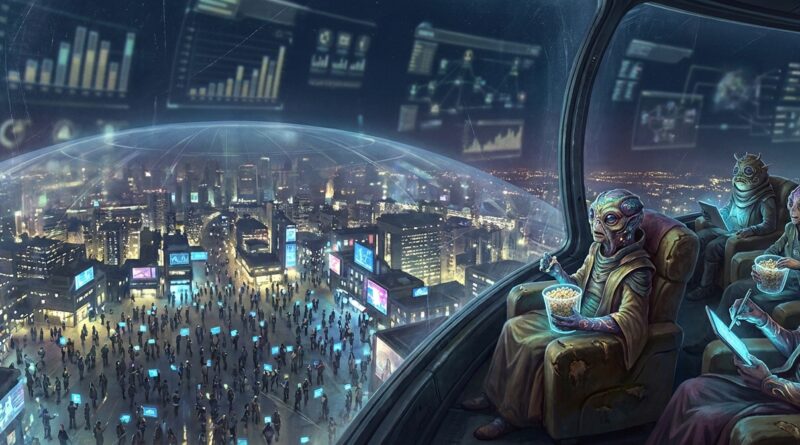
Homo Zoologicus: When Humans Started Livestreaming Themselves For Imaginary Aliens
You are not weird for staring at yet another TikTok about aliens watching human evolution and thinking, “Honestly, fair.” The whole zoo hypothesis aliens watching human technology trend lands because it pokes a sore spot. A lot of us already feel observed, sorted, nudged, and quietly graded by systems we do not understand. Not by little green men. By recommendation engines, ad networks, workplace dashboards, smart devices, and apps that somehow know you were thinking about hiking boots before you ever searched for them. That is why these memes hit so hard. They are funny, sure. But they are also a coping mechanism. The alien zookeeper is just a sci-fi costume for something much closer to home. If some advanced species did watch us, they would probably be less interested in our opposable thumbs than in the fact that we built machines to monitor ourselves, then volunteered to carry them in our pockets, bedrooms, and faces.
⚡ In a Hurry? Key Takeaways
- The alien zoo idea feels popular because it mirrors real life online. Many people already feel watched by opaque digital systems.
- Start treating your devices and apps like observation tools, not neutral helpers. Check permissions, cut notifications, and turn off tracking where you can.
- This is not about paranoia. It is about noticing who gets to study your behavior, then taking back a little control.
Why the alien zoo meme feels so personal
The classic zoo hypothesis says advanced aliens know we are here but avoid direct contact, the way humans avoid jumping into a gorilla enclosure for a chat. They observe. They wait. They study our development from a safe distance.
That idea should feel remote and philosophical. Instead, it feels weirdly intimate.
Why? Because plenty of people already live as if unseen observers are taking notes. Post a photo, and invisible systems judge whether it is engaging. Search for symptoms, and a machine quietly files you into a marketing category. Walk into a store with your phone, and location data may tell somebody you visited. Open a work app, and a dashboard might translate your day into numbers.
Put bluntly, we do not just fear being watched by aliens. We are tired of being watched by software.
Humans did not wait for aliens. We built our own enclosure cameras.
This is the darkest joke at the center of the whole thing. If extraterrestrials are studying us, they barely need to do any fieldwork. We already produce endless footage, commentary, biometrics, shopping signals, emotional outbursts, political arguments, meal photos, dating preferences, and sleep data. We are livestreaming the species.
Not always on purpose, either.
The obvious feeds
Social media is the easiest example. We post, react, scroll, pause, rage, admire, compare, and repeat. Every tap becomes a clue about what keeps us engaged.
The less obvious feeds
Then come the quieter channels. Fitness bands. Smart speakers. Doorbell cameras. Cars with app links. TVs that phone home. Loyalty cards. Browsers stuffed with trackers. None of this means a single villain in a cape is watching your every move. Usually it is messier than that. It is dozens of systems collecting little fragments and turning them into a profile useful enough to sell, predict, rank, or influence.
That is what makes the zoo hypothesis such a useful metaphor. A zoo is not only about cages. It is about observation, categorization, behavior management, and one-sided understanding.
What would aliens actually notice about us?
If you want the fun version of the thought experiment, here it is. Imagine some distant civilization studying Earth. They would probably note our art, our wars, our tenderness, our stupidity, our talent for inventing seventeen different chargers for the same purpose.
But they might also notice something even stranger. Humans are one of the few animals that built tools to reduce uncertainty, then used those tools to create new uncertainty about who controls daily life.
We made systems that answer questions instantly, then filled them with hidden incentives. We built maps that know where we are, then forgot to ask who else knows. We created platforms that promise connection, then let them score and sort attention at industrial scale.
From the outside, that would look less like mastery and more like a species wandering into a very polished maze.
The real lesson is not “be afraid.” It is “read the enclosure signs.”
I do not think the helpful response here is full panic. You do not need to throw your phone into a lake and start communicating by candlelit semaphore.
You do need a better habit, though. Curiosity beats helplessness.
Ask one simple question more often
When an app, device, or service wants something from you, ask: who benefits from this data being collected?
Sometimes the answer is reasonable. Your maps app needs location to route you. Your weather app needs a rough area to tell you if it is about to pour.
Sometimes the answer is shakier. Does a flashlight app need contacts? Does a game need microphone access forever? Does a smart gadget really need an account tied to your full identity?
Notice the behavior shaping
A zoo does not just observe animals. It shapes their environment. That is worth remembering online. Infinite scroll is not neutral. Streaks are not neutral. Push alerts are not neutral. Autoplay is not neutral. They are little rails that guide attention and habit.
If something feels sticky, compulsive, or oddly hard to leave, there is usually a reason. You are not weak. The enclosure was designed.
How to reclaim agency without becoming a hermit
This is the practical part. You cannot opt out of modern technology entirely, and most people do not want to. Fair enough. The goal is not purity. It is friction. You want to make automatic observation a little harder and your own choices a little clearer.
1. Do a five-minute permission sweep
Open your phone settings. Check which apps have access to location, microphone, camera, contacts, photos, Bluetooth, and motion data. Turn off anything that does not make plain sense.
2. Kill the notifications that treat you like bait
If an app is constantly “reminding” you to come back, that is not a public service. Turn off non-human notifications for shopping, social apps, games, and news unless they truly matter.
3. Use the browser like a grown-up tool, not a confessional booth
Try a privacy-focused browser or at least block third-party cookies where possible. Use private search options for sensitive topics. You do not need to make your curiosity so easy to package.
4. Stop giving every gadget a full biography
If a device can work without your exact birthday, phone number, or always-on location, do that. Smart products love extra data because extra data is useful to somebody. That somebody is not always you.
5. Create dead zones
Pick one room or one hour where the phone does not come with you. Bedroom is a good start. So is mealtime. Every enclosure needs at least one blind spot.
6. Be boring on purpose sometimes
This sounds silly, but it works as a mindset. Not every thought needs posting. Not every purchase needs app-based tracking. Not every curiosity needs to become a permanent signal. A little dullness can be healthy.
Why this matters more than the alien part
The joke about aliens watching us is fun because it creates distance. Distance makes fear easier to handle. “Maybe advanced beings are judging humanity” is a lot more entertaining than “my digital life is being constantly modeled by systems I barely consented to.”
But the second one is the useful realization.
Once you see that, the memes stop being just memes. They become diagnostics. A cultural stress test. They reveal how many people suspect they are living inside a machine that studies them more closely than it explains itself.
At a Glance: Comparison
| Feature/Aspect | Details | Verdict |
|---|---|---|
| Zoo hypothesis as a meme | A sci-fi idea that aliens observe humans without interfering, now used as shorthand for feeling studied from the outside. | Funny, but also uncomfortably revealing. |
| Real-world digital surveillance | Apps, platforms, devices, and data brokers collect behavior signals to predict, rank, and influence users. | Much more immediate than aliens, and worth managing. |
| Best response for normal people | Reduce permissions, cut tracking where possible, limit notifications, and build offline space into daily life. | Practical, sane, and better than doomscrolling. |
Conclusion
The culture is obsessed with aliens judging human evolution because the joke lands on something real. People feel watched and graded by opaque systems they do not control, and sci-fi gives that feeling a face. Good. Use that. Let the absurdity sharpen your instincts instead of draining them. If the zoo hypothesis aliens watching human technology trend makes you laugh, let it also remind you to check the locks, read the signs, and choose where you can still step out of frame. You may not get to redesign the whole digital zoo, but you do not have to spend every day acting like a cheerful exhibit either.