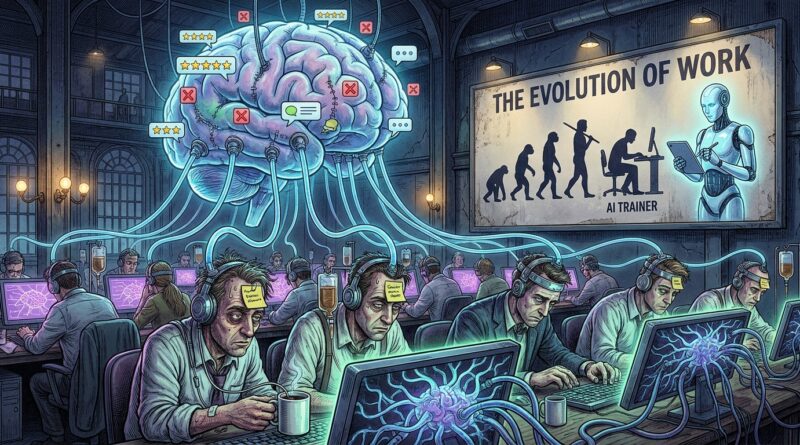
Homo Self‑Obsoletus: When Humans Evolved To Train The AI That Replaces Them
You sit down at night to rate chatbot replies, clean up labels, score outputs, or fix the machine’s weird little mistakes. It pays something. Maybe not enough, but something. And after a while a nasty thought starts tapping you on the shoulder. Am I teaching this thing to do my job for less money than it takes me to survive? That feeling is not paranoia. It is the emotional core of a lot of hidden AI work right now. You are not crazy for feeling used. You are being asked to act as both expert and disposable labor, both teacher and future redundancy plan. That is a grim setup. It deserves plain language, not corporate pep talks. So let’s call this what it is. A strange stage of evolution where humans are being selected less for creativity and more for how neatly we can help software absorb us.
⚡ In a Hurry? Key Takeaways
- This is the joke and the warning. Many people are quietly training AI systems to copy the very work they rely on for income.
- If you are doing this kind of work, start keeping records of your skills, set limits on what knowledge you hand over, and use the job to build an exit ramp.
- The real value here is seeing the pattern clearly. Once you have words for it, you can make better choices instead of sleepwalking into replacement.
The new species joke is funny because it hurts
The search term here is satire about humans training ai to replace themselves, but the sting lands because it is barely satire. A lot of modern AI depends on humans doing careful, repetitive, highly skilled correction work in the background. Somebody has to say, “No, that answer is wrong.” Somebody has to tag the edge cases. Somebody has to rewrite robotic text so it sounds like a person with a pulse.
That somebody is often a contractor, a temp, a freelancer, or a specialist who is told this is just part of innovation. Translation. Please donate your judgment so the product can one day need less of you.
That is why “Homo Self-Obsoletus” lands. It names the role. A human creature selected to transfer know-how into a system designed to reduce the market value of that same know-how.
What is actually happening behind the curtain
When people hear “AI boom,” they often picture chat apps, image generators, and flashy product demos. The less glamorous truth is that a huge amount of effort goes into human tutoring work. This can include:
- Ranking which answer is better
- Flagging harmful or low-quality outputs
- Writing sample responses in a preferred tone
- Labeling images, audio, or text
- Correcting domain-specific errors in law, medicine, coding, finance, and support
This is not side noise. This is the fuel. The machine appears smooth up front because a lot of invisible people are sanding it down in the back room.
The power imbalance is the whole plot
The weirdness is not only that you are training a model. It is that the company gets a scalable asset while you get hourly pay, weak protection, and no real ownership. Your expertise is turned into system behavior. Their valuation goes up. Your bargaining power may go down.
That is a hard feeling to shake because it is structurally real.
Why so few outlets say the quiet part out loud
Because the quiet part sounds ugly. “We are using skilled humans to help automate skilled human work” is not a great slogan for a keynote. So you get softer language. Augmentation. Efficiency. Assistance. Productivity.
Sometimes those words are fair. AI can help people. But they can also hide the labor politics. If you are the person doing the tutoring, the experience can feel less like empowerment and more like being asked to dig your own replacement trench with excellent attitude.
This is also why pieces like Homo Filter‑Fugitive: When Humans Evolved To Escape AI Surveillance By Curating Fake Selves hit a nerve. Once your behavior becomes training data, “just be yourself” starts sounding like a trap with nice branding.
How to tell if you are in the self-obsoleting zone
Not every AI-related job is a doom spiral. But a few signs should make you stop and think.
1. Your judgment is the product
If the core of your task is not making a final thing for a customer, but teaching a system what good looks like, that matters. You may be transferring the scarce part of your work into a reusable model.
2. The pay is transactional, the value extraction is permanent
If you are paid once for insights that can be used at scale forever, there is an imbalance. That does not mean never take the job. It means understand the trade.
3. You are kept far from strategy
If you are good enough to train the model but not included in decisions about where it is going, you are probably labor, not partner.
4. The company describes your work as “simple” while relying on your expertise
This one is classic. If it were truly simple, the system would not need you to clean up after it.
What to do if this is your job right now
You may not be in a position to walk away. Fair enough. Rent is real. So the useful question is not “Should I panic?” It is “How do I stop being passive in this arrangement?”
Build an exit ramp, not just a paycheck
Use the work to learn how the systems fail, where humans still matter, and what companies cannot easily automate. That knowledge is portable. A lot of people in these roles develop sharp instincts for quality control, prompt design, workflow weak points, safety review, domain auditing, and model evaluation. Those are more defensible than being “person who clicks labels fast.”
Keep a private skills log
Write down what you actually do. Not the vague job title. The real tasks. Examples:
- Evaluated output accuracy in specialized subjects
- Created high-quality examples to shape model tone
- Identified recurring failure patterns in automated responses
- Improved consistency, safety, and factual quality
This helps you later when you need to explain your value to a human employer who does not understand this weird slice of the economy yet.
Do not confuse access with security
Just because you are close to AI systems does not mean you are safe from them. Plenty of people assume being “in the room” protects them. Sometimes it does. Sometimes it just means you get a better seat while your role is being squeezed.
Set mental boundaries
You are allowed to say, “This work pays me, but it does not define me.” That sounds soft, but it matters. If every task feels like a referendum on your future, you will burn out fast. Keep a piece of yourself off the assembly line.
The satire helps because it restores perspective
One reason this kind of writing matters is that satire can say the thing polite industry language avoids. “Selectable biomass for the next algorithm” is crude, yes. It is also clarifying. It reminds you that labor markets are not natural weather. They are shaped by incentives, ownership, and what workers are willing to normalize.
Naming the absurdity does not solve it. But it does break the spell.
Once you can laugh at “Homo Self-Obsoletus,” you can also ask sharper questions. Who benefits? Who scales? Who becomes interchangeable? Who gets to call this progress?
At a Glance: Comparison
| Feature/Aspect | Details | Verdict |
|---|---|---|
| Short-term benefit | AI tutoring work can pay now, offer flexibility, and give you firsthand knowledge of how models are trained and corrected. | Useful, but treat it as a stepping stone, not a shelter. |
| Long-term risk | Your expertise may be absorbed into systems that reduce demand for the same kind of human labor later. | Very real. Go in with eyes open. |
| Best personal strategy | Document skills, learn system weaknesses, move toward oversight, auditing, strategy, or high-trust human work. | Best chance of staying valuable as the market shifts. |
Conclusion
The hottest frontier in AI is not always the shiny app on your phone. A lot of it is hidden human tutoring labor, where specialists quietly teach models to mimic their own jobs. That irony is not small. It is emotionally raw, economically important, and weirdly under-discussed. If you do not understand the evolutionary game you are in, you really can end up as selectable biomass for the next algorithm. The good news is that seeing the joke helps. Satire gives you a handle. It lets you vent, think, and spot the bargain before it hardens into normal life. If you are in this world now, do not waste energy pretending it is noble or harmless. See it clearly. Take the money if you need to. Learn everything you can. Then redraw your boundaries before somebody else draws them for you.