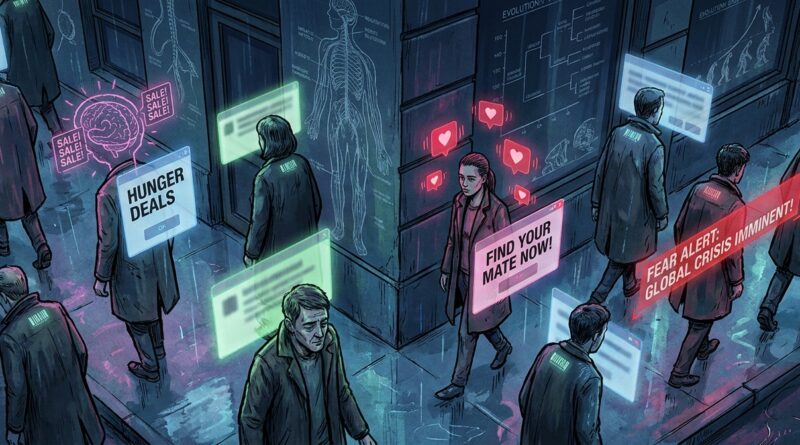
Homo Ad-Targeted: When Humans Evolved Into Walking Pop‑Up Windows
You look up one hiking boot, and by dinner your phone has decided you are an outdoorsman, a survivalist, and possibly a man going through something. That feeling is real. It is creepy, yes, but it is also tiring. Modern ad systems do not just watch what you click. They keep sorting you into little boxes, then selling access to those boxes in milliseconds. Bit by bit, a whole person gets flattened into “likely buyer,” “anxious parent,” “late-night snacker,” or “person vulnerable to skin care promises.” This is where the joke writes itself. We have not evolved into wiser digital citizens. We have evolved into walking pop-up windows. A good satire on targeted ads and human evolution helps because it gives a ridiculous shape to a very real problem. Once you can laugh at the absurdity, you can also spot it faster, name it out loud, and push back without feeling paranoid.
⚡ In a Hurry? Key Takeaways
- Targeted ads work by reducing you to a live bundle of guesses, then selling those guesses constantly.
- You can cut the noise by changing ad settings, limiting tracking, using private browsers, and pausing before “personalized” suggestions.
- The biggest risk is not just privacy loss. It is letting feeds quietly shape what feels normal, urgent, desirable, or true.
Meet Homo Ad-Targeted
Picture the new digital subspecies.
Homo Ad-Targeted wakes up, checks the phone, and is immediately greeted by an ad for a mattress, a protein powder, and a language app. Why? Because yesterday they searched “back pain,” watched one gym clip, and liked a post about moving abroad.
To the ad machine, this is not a messy human life. It is a pattern. A category. A profit opportunity.
That is the dark joke. You are not browsing the internet. The internet is browsing you.
The evolutionary leap nobody asked for
Old advertising used to shout at crowds. Buy soap. Drink soda. Visit dealership.
Now it whispers to individuals. It knows when you are bored, when you linger, when you hesitate, when you are likely to buy, and sometimes when you are feeling low. It does not need to know your soul. It just needs enough signals to predict your next weak moment.
That is why the whole thing feels intimate and cheap at the same time.
Why It Feels So Gross
The obvious answer is surveillance. Nobody likes feeling watched.
But there is another part. Exhaustion.
When every app keeps translating your behavior into “interests,” you start to feel less like a person and more like a menu. Your style becomes a segment. Your fears become a market. Your curiosity becomes inventory.
And because this happens all day, below the level of conscious thought, it wears you down. Not with one huge violation, but with a thousand tiny nudges.
You are not being understood, you are being approximated
This matters. The system is not actually smart in a human way. It is not reading your heart. It is making rough guesses based on patterns from millions of other people.
That is why the ads can feel both creepy and stupid.
You search for a wedding gift. It decides you are getting married.
You watch one video about debt. It decides you are financially desperate.
You joke about moving to a cabin. It starts selling you apocalypse gear.
The machine is always overconfident. That is part of the comedy, and part of the danger.
The Real-Time Auction for Your Attention
Most people know ads follow them around. Fewer people know how fast and routine the process is.
Every time you load a page or app, networks can trade information about you in real time. Not your full life story, usually. But enough signals to say, “Here is someone likely to click on luxury skincare,” or “Here is someone worried about home security,” or “Here is someone in the market for political panic.”
Then bidders compete for the chance to get in your face.
That is the part that should make everyone pause. Your attention is not just being requested. It is being auctioned.
And the product is often your mood
Advertisers do not only care what you like. They care when you are persuadable.
Late at night. During stress. After a breakup. During a health scare. While doomscrolling. After looking up baby names. During a rent panic.
These are not abstract categories. They are emotional conditions.
So yes, the whole system deserves satire. It is absurd that so much computing power has been devoted to figuring out the exact second you are most likely to buy an air fryer or believe nonsense.
A Field Guide to the Ad-Targeted Human
Sometimes the best way to explain a broken system is to describe its creatures.
Type 1: The Recently Mentioned Consumer
This specimen says one brand name near a phone and becomes convinced the phone is listening.
Sometimes it is coincidence. Sometimes it is data sharing, cross-device tracking, or brutal prediction. Either way, the result feels haunted.
Type 2: The Algorithmic Midlife Crisis
One search for “best running shoes for beginners” and suddenly every platform thinks this person is rebranding into a disciplined wellness monarch.
Ads arrive for supplements, smartwatches, posture correctors, and expensive water bottles. The machine saw a momentary impulse and built a whole identity around it.
Type 3: The Fear-Based Subscriber
This one gets trapped in a loop of alarm. Home invasion videos lead to camera ads. Skin concerns lead to miracle creams. Parenting worries lead to endless products designed to solve problems the parent did not know they had five minutes ago.
Fear sells. It always has. Tech just made it more precise.
Type 4: The Infinite Maybe-Buyer
This person looked at a chair once. Now the chair follows them across the web like a Victorian ghost demanding closure.
No, they do not want the chair. They never wanted the chair. But the system has confused hesitation with destiny.
Why Satire Actually Helps
People often think satire is just decoration. A fun way to complain.
It is more useful than that.
When you give something a ridiculous name, you make it visible. “Walking pop-up window” is easier to remember than “persistent behavioral ad segmentation under surveillance capitalism.” One is a phrase people repeat to friends. The other is a graduate seminar.
That shared language matters. It lets people say, “Oh, that weird thing is happening to me too.” It turns private discomfort into a social fact.
That is also why pieces like Homo Meme‑Golem: When Humans Evolved To Let AI Protest On Their Behalf land so well. The joke gives people enough distance to see the machinery clearly. Once you see it, you can stop treating it like weather.
Digital Self-Defense, Without the Tinfoil Hat
You do not need to disappear into the woods to push back. Small steps help.
1. Cut ad personalization where you can
Check Google, Meta, Amazon, TikTok, and your phone settings. Turn off ad personalization, clear inferred interests, and remove categories that are wildly wrong or too personal.
Will this stop all tracking? No. Will it reduce some of the more invasive tailoring? Yes.
2. Use browsers and extensions that block trackers
Firefox with privacy settings turned up is a good start. Brave is another option. Tracker blockers can reduce the amount of background data sharing that fuels ad profiling.
You do not have to become a privacy monk. Just stop handing out free samples of yourself.
3. Be suspicious of “recommended for you”
Sometimes a suggestion is helpful. Often it is an attempt to steer your mood or spending.
When something feels uncannily well-timed, pause. Ask, “Did I want this, or was I softened up for it?”
4. Do not confuse repetition with truth
If a product, fear, or opinion keeps showing up, that does not mean it is important. It may simply mean it is profitable.
This is especially important with health claims, finance tips, and political content.
5. Talk about it with other people
This sounds small, but it is powerful. Once people compare notes, patterns become obvious. “Why am I suddenly seeing all these panic ads?” becomes “Oh, they are running the same play on all of us.”
That shift matters. Shame thrives in silence. Manipulation hates witnesses.
The Bigger Issue Is Not Ads, It Is Identity
The most unsettling part of targeted advertising is not the coupon. It is the constant rehearsal of who the system thinks you are.
You are shown versions of yourself all day.
The anxious homeowner.
The aging face.
The underperforming worker.
The desirous body.
The worried parent.
The angry citizen.
Even when the guess is wrong, the repetition can still shape how you see yourself. It pushes. It frames. It suggests what kind of person you might be, or what kind of insecurity you should rent for the afternoon.
That is why this is about more than annoyance. It is about who gets to narrate your life.
At a Glance: Comparison
| Feature/Aspect | Details | Verdict |
|---|---|---|
| Personalization | Ads are tailored from your searches, clicks, pauses, purchases, location, and inferred interests. | Convenient in tiny doses, manipulative at scale. |
| Accuracy | Systems make rough guesses that can be oddly specific one minute and wildly wrong the next. | Good enough to influence, not good enough to trust. |
| User Control | You can limit tracking, reset ad topics, use privacy tools, and build better habits around feeds. | Not perfect control, but enough to make a real dent. |
Conclusion
Feeds, recommendation engines, and hyper-personalized ads are already helping decide what people buy, fear, desire, and even believe. The trick is that much of it happens just below awareness, where it feels less like pressure and more like atmosphere. That is why a satire on targeted ads and human evolution is useful. It gives people a picture they can hold onto. Not “I am bad at self-control,” but “right, they are farming us again.” That change in language is not trivial. It makes digital self-defense feel normal instead of paranoid. It helps people spot manipulative patterns in real time. And maybe most important, it turns that lonely, drained feeling into a shared joke with teeth. Once people can name the game, they are a lot harder to play.