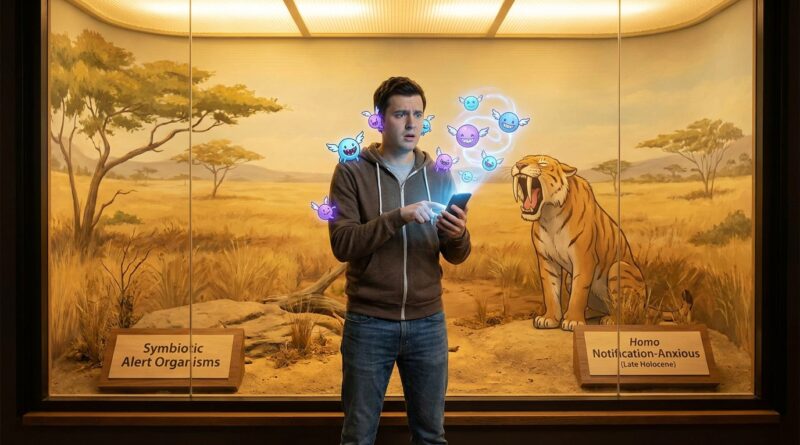
Homo Notification-Anxious: When Humans Evolved To Fear Missing A Vibe More Than Missing A Threat
You know the feeling. Your phone lights up on the table, your chest does a tiny clench, and suddenly the rest of your brain is gone. You were making dinner, helping your kid, answering an email, or just trying to exist like a normal mammal. Then came the red dot. The buzz. The lock screen preview that makes everything else feel less urgent than whatever is hiding behind it. That reaction is not you being weak. It is old wiring meeting very new bait. Humans used to stay alive by noticing rustles in the bushes. Now we notice badges, pings, vibration patterns, and little glowing rectangles. Your nervous system is not great at telling “possible social update” from “possible danger,” and tech companies know it. They keep feeding that confused little alarm system because an anxious thumb scrolls more than a calm one.
⚡ In a Hurry? Key Takeaways
- Your phone notifications act like fake threats, and your brain often reacts before your rational mind catches up.
- The fastest fix is not a full detox. Turn off non-human alerts, remove red badges, and batch-check messages on your schedule.
- If notifications make you feel jumpy, scattered, or oddly guilty, that is useful feedback, not a personal failure.
Your Brain Thinks the App Icon Might Be a Tiger
Not literally, of course. If your banking app were actually a tiger, customer service would be much more exciting.
But your body does not wait for a committee meeting before reacting. It sees novelty, uncertainty, and the possibility that something important is happening without you. That is enough to trigger attention.
This is the core joke inside the whole mess, and also the problem. We are running ancient survival software on hardware surrounded by badges, banners, pings, and “just checking in” alerts that are very much not trying to help us relax.
That is why a satire on smartphone notifications human evolution lands so well. It feels silly because it is silly. It also feels uncomfortably true because your body really does treat interruption like a possible threat.
How We Got Here
For most of human history, ignoring the wrong signal could go badly. A sound in the dark might be wind. It might also be teeth. A flicker at the edge of your vision might be nothing. It might also be the end of your afternoon.
So evolution did what evolution does. It built a system that is biased toward noticing things fast, especially uncertain things. Better to overreact a little than underreact once.
Now move that same system into modern life. Replace rustling grass with lock screen previews. Replace actual danger with “Taylor liked your story” or “Flash sale ends in two hours.” The mechanism still fires.
Your body says, “Check this now.”
Your higher brain says, “This is a coupon for socks.”
Your thumb has already opened the app.
The Red Dot Is Not Neutral
Notifications are often framed as convenience. And sometimes they are. A two-factor login code, a school closure alert, a message from family, those are useful. Nobody is arguing that every alert is evil.
The problem is volume, design, and intent.
Many alerts are built to feel unresolved. They create a small cognitive itch. A red badge says something is incomplete. A vague subject line says there might be a problem. A vibration says stop what you are doing and orient toward this object immediately.
That is not an accident. It is product design meeting your nervous system in a dark alley.
If this sounds familiar, you might enjoy Homo Push‑Notification: When Humans Evolved Into Pavlov’s Favorite Gadget, which makes the same point with the correct level of mockery.
Why Missing a Vibe Feels Worse Than Missing a Threat
Here is the weird modern twist. Most of us are not checking because we think danger is coming. We are checking because we think relevance is happening somewhere else.
That matters.
We are social animals. Being left out of useful information, changing plans, social cues, gossip, work updates, and group chat nonsense can feel bigger than it objectively is. Missing a vibe sounds trivial until you remember that human brains are extremely sensitive to belonging, status, and uncertainty.
So the lock screen becomes a tiny slot machine for social reassurance.
Maybe it is important. Maybe it is affectionate. Maybe it is flattering. Maybe it is bad news. Maybe it is nothing. The uncertainty keeps you hooked.
The Cost Is Not Just Time
People often talk about notifications as a productivity problem. They are that. But they are also an emotional regulation problem.
They fracture attention
Even a quick glance is not always quick. Your brain has to leave one task, orient to another, then stumble back and pretend nothing happened.
They raise baseline stress
If your day is full of little alarms, your body lives in a mild state of “what now.” That gets tiring fast.
They train compulsive checking
Eventually the phone does not even need to buzz. You start checking preemptively, like a sentry guarding a gate no one asked you to guard.
They steal boredom
This sounds minor until you notice that boredom is where reflection, creativity, and the occasional original thought tend to show up.
Run a Controlled Reset, Not a Monastic Retreat
You do not need to throw your phone into a lake. A lot of people avoid changing notification settings because the choice feels too extreme. Total digital detox or total surrender. Those are not the only options.
Think like a scientist. You are running an experiment on one nervous system. Yours.
Step 1: Turn off non-human notifications
Keep alerts from actual people you care about or truly critical services. Turn off promotional alerts, engagement bait, shopping prompts, news blasts, game nags, and “we miss you” nonsense.
Step 2: Kill red badges where possible
Badges are tiny unpaid interns whose only job is to whisper, “Something is unfinished.” Fire them.
Step 3: Move noisy apps off the home screen
If an app makes money by pulling your attention back, do not give it front-row seating.
Step 4: Batch your checking
Check messages and social apps at specific times. Not because schedules are glamorous, but because randomness is what hooks you.
Step 5: Use custom exceptions
Let important people break through. Everyone else can wait twenty minutes. Civilization will hold.
Step 6: Notice the phantom urge
When you reach for your phone and nothing happened, do not scold yourself. Just note it. “Ah. The internal predator scanner is still on patrol.” That little bit of humor helps.
What to Change on Your Phone Right Now
If you want the simple version, here it is.
- Disable push notifications for shopping, games, social media, and news.
- Turn off badge icons for the worst offenders.
- Set messaging apps to allow alerts only from favorites if your life allows it.
- Use Do Not Disturb during meals, work blocks, and sleep.
- Switch from previews on the lock screen to “notification received” if previews pull you in.
- Charge your phone outside the bedroom if nighttime checking is your weakness.
These are boring fixes. That is why they work. The most powerful tech habits are usually not dramatic. They are mechanical.
If You Work Online, This Gets Trickier
Some people genuinely need fast alerts. If your job depends on customer response, team chat, or on-call systems, you cannot just vanish.
Fine. Separate signal from sludge.
Use different sounds for different classes of alerts. Let urgent work tools break through, but mute reactions, likes, follower updates, and all the decorative nonsense that dresses itself up as urgency. Your goal is not silence. Your goal is credibility. If every app screams, none of them deserve trust.
This Is the Dumb Tech Problem Hiding Behind the Big Scary Ones
Right now, tech conversation is crowded with giant ideas. Superintelligence. Existential risk. Machines replacing everything. Those are dramatic and worth debating.
But for most people, the daily problem is much smaller and much sneakier. It is not a godlike system deciding the fate of humanity. It is thirty-seven tiny interruptions a day training your brain to live in a state of twitchy partial attention.
That is not science fiction. That is Tuesday.
At a Glance: Comparison
| Feature/Aspect | Details | Verdict |
|---|---|---|
| Threat response | Your brain reacts quickly to uncertainty, novelty, and possible social consequences, even when the trigger is just a phone alert. | Very real effect, even if the “threat” is fake |
| Notification design | Badges, vibrations, previews, and vague wording are built to interrupt and pull attention back. | Useful in small doses, manipulative in bulk |
| Best fix | Turn off non-essential alerts, remove badges, and check apps on purpose instead of on reflex. | Most people can feel a difference within a day or two |
Conclusion
The good news is that this problem is both absurd and fixable. You are not failing some moral test because your brain keeps reacting to pings and red dots. You are watching old human wiring get poked by systems designed to keep poking. Once you see notifications as a tiny invasive predator, the whole thing becomes easier to laugh at and easier to change. And that matters. While everyone argues about world-ending future tech, most people are being slowly retrained by something much dumber and much closer. Endless alerts are hijacking an ancient threat-detection loop. The win is not swearing off phones forever. The win is a controlled reset that gives you back a little agency, a little calm, and maybe enough empty mental space to remember what you were doing before your lock screen decided it was the main character.