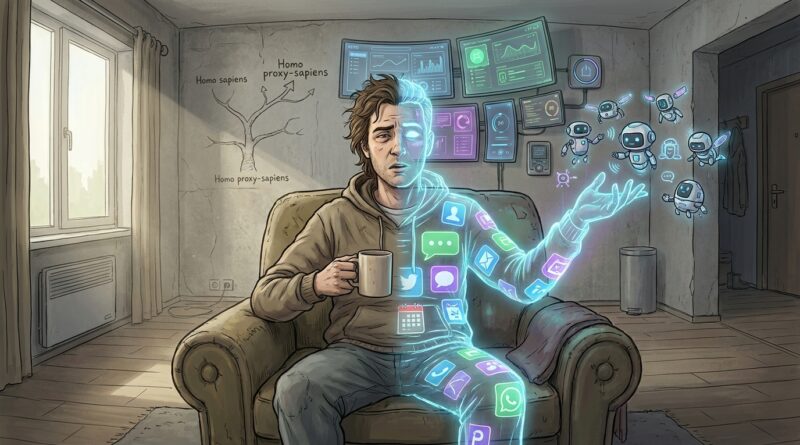
Homo Proxy‑Sapiens: When Humans Evolved To Outsource Real Life To Digital Stand‑Ins
You know that slightly creepy moment when your phone reminds you about dinner plans before the person you are having dinner with does. Or when your streaming app seems more aware of your mood than your partner. Or when your out-of-office reply, grocery subscription, smart thermostat, and meeting scheduler have already made half your daily choices before you have even found your socks. That feeling is real, and yes, it is a little annoying. We keep hearing dramatic talk about machines replacing people, but the stranger story is that many of us have already started outsourcing the boring, messy, human parts of life to apps and silent little systems. The biological you still exists, of course. You eat lunch. You answer texts three hours late. But more and more, your digital stand-ins are handling the first draft of your existence, and you are mostly there to approve the transaction after the fact.
⚡ In a Hurry? Key Takeaways
- We are not just worried about AI replacing jobs. We are already letting apps and scripts replace small pieces of daily judgment.
- Do a quick “proxy audit” of your week. List what decisions your calendar, feeds, subscriptions, and auto-tools are making for you.
- Automation is useful, but if you never review it, convenience can quietly turn into drift, wasted time, and less control over your own life.
Welcome to the age of Homo Proxy-Sapiens
This is the satire on humans outsourcing life to AI and apps, but only because satire is sometimes the politest way to describe something awkwardly true.
We used to think of technology as a tool. A calculator. A map. A search box. Something you picked up, used, and put down. Now a lot of technology behaves more like a junior life manager who started as an intern and somehow ended up with access to your schedule, shopping habits, attention span, social life, and preferred pasta shape.
Your calendar decides when you are free. Your map decides which streets are worth existing. Your feed decides what matters today. Your recommendation tab decides what you are “into now.” Your inbox filter decides which human beings count as urgent.
That is not science fiction. That is Tuesday.
The quiet replacement story nobody talks about enough
The loud version of the AI debate is easy to sell. Robots take jobs. Chatbots write emails. Algorithms beat humans at this or that. It is dramatic, so it gets attention.
The quiet version is more personal. We are replacing ourselves in tiny installments.
Not all at once. Not with killer androids. With defaults.
It starts with harmless convenience
You let an app auto-sort your photos. Fine. Then auto-suggest replies to your messages. Also fine. Then it starts telling you when to leave, what to watch, what to buy again, which article to read next, which friend to text back, and whether you are sleeping “well enough” according to a graph.
Each step feels small. None of them seem dangerous. But stack them together and something odd happens. Your life begins to look less like a set of choices and more like a subscription box assembled by software.
The human is still present, technically
You are still the account holder. You are still legally responsible. You are still, in theory, the one in charge.
But functionally, a growing number of your decisions are pre-chewed by systems that were built to reduce friction, keep you engaged, and move you along. The result is a weird split-screen existence. One version of you lives in the body. The other lives in settings menus, auto-renewals, recommendation engines, and half-read notifications.
How your digital stand-ins started running the week
If you want to spot where your agency has leaked, look at the places where software now acts before you do.
Your calendar became your social memory
Once upon a time, your friendships lived in actual conversation. Now they often live in calendar invites, reminder pings, and “circling back” messages. The app knows you have brunch on Saturday. Your friend vaguely remembers there was “something this weekend.”
If the event disappears from the calendar, does it still exist emotionally. Tough question.
Your feed became your sense of reality
The feed does not just show you what happened. It quietly teaches you what counts as happening. If your feed is all layoffs, your week feels like a recession. If it is all fitness content, your week feels like a failed wellness retreat. If it is all gadget launches, your week feels like you are somehow behind on owning a titanium rectangle.
Feeds are not neutral windows. They are stage managers.
Your recommendations became your taste
There was a time when taste involved wandering around, hearing a friend rave about a movie, stumbling into a weird album, or taking a chance on a book because the cover looked unhinged.
Now your recommendations say, “Based on your history, you are the sort of person who would like this.” After a while, many people stop asking what they actually want and start asking what the machine thinks people like them usually want.
That is not discovery. That is identity by autocomplete.
Your auto-replies became your personality
“Sounds good.” “On it.” “Thanks so much.”
Millions of people now communicate through approved snippets that save time and drain every sentence of blood. It is efficient. It is also a little bleak. Somewhere along the line, many of us hired software to impersonate our politeness.
The evolutionary joke is funny because it stings
Imagine future archaeologists digging through the ruins of modern life.
They find a species that built tools to save time, then used the saved time to manage the tools. They conclude that Homo sapiens slowly evolved into Homo Proxy-Sapiens, a creature that survived by creating digital stand-ins to handle errands, memory, attention, taste, and low-stakes emotional labor.
The species did not go extinct. It simply forwarded itself.
If that sounds like it belongs next to something like Homo Neo-Lawless: When Future Humans Evolved Past Morality But Still Needed Terms of Service, that is because modern life keeps producing these absurd little evolutionary side quests.
How to tell if you have outsourced too much of your life
You do not need to move to a cabin or start churning your own butter. You just need to notice the difference between useful help and quiet surrender.
Red flag 1: You follow systems you no longer remember setting up
Maybe you have recurring deliveries arriving because some version of you, nine months ago, thought monthly lentils made sense. Maybe filters route messages into folders you never check. Maybe your smart home runs a routine that surprises you every night at 10:30.
If your tools are operating on old instructions, you are living under the rule of Past You and a few scripts.
Red flag 2: You confuse prompts with priorities
If you only call people when reminded, only read what is surfaced, and only tackle tasks when an app nags you, then your attention is no longer steering. It is being steered.
Prompts are helpful. But a prompted life can become a rented life.
Red flag 3: Your convenience stack makes you passive
The point of automation should be to free up energy for more meaningful choices. If instead it makes you less curious, less intentional, and less likely to make plans without software assistance, then the savings are not really savings.
Do a simple proxy audit
This sounds nerdy, but it works.
Step 1: List your invisible assistants
Write down everything that acts on your behalf. Calendar suggestions. Smart home routines. Auto-payments. Shopping subscriptions. Password managers. Email rules. Recommendation feeds. Auto-replies. GPS. News alerts. Fitness nudges.
You are not judging them yet. Just naming them.
Step 2: Ask what decision each one is making
Not what task it performs. What decision it shapes.
Your map app does not just guide you. It decides what counts as the best route. Your feed does not just entertain you. It decides what enters your mental world. Your subscription does not just save time. It decides what keeps showing up at your door.
Step 3: Mark each one as helpful, harmless, or hijacking
Helpful means it saves effort without changing your values. Harmless means it does not matter much. Hijacking means it is making choices you would rather make yourself, or nudging you in ways you do not like.
Most people find a few surprises here.
Step 4: Take back one thing this week
Not ten things. One.
Pick a category where you want your own brain back. Maybe choose what to watch without recommendations. Maybe turn off a few notifications. Maybe plan one outing without checking reviews, rankings, traffic estimates, and five weather models.
Give yourself a tiny pocket of unautomated life.
What to keep outsourcing, and what to keep human
Not all outsourcing is bad. Some of it is excellent. Nobody wins a medal for manually paying the electric bill if auto-pay prevents late fees. Let the machine do machine work.
Good things to outsource
Repetitive admin. Password storage. Fraud alerts. Backups. Basic reminders. Boring maintenance. Things that reduce risk and free up attention.
Things worth keeping human
Your values. Your close relationships. Your taste. Your attention. Your priorities. Your sense of enough.
If an app can help with those, great. If it starts replacing those, maybe tap the brakes.
Why this matters more than the robot takeover headlines
The real issue is not whether a machine can do a human task. It is whether humans slowly stop practicing the parts of life that make them feel present, connected, and accountable.
That is the sneaky cost.
When we automate too much without thinking, we do not become superhuman. We become oddly absent from our own routines. We show up after the systems have already made the weather report of our day.
At a Glance: Comparison
| Feature/Aspect | Details | Verdict |
|---|---|---|
| Convenience | Apps save time on reminders, payments, routing, and routine tasks. | Great when it cuts busywork, not when it replaces thought. |
| Personal agency | Feeds, recommendations, and defaults can slowly shape what you notice, want, and choose. | Needs regular check-ins, or you drift into autopilot. |
| Best practice | Use automation for repetitive chores, then protect a few areas where you decide things yourself. | Balanced use wins. Neither total surrender nor total rejection helps much. |
Conclusion
The loudest conversation about AI is still whether it will replace humans, which is handy because it distracts from the quieter truth that many of us have already started replacing ourselves with barely supervised scripts. That is why this little evolutionary joke lands. Homo Proxy-Sapiens is funny, but it is also a pretty decent mirror. If your calendar, feed, and recommendation tabs know more about your week than your friends do, that is not proof you are lazy or broken. It just means convenience has been doing what convenience does. It expands until somebody notices. So notice. Map where your agency has leaked. Keep the automations that handle the drudgery, and reclaim the parts that make life feel like yours. You do not need to win a war against apps. You just need to stop letting your proxies live your week before you do.