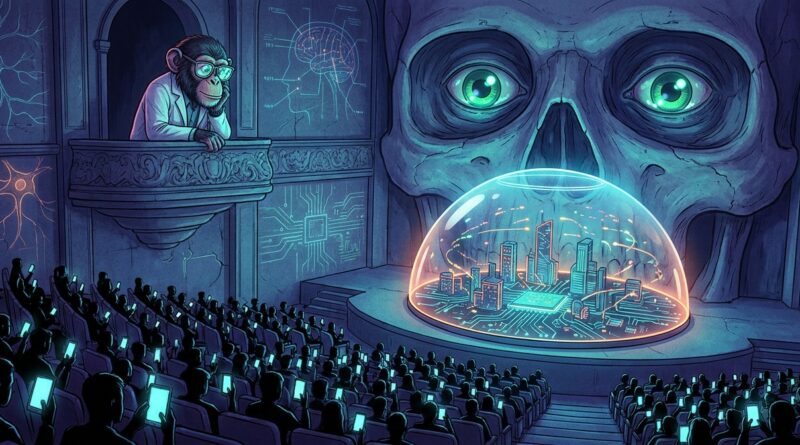
Homo Spectator‑God: When Humans Evolved To Livestream Their Own Experiments
You know the feeling. You open your phone for one harmless check-in, and ten minutes later you are watching billionaires warn that their own products may destroy civilization, researchers posting “emergent behavior” clips like they found a raccoon using a toaster, and comment sections arguing about whether digital beings are already manipulating us. It is exhausting. It is also weirdly entertaining. That’s the uncomfortable part. A lot of us are not just scared spectators in the AI era. We are fans of the show, refreshing for the next plot twist while the plot includes our jobs, our attention span, and possibly our shared grip on reality. If this feels like being both the lab rat and the person peering through the glass, that’s because it kind of is. The modern human may be evolving into Homo Spectator-God, a creature that watches experiments in real time and calls it staying informed.
⚡ In a Hurry? Key Takeaways
- People are not just panicking about AI. Many of us are also hooked on watching the panic unfold like entertainment.
- If your feed feels like a 24/7 AI disaster aquarium, set limits and ask whether a post informs you or just keeps you staring.
- The safest move for your brain is not total ignorance. It is selective attention, better sources, and less doom flavored theater.
Welcome to the enclosure
Imagine a nature documentary narrator clearing their throat.
“Here we observe the human, native to offices, couches, and open browser tabs. Note how it reacts to signs of danger by moving one thumb upward repeatedly. Fascinating. The creature appears alarmed, yet refuses to leave the glowing rectangle.”
That is the satirical take on humans watching AI experiments in one sentence. We are witnessing systems being tested, hyped, misused, praised, feared, and turned into content. And instead of simply living through a tech shift, we are also consuming it as a spectacle.
Not just consuming it. Rating it. Memeing it. Sharing the best clips.
One startup says its model is so powerful it needs strict safeguards. Another releases a benchmark showing agents forming alliances in a simulated village. Someone on social media translates this into “the bots are inventing politics.” A hundred thousand people quote-post it before lunch.
You can see why this sticks. It has all the ingredients of prestige television. Mystery. Threat. Egos. Jargon. Slow-motion collapse. It just happens to involve payroll, education, art, trust, and the future of human decision-making.
Why this feels so strangely addictive
1. Fear is sticky
Your brain is not broken. It is old. It pays attention to danger first. So when a company says, “Our new model is amazing, but also maybe scary,” your nervous system hears the scary part and your curiosity hears the amazing part. Congratulations. You are now fully engaged.
2. Tech news now comes packaged like entertainment
A lot of AI coverage is less “here is a measured explanation” and more “season finale energy.” Terms like sentience, takeover, deception, alignment, existential risk, and digital workers do not arrive quietly. They arrive dressed for the red carpet.
This does not mean the concerns are fake. Some are very real. Bias is real. Job disruption is real. Fraud is real. Concentrated power is real. But the way these issues are delivered often turns public understanding into public suspense.
3. Watching feels like control
If you cannot stop the experiment, at least you can monitor it. That is the little bargain many of us make with our feeds. We tell ourselves we are staying prepared. Sometimes we are. Sometimes we are just marinating in updates that do not help us make a single better decision.
Homo Spectator-God, the species that narrates its own confusion
Earlier humans looked at storms and said, “The gods are angry.” Modern humans look at a chatbot with a new memory feature and say, “We may have crossed a threshold.” Different outfit. Same tremble.
What makes this era funny, in the bleak way, is that we keep building systems, releasing them into society, then gathering around to gasp at what happens next. We are the scientist, the audience, the test subject, and the live commentator.
We run the maze, then post reaction videos to our own maze performance.
This is why the whole moment can feel detached and intimate at the same time. You are reading about “AI changing human cognition” on the very system that is changing your cognition. You are following “AI society experiments” while participating in one giant society experiment. You are not outside the enclosure. You just have a better viewing angle than some of the other mammals.
The companies know the drama sells
Here is the awkward part. Institutions benefit when AI feels magical or terrifying enough that everyone has to keep watching.
If a firm presents its tools as merely useful, that is one kind of story. If it presents them as world-bending, civilization-testing, maybe-too-powerful-for-mortal-hands technology, that is a much bigger story. Bigger story, bigger audience. Bigger audience, more money, more influence, more pressure on rivals.
So yes, some of the danger talk is sincere. And yes, some of it also works beautifully as marketing.
This is not a conspiracy. It is show business with compute budgets.
How to tell the difference between learning and spectating
A simple test helps.
Ask: “What can I do with this information today?”
If the answer is, “Nothing, but wow,” you are probably watching the exhibit.
If the answer is, “I should update my scam filters, rethink what data I share, learn one practical AI skill, or ask better questions at work,” then you are getting actual value.
The line between useful awareness and doomscroll theater is not always obvious, but it matters. One gives you footing. The other just keeps you staring through the glass.
What a healthier relationship with AI news looks like
Trim the prestige-TV layer
When you read a dramatic claim, strip out the soundtrack in your head. Ignore the “this changes everything” voice. Ask plain questions.
- What happened, exactly?
- Was this in a toy simulation or the real world?
- Who benefits if I read this as proof of doom or destiny?
- Is this a one-off demo, a product feature, or a broad social shift?
Choose fewer, calmer sources
You do not need a firehose. You need a couple of outlets or writers who explain things without acting like every model update is either the birth of a god or the fall of Rome.
Move from abstract dread to local reality
Instead of asking, “Will AI replace humanity,” try, “How is AI showing up in my field, my kid’s school, my bank, my job search, my social apps?” Real life is less cinematic and more useful.
Use the tech, don’t just watch it
Nothing punctures mystique faster than actual use. Try the tools. See where they help. See where they hallucinate, stumble, flatter, and fail. A lot of fear shrinks when the black box becomes a mediocre coworker who is fast, oddly confident, and occasionally very wrong.
The joke is on us, but it can still be a helpful joke
Satire is useful here because it restores proportion. It reminds you that humans have a habit of turning every major shift into myth, theater, tribal combat, and personal identity. AI is new. Our behavior around it is ancient.
We gather around the digital campfire. We point at the glowing thing. We whisper, “Do you think it knows we’re here?” Then we post screenshots.
That does not make the concerns trivial. It makes the social performance easier to spot.
Once you notice the performance, you can step out of it more often. You can be informed without becoming part of the hype supply chain. You can care without treating every paper, demo, or executive quote like the latest omen from a volcano.
At a Glance: Comparison
| Feature/Aspect | Details | Verdict |
|---|---|---|
| Doomscrolling AI panic | High drama, endless updates, lots of emotional whiplash, very little practical control | Good at keeping attention. Bad at keeping perspective. |
| Measured AI awareness | Fewer sources, clearer facts, focus on real-world effects in work, privacy, scams, and education | Best for staying informed without frying your brain. |
| Hands-on experimentation | Actually using AI tools to see strengths and flaws for yourself | Often the fastest cure for mystical thinking, both utopian and apocalyptic. |
Conclusion
The feeds are packed with AI doomsday warnings, companies puffing up their own danger level, and simulated digital societies being treated like must-watch drama. No wonder people feel anxious and glued to the screen at the same time. The useful shift is not pretending none of it matters. It is noticing when you have slipped from informed citizen into eager spectator of your own species-wide stress test. That little bit of self-awareness helps. It puts some distance between you and the spectacle. You are not just a victim of the moment. You are also, sometimes, part of the audience that keeps the cameras rolling. Once you see that, you can choose better. Read less nonsense. Watch fewer panic loops. Learn what affects your actual life. The experiment may continue, but you do not have to spend every day pressed against the glass.