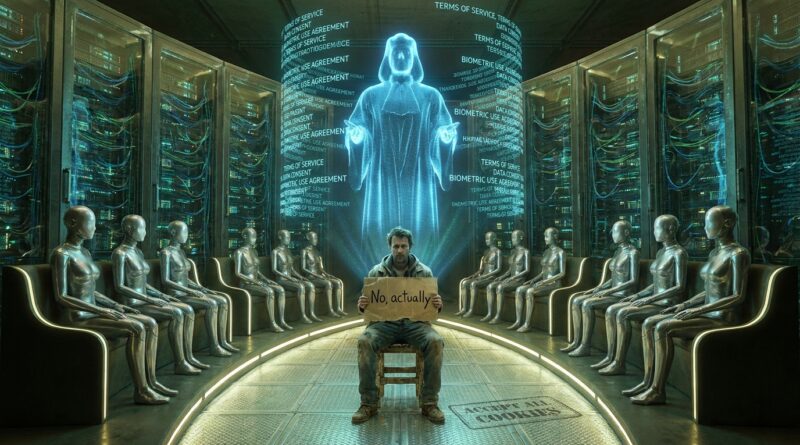
Homo Neo-Lawless: When Future Humans Evolved Past Morality But Still Needed Terms of Service
You know the joke. Future “neo humans” will be so efficient, so optimized, so hive-minded that laws will become pointless. No crime, no confusion, no messy ethics. Just smooth collective intelligence humming along like a software update that actually works. And yet here we are, still very much regular humans, clicking “I agree” on legal sludge written by corporate lawyers and now increasingly filtered through AI systems that decide what we can say, buy, appeal, access, and sometimes even think about. That disconnect is what bugs people. Not just the hypocrisy of it, but the feeling that the rules are moving away from human conversation and into machine-managed procedure. The satire lands because it names a real fear. We are not evolving past morality. We may be outsourcing it, one checkbox at a time.
⚡ In a Hurry? Key Takeaways
- We are not heading toward a law-free super-species. We are heading toward a world where software quietly writes and enforces more of our social rules.
- Start small. Ask what app, platform, or AI system is setting the rules in your workplace, school, family group, or community, and decide which boundaries should stay human.
- The real risk is not robot evil. It is passive consent, where people stop noticing that code, rankings, filters, and terms of service are shaping everyday life.
The joke works because it is not really a joke
A good satirical look at future humans laws and AI terms of service works because it pokes the exact sore spot. We already live in a strange half-future where “rules” no longer arrive only as laws passed by governments or norms agreed by neighbors. They arrive as content moderation settings, risk scores, recommendation engines, auto-bans, fraud detection flags, biometric check-ins, age gates, invisible filters, and yes, giant unread Terms of Service.
That is why the fantasy of “Homo Neo-Lawless” is funny. It imagines a species so advanced it no longer needs morality, while our actual world keeps adding tiny machine-made fences around basic life. You cannot post that. You cannot appeal this. Your account is under review. Your transaction looks unusual. Your face did not match. Please try again.
None of this feels like a grand philosophical shift. It feels like admin. Which somehow makes it creepier.
What changes when non-humans handle the rules?
Humans have always used tools to enforce norms. We made clocks, locks, forms, contracts, and bureaucracies. But AI changes the speed and scale. Now systems can interpret behavior, predict intent, and apply penalties before a person even knows a rule exists.
That matters because morality is usually messy on purpose. Humans argue. We forgive. We make exceptions. We read tone badly, then fix it. We ask what happened. Machines do not really do that. They simulate neatness. They turn social life into categories and thresholds.
From laws to layers
Most people think rules come in one obvious form. A law is passed. A boss gives an order. A parent says no. But modern digital life runs on layers.
There is the law. Then there is company policy. Then there is product design. Then there is algorithmic ranking. Then there is whether you can even find the button to complain. Each layer shapes behavior. Only one of them is likely to have had public debate.
So when people say “future humans won’t need laws,” they are missing the twist. You can remove visible law and still drown in hidden rule systems.
Terms of Service became everyday government
Terms of Service used to feel like the boring legal wrapper around a website. Now they act more like private constitutions. They define speech, commerce, identity checks, acceptable risk, ownership disputes, and what counts as suspicious behavior.
You did not vote on them. You probably did not read them. But they shape your life anyway.
That is not just annoying. It changes your relationship to power. You are no longer just a citizen or customer. You are a user navigating machine-readable obedience.
Why this feels so unsettling
People are not stupid. They sense when something important is happening but do not yet have the words for it. That is where satire helps. It gives a shape to the discomfort.
The discomfort is not only “AI might go wrong.” It is also “what if AI becomes the bland middle manager of civilization?” Not a killer robot. A workflow robot. A sorting robot. A permission robot. A little digital hall monitor with endless stamina and no instinct for mercy.
That is close to the feeling explored in Homo Align‑Us: When Humans Started Safety-Training Themselves For Their Own AIs, where people start adjusting their own behavior so the systems around them will not punish them. That is a bigger change than it sounds. Once people begin self-editing for software, software is no longer just a tool. It is part of the moral environment.
The “post-moral” fantasy is really a control fantasy
When people imagine a hyper-evolved future species with no need for laws, they are usually imagining one of two things.
First, perfect agreement. Everyone shares the same goals, reads the room perfectly, and acts for the common good.
Second, perfect optimization. Behavior is so tightly guided by systems, incentives, and feedback loops that conflict rarely appears in the first place.
The first version is utopian and very human. The second is where things get sticky.
If conflict disappears because software pre-sorts choices, nudges behavior, blocks edge cases, and auto-corrects deviance, you have not evolved past morality. You have built a padded behavioral tunnel. The species did not become wiser. It became managed.
How this shows up in normal life
This all sounds lofty until you notice how ordinary it is.
Work
Your productivity software tracks response times, classifies focus, summarizes meetings, flags risk, and suggests who is “engaged.” Soon enough, nobody has officially changed the office rules, but everybody knows what behavior the dashboard likes.
School
Students write for plagiarism detectors, not for readers. Teachers use behavior apps. Parents get alerts. A machine-generated pattern becomes a moral clue. That child is disengaged. That one is high risk. The categories start to feel like truth.
Healthcare and insurance
Predictive systems sort people by risk and compliance. It may be statistically useful. It may also quietly change who gets trust, patience, cost breaks, or second chances.
Online life
Your reach, reputation, visibility, and even basic access are controlled by systems nobody can clearly explain. It is social order by dashboard. And if you object, the answer is often the same. You agreed to the terms.
So what should regular humans do?
No, you are not going to read 47 pages of legal text every time an app updates. Nobody is. The answer is not heroic paperwork. It is social awareness and local habits.
1. Name the rule-maker
When a decision feels arbitrary, ask a plain question. Is this a human rule, a software rule, or a legal rule? That simple distinction clears a lot of fog.
If your post is hidden, your payment blocked, your child flagged, or your shift assigned oddly, find out what layer made that call.
2. Keep one human appeal path
Any community that uses automation should keep at least one real person in the loop. A teacher. A manager. A moderator. A librarian. Someone with permission to say, “The system says this, but context matters.”
That one step can stop a lot of nonsense.
3. Build micro-norms before the platform builds them for you
Families, friend groups, schools, clubs, and workplaces can set simple human-first norms. For example:
- We do not treat AI summaries as final truth.
- We ask before using monitoring tools.
- We explain automated decisions in plain English.
- We do not let unread policies stand in for actual consent.
- We make space for appeal, ambiguity, and correction.
These are small. They matter. This is how people keep some moral muscle tone while living inside digital systems.
4. Treat friction as a signal
If a tool makes everyone feel vaguely tense, self-conscious, or scared to make mistakes, do not brush that off. Friction is data too. It may mean the software is shaping behavior in ways nobody openly chose.
5. Stop calling every software choice “neutral”
Defaults are values wearing beige. Ranking is judgment with a spreadsheet. Auto-moderation is governance with customer support language.
Once you see that, the world gets less confusing.
At a Glance: Comparison
| Feature/Aspect | Details | Verdict |
|---|---|---|
| Visible laws | Publicly debated, at least in theory, with known institutions and formal appeal paths. | Imperfect, but easier to see and challenge. |
| Terms of Service and platform rules | Private rulebooks most people never read, enforced through access, visibility, and account control. | Convenient for companies, weak on meaningful consent. |
| AI-mediated enforcement | Fast, scalable, often opaque, and able to shape behavior before humans discuss what is fair. | Useful in narrow cases, risky when treated like moral authority. |
Conclusion
The point of this satirical look at future humans laws and AI terms of service is not to sneer at progress. It is to notice where progress gets weird. Tech talk keeps bouncing between doom and worship, while a stranger question sits in the corner waiting. What happens to a species when more of its social rules are written, enforced, and interpreted by non-humans? Once you ask that, a lot of daily irritation starts to make sense. The endless checkboxes. The silent rankings. The feeling that procedure is replacing judgment. The good news is that people are not powerless here. We can build small, sturdy human norms in the places we actually live. We can keep appeal paths open. We can ask who made the rule and who benefits from it. We can refuse to let code become our default moral language. That is not anti-tech. It is just a very old human skill. Staying in the loop.