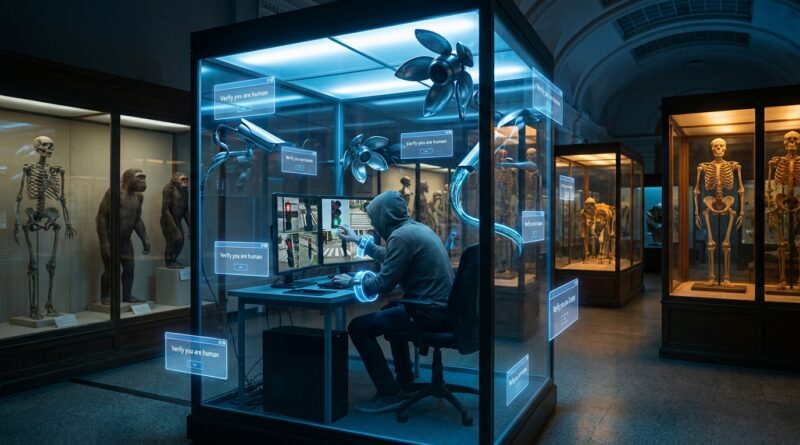
Homo Captcha‑Tamed: When Humans Evolved To Prove They’re Not Robots Every 5 Minutes
You used to open an account, type a password, and get on with your day. Now every small digital task feels like a border crossing. Click the traffic lights. Confirm the bicycle. Enter the code we texted you. Explain to a fraud filter why buying a gift card at 9:14 p.m. does not make you an international criminal. Then, for extra fun, post something online and get treated by an AI detector like a suspicious toaster with opinions. If this feels insulting, that is because it is a little insulting. The systems meant to create trust often start by distrusting you. That is the real mood behind this satire about humans proving they are not robots. It is not just about annoying CAPTCHAs. It is about what happens when daily life gets redesigned around constant verification, and regular people start feeling less like customers or citizens and more like lab rats pressing the correct button for pellets.
⚡ In a Hurry? Key Takeaways
- The joke is real. Modern tech increasingly treats normal human behavior as suspicious until proven otherwise.
- Start asking what a verification step actually protects, who benefits, and whether a less invasive option exists.
- Not every “trust and safety” feature is bad, but many quietly train you to accept more surveillance and less autonomy.
Welcome to the age of Homo Captcha-Tamed
There is a darkly funny way to describe modern digital life. We did not evolve into smarter, freer internet citizens. We evolved into Homo Captcha-Tamed. A species trained to identify blurry buses on command and wait calmly while apps decide whether our face, typing rhythm, location, and shopping habits seem human enough for entry.
It sounds absurd because it is absurd. But it is also useful language. Good satire names a feeling before a policy paper does. And the feeling here is simple. The more technology talks about safety, trust, and frictionless convenience, the more friction gets pushed onto you.
That is why this lands harder than a joke about annoying login screens. It gets at something bigger. Your attention is being taxed. Your autonomy is being negotiated away in tiny pieces. Your basic legitimacy is now a recurring subscription service.
How we got here
Some of this started for understandable reasons. Bots are real. Fraud is real. Account takeovers are real. Spam is real. If you run a website, bank, store, or social app, you do need ways to separate normal use from abuse.
The problem is what happened next. Instead of building systems that quietly absorb complexity in the background, many companies built systems that dump suspicion onto users. They made proof of humanity part of the customer journey.
And because no company wants to be blamed for letting one bad thing through, the incentives are obvious. Add one more check. Then one more. Then a behavior score. Then device fingerprinting. Then a risk engine. Then an AI model that decides whether your writing sounds “too artificial,” as if actual humans do not also write awkwardly, formally, or fast.
You can see the earlier version of this evolutionary joke in Homo Captcha‑Sapiens: When Humans Evolved To Prove They’re Not Bots For A Living. The newer twist is worse. We are not just proving ourselves at logins anymore. We are proving ourselves across banking, shopping, hiring, posting, dating, and learning.
Why this feels so exhausting
It steals tiny pieces of attention
One CAPTCHA is not a tragedy. One text code is not oppression. One “verify it’s really you” prompt is not the end of freedom. But stacked together, these checks create a constant low-grade drain. You are pulled out of your task and made to perform compliance.
That matters because attention is not infinite. Every pointless challenge chips away at your patience and focus. It also normalizes interruption as the price of participation.
It turns trust upside down
Healthy systems assume most people are acting in good faith and then deal with bad actors carefully. A lot of modern systems reverse that. They begin with suspicion and make everyone earn normal treatment.
That is a quiet cultural shift. If every transaction starts with “prove you are real,” then trust is no longer social. It becomes procedural. Cold. Automated. Revocable by a false positive.
It trains obedience
This is the creepiest part. You get used to it. You stop asking why your bank needs your location, why your shopping cart triggered a fraud review, or why a school tool is scoring your essay for “AI-like” phrasing. You just do the ritual.
Click. Confirm. Retry. Appeal. Upload ID. Smile at camera.
That is what taming looks like. Not chains. Habits.
When “trust and safety” becomes behavior management
Trust and safety can be real. Sometimes it protects people from scams, harassment, and account theft. But those words also make excellent packaging for systems that monitor, rank, and shape user behavior far beyond what is necessary.
A useful question is this. Is the tool reducing harm, or is it mainly making users more legible and controllable?
If a platform asks for verification to stop coordinated abuse, that may be reasonable. If the same platform quietly expands that data into ad targeting, risk scoring, or identity linking across services, now you are not being protected. You are being processed.
This is why so much public discussion feels unsatisfying. One side says any friction is tyranny. The other says if you are not doing anything wrong, just comply. Real life is messier. People want safety. They also want dignity. They want fraud prevention without being treated like a shoplifter by default.
The AI panic made it weirder
Once generative AI became the villain of the month, every gatekeeper found a fresh excuse to verify more aggressively. Schools started hunting for robot essays. Employers started screening for fake applicants. Platforms started tightening posting rules. Customer service got flooded with “suspicious activity” logic because machines were now talking like people.
And so regular humans got caught in the blast radius.
The irony is hard to miss. The people building systems that blur the line between human and machine are also building systems that punish users for being hard to classify. Write too smoothly, and you look fake. Move too quickly, and you look automated. Travel too often, and your card looks stolen. Buy too many socks, and who knows, maybe you are part of a sock cartel.
Satire helps here because it exposes how ridiculous this has become. It gives you language for the insult. Not just “this is annoying,” but “I am being treated like an untrusted background process in my own life.”
How to push back without becoming a full-time digital survivalist
Ask what problem the check is solving
Not every hoop is pointless. Some really do stop fraud or abuse. But you should get in the habit of asking, at least mentally, what this step is for. Is it account security? Regulatory compliance? Anti-spam? Or just data collection wearing a security costume?
Prefer services that offer fallback options
Good systems usually have backup paths. Security key support. Authenticator apps instead of SMS. Human review when automated flags get it wrong. Privacy settings that reduce tracking. Customer support that can fix false positives without sending you into a week-long appeal maze.
If a service has only one rigid path, and that path assumes the machine is always right, that is a warning sign.
Reward companies that respect your time
People often think they have no choice, but habits matter. Use products and services that do not flood you with pointless checks. Notice which apps make security feel calm and which make it feel accusatory. Over time, your attention is worth something.
Stop calling every new control “convenience” just because it is digital
This one is cultural. A face scan can be faster than a password and still feel invasive. A risk score can stop fraud and still be unfair. A verification layer can be useful and still be too much. Speed is not the same as respect.
Push for proportionality
The best pushback is not “no security ever.” It is “use the least intrusive tool that actually fits the risk.” Buying groceries should not feel like applying for witness protection. Posting a forum comment should not require a spiritual confession and three rounds of crosswalk identification.
What this satire gets exactly right
The sharpest part of this satire about humans proving they are not robots is that it makes the emotional truth impossible to miss. We are living through a trust crisis where the burden of proof keeps sliding downward onto ordinary people.
Not because you did something wrong. Because systems are cheaper to build when users absorb the hassle.
That is the part worth remembering. Friction is often a design choice. Suspicion is often a business choice. And “safety” can become a marketing word that hides a simple reality. Someone decided your time, privacy, and dignity were acceptable trade-offs.
At a Glance: Comparison
| Feature/Aspect | Details | Verdict |
|---|---|---|
| CAPTCHAs and login checks | Can block obvious bots and account attacks, but often interrupt normal users and fail in silly ways. | Useful in moderation. Miserable as a lifestyle. |
| AI detectors and fraud filters | Promise trust, but often rely on shaky signals that misread innocent behavior as suspicious. | High false-positive risk. Needs human override. |
| User pushback | Choosing better services, asking what data is needed, and refusing to praise every new check as progress. | The most practical response. Small choices add up. |
Conclusion
You are not crazy for feeling worn down by all this. People are exhausted by AI panic, surveillance capitalism, and endless verification hoops, and too much coverage either screams apocalypse or shrugs and says to get used to it. A better response is to name the pattern clearly. This is not just innovation. It is a shift in how attention, autonomy, and social trust are being managed. The dark joke of Homo Captcha-Tamed helps because it gives people a frame that is funny, sharp, and true enough to use. Once you can spot when a new “trust and safety” tool is actually just another collar around behavior, you can push back with intention instead of quiet resentment. That alone is a start. And right now, a clear name for the problem is worth more than another blurry picture of a bus.