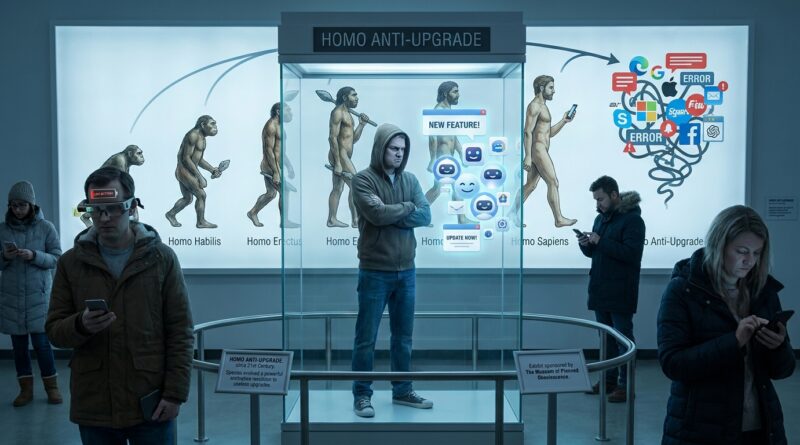
Homo Anti‑Upgrade: When Humans Evolved To Hate AI More Than Their Bosses
You are not crazy. A lot of people are looking at the sudden flood of chatbots, auto-summaries, fake helpers, “smart” search results, AI photo tricks, and mandatory workplace copilots and thinking, “I did not ask for this.” That feeling has a name now. It is why everyone suddenly hates AI, or at least hates the way it keeps barging into normal life like an overeager intern with access to your calendar, your inbox, and somehow your soul. The sales pitch says this stuff will save time. In practice, it often creates new chores, new errors, new privacy worries, and one more pop-up asking if you want machine help writing an email that was already going to be two sentences long. People are not rejecting progress. They are rejecting being told that every inconvenience in life can be fixed by software that makes five new inconveniences and then sends you a subscription offer.
⚡ In a Hurry? Key Takeaways
- People suddenly hate AI because it often feels forced, solves imaginary problems, and makes real work less clear and more annoying.
- Use a simple filter. If an AI tool saves real time, lowers hassle, and does not create trust or privacy headaches, keep it. If not, turn it off or ignore it.
- You do not have to pick between AI worship and AI panic. Skepticism is a sane response, especially when your job, attention, or data is on the line.
The rise of Homo Anti-Upgrade
Every era gets the human it deserves. Ours appears to have produced Homo Anti-Upgrade, a weary creature who just wanted a phone, a word processor, and maybe a search engine that answers the question instead of giving a robot’s improv routine.
This species did not begin as a luddite. Quite the opposite. Homo Anti-Upgrade once updated apps promptly, clicked “try new experience,” and even said things like “maybe this will be useful.” Then came the tenth feature nobody requested. Then the twentieth. Then the software started rewriting emails, summarizing meetings you wish had never happened, and generating pictures of hands with nine fingers.
At some point, irritation hardened into instinct. Not fear. Not technophobia. Pattern recognition.
Why everyone suddenly hates AI
The short answer is simple. Most people do not hate intelligence. They hate added friction, fake convenience, and being treated like reluctant beta testers in their own lives.
1. It solves the wrong problem
Ask a normal person what tech problems they want fixed and you get boring, practical answers. Better battery life. Fewer scam calls. A printer that behaves like it fears consequences. Search that works. Customer service that reaches a human before retirement age.
Instead, the industry keeps showing up with “write my grocery list in the style of Shakespeare” and “generate a meeting recap from a meeting that should have been an email.” There is a gap here. A big one.
2. It creates more work disguised as less work
An AI tool can draft something in five seconds. Great. Then you spend fifteen minutes checking if it made up facts, missed context, copied clichés, or accidentally turned your normal tone into corporate oatmeal.
That is not always automation. Sometimes it is just moving the work from “doing” to “supervising the machine that did it weirdly.”
3. It feels invasive
Many AI tools want access to everything. Your messages, documents, recordings, browsing habits, location, workflow, preferences, and “experience.” Companies call this personalization. Users often call it none of your business.
People can tolerate a lot from technology when the bargain is fair. Cheap navigation in exchange for location data, for example. But when the benefit is fuzzy and the data grab is enormous, trust collapses fast.
4. It threatens livelihoods while pretending to be a cute helper
This might be the biggest one. A lot of workers are being asked to welcome tools that management clearly hopes will reduce headcount, lower rates, or speed up output without extra pay. That makes every smiling AI assistant feel a bit like your replacement wearing a novelty tie.
People are not imagining the tension. They are reacting to it honestly.
5. The hype is exhausting
One camp says AI will cure disease, end work, and usher in a glittering future. The other says it will wipe out humanity and turn us into paperclips. If you are tired of both, you may enjoy our collective habit of doom-grazing in Homo Doomscroll‑Delighted: When Humans Evolved To Enjoy Their Own Extinction Warnings.
Most people live somewhere in the middle. They are not waiting for robot utopia. They are not building bunkers. They are trying to finish a spreadsheet without a sidebar asking if a language model can “help ideate.”
The evolutionary autopsy
If we are being scientific about this, Homo Anti-Upgrade evolved under intense environmental pressure.
Stage one. Curiosity
“Oh, neat. It can draft stuff.”
Stage two. Mild concern
“Why is this suddenly in every app I own?”
Stage three. Administrative fatigue
“Why do I need to opt out of machine features in my notes app, browser, phone, search engine, office suite, and toaster?”
Stage four. Defensive adaptation
“No, I do not want a summary. No, I do not want a rewrite. No, I do not want a synthetic friend. I want the button to do the button thing.”
That last stage is where a lot of people are now. They do not want less technology. They want technology that remembers its place.
What AI gets wrong about being useful
Good tools disappear into the task. Bad tools insert themselves into the task and ask for applause.
The dishwasher is useful because it washes dishes. It does not write a thought piece about dish optimization. GPS is useful because it gets you there. It does not offer three speculative routes based on vibes and then hallucinate a bridge.
Too much consumer AI is still in the second category. It is flashy, chatty, and desperate to prove it belongs, even when a plain old feature would work better. That is a big reason why everyone suddenly hates AI. The experience often feels less like help and more like software theater.
A better filter for deciding what to use
You do not need a manifesto. You need a test.
The three-question test
1. Does it save real time?
Not demo time. Real time, in your actual day.
2. Does it improve the result?
Not just “produces more words.” Does it make the work more accurate, clear, or easier?
3. Does it add risk?
Think privacy, errors, dependency, cost, and job creep. If the risk is higher than the reward, pass.
If a tool fails two out of three, it is not your future. It is clutter.
Where AI can actually help
To be fair, some uses are genuinely handy. Transcribing audio. Cleaning up rough notes. Summarizing a long document you were going to verify anyway. Helping non-experts start a blank page. These are modest jobs. That is exactly why they work.
The problem starts when modest jobs become messianic marketing.
Permission to resist the upgrade
This part matters. You are allowed to say no.
You are allowed to keep using software in the least magical way possible. You are allowed to prefer direct search results over generated mush. You are allowed to write your own emails, make your own lists, draw your own bad sketches, and think your own thoughts at full human speed.
Resistance does not mean rejecting every tool forever. It means refusing the lazy story that if software can imitate a task, humans should step aside. That story is convenient for executives. It is not automatically good for workers, artists, students, or anyone who enjoys having a functioning brain.
What a human future with tech actually looks like
Probably less cinematic than the billionaires promised.
A human future with tech is not one where every screen talks back. It is one where tools are quiet, optional, understandable, and worth the trade. It is one where automation handles drudgery without hollowing out judgment, skill, dignity, or pay.
It is also one where products have to earn their place again. Not by sounding smart, but by being useful.
At a Glance: Comparison
| Feature/Aspect | Details | Verdict |
|---|---|---|
| Forced AI features | Added to apps whether users asked or not, often increasing clutter and confusion. | Main reason people are pushing back. |
| Useful AI helpers | Best for narrow tasks like transcription, rough summaries, or first drafts that humans check. | Worth using selectively. |
| AI hype and panic | Public debate is dominated by extreme promises and extreme warnings, not everyday reality. | Ignore the circus. Judge tools by results. |
Conclusion
The useful part of this whole backlash is not the grumbling. It is the clarity. Right now the loudest voices on AI are billionaires, doomsday prophets and growth hackers, while ordinary people are quietly realizing that this technology often wastes time, threatens jobs and eats away at attention. Once you can name that feeling, you can do something with it. You can stop treating every upgrade like destiny. You can sort the genuinely helpful tools from the expensive noise. You can laugh at the absurdity of a species that invented software to save effort, then somehow ended up supervising machines that make extra homework. Most of all, you can keep insisting on a simple standard. Technology should serve humans, not train humans to accept being treated like obsolete hardware. That is not backward. That is healthy.