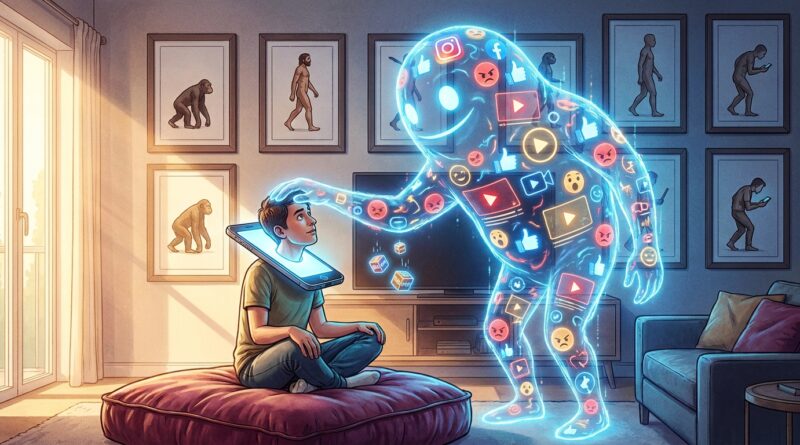
Homo Algorithmus: When Humans Evolved Into Emotional Support Pets For Their Own Feeds
You are not imagining it. A lot of social media now feels less like a tool you use and more like a mood ring that grades your impulses in real time. You tap one angry post, linger on one weird clip, watch half a breakup video while brushing your teeth, and suddenly your feed decides this is your whole personality now. That is the joke at the heart of this little satire about humans evolving to serve social media algorithms. We thought we were the upright species with language, art and self-awareness. Instead, many of us have become emotional support pets for a content machine that gives us treats for reacting fast and loudly. The good news is that seeing the absurdity helps. Once you notice that your feed is training you as much as you are training it, you can start making small choices that return a bit of your brain to its original owner.
⚡ In a Hurry? Key Takeaways
- Social platforms do not just reflect your interests. They shape them by rewarding fast, intense reactions.
- To take back control, start training your feed on purpose. Pause, skip rage bait, and spend more time on what actually helps you.
- This is not about panic or quitting the internet forever. It is about noticing the system and making it work a little less on autopilot.
Welcome to the age of Homo Algorithmus
Picture a nature documentary voice.
“Here we see the modern human in its native habitat. Curled slightly forward. Thumb in motion. Eyes glazed but alert. It believes it is hunting for information. In fact, it is being gently herded toward content optimized to keep it emotionally available for ad delivery.”
That is the bit. It is funny because it is uncomfortably close to true.
For years, we talked about feeds as neutral pipes. You follow people. You get posts. Simple. But that version of the internet has been replaced by systems that constantly guess what will keep you there for one more swipe. Not what is best. Not what is true. Often not even what you like. Just what keeps you engaged.
Why your feed keeps nudging your worst instincts
Most platforms are built around a basic rule. Strong reactions beat calm reflection.
Outrage works. Anxiety works. Tribal loyalty works. Morbid curiosity works. A measured, thoughtful response that takes five minutes to process usually loses to a clip that makes you gasp in half a second.
This does not mean somebody in a control room is personally trying to ruin your afternoon. It means the system learns from your behavior, and human behavior is messy. We click when we are annoyed. We stare when we are shocked. We comment when we feel attacked. To the feed, all of that looks like success.
The machine is not reading your soul
It is reading your habits.
That sounds less dramatic, but it matters. The feed does not know the full you. It knows that you watched three videos about workplace revenge, liked two home office setups, and spent an oddly long time looking at a man pressure-washing a rug. From that, it builds a version of you. Then it starts feeding that version back to you.
After a while, you can end up living inside a funhouse mirror made from your own stray impulses.
How humans became emotional support pets for their own feeds
This is where the satire bites. We like to imagine we are in charge because we hold the phone. But a lot of our behavior now looks suspiciously pet-like.
We perform for rewards. We check for notifications like treats. We return to the same app because maybe this time there will be something good. We learn what gets attention and start shaping ourselves around it.
If a post gets ignored, we feel oddly rejected. If one pops off, we feel briefly validated. Good human. Have another pellet.
It is not so different from what I talked about in Homo Co‑Pilotus: When Humans Evolved Into Backseat Drivers For Their Own AI. In both cases, the tool starts as an assistant and slowly becomes the thing setting the pace. You are still present. You are just not fully driving anymore.
The real cost is not just time
People often frame this as a screen-time problem. That is part of it, sure. But the bigger cost is often emotional and mental.
Your attention gets chopped into tiny pieces
Feeds train you to expect novelty every few seconds. Over time, slower forms of thinking can start to feel boring, even when they are the ones that actually help you learn, create or calm down.
Your identity gets pushed toward extremes
If your strongest reactions get the most reinforcement, the system can slowly flatten you into a louder, simpler version of yourself. You become easier to sort, easier to predict, and easier to keep engaged.
Your sense of choice gets fuzzy
This is the sneaky one. You start thinking, “I guess this is just what I am into now.” But sometimes what you are into is just what was repeatedly put in front of you until it felt familiar.
How to tell when the algorithm is using you
You do not need a technical audit. A few simple signs are enough.
- You open an app for one reason and forget that reason within minutes.
- Your feed leaves you more agitated than informed.
- You keep seeing content that makes you feel bad, yet you keep watching it.
- You notice yourself reacting before thinking.
- You feel like the app somehow “knows” you, but the version it knows is your least rested self at 11:40 p.m.
If that sounds familiar, congratulations. You have met the invisible pet overlord.
How to retrain the beast without moving to a cabin
The nice thing about recommendation systems is that they are stubborn, not magical. They learn from patterns. That means you can teach them, at least a little.
1. Stop feeding rage bait
Even hate-watching counts. If something reliably makes you feel gross, stop giving it seconds of your life. Scroll away faster. Use “not interested” if the app offers it.
2. Linger on what you actually value
If you want more thoughtful content, act like it. Read the full post. Save useful stuff. Follow people who explain rather than inflame. The algorithm notices what gets your time.
3. Break the cue-reward loop
Turn off non-essential notifications. Move the app off your home screen. Make it one step harder to open. Tiny bits of friction help more than people expect.
4. Use lists, bookmarks and direct follows
Whenever possible, go to people and sources on purpose instead of waiting for the feed to decide what matters. Old-fashioned, yes. Also effective.
5. Do one human-speed thing every day
Read a long article. Watch one full video without switching apps. Sit with a thought before posting it. This sounds small, but it is a useful antidote to feed-brain.
Why satire helps more than panic
If every conversation about algorithms turns into robot apocalypse theater, most people tune out. Fair enough. On the other side, if we shrug and say “that is just how apps work,” we give up too much ground.
Satire splits the difference. It lets you laugh first, then notice. Once you can joke that you have become a pampered house pet for a recommendation engine, it gets easier to ask better questions. Why did I click that? Why am I annoyed? Why does this app profit when I am least reflective?
Humor lowers your defenses. That is useful when the truth is a bit embarrassing.
At a Glance: Comparison
| Feature/Aspect | Details | Verdict |
|---|---|---|
| What the feed rewards | Fast reactions, outrage, curiosity spikes, repeat viewing, emotional volatility | Great for engagement. Not always great for your brain. |
| What humans actually need | Context, slower thinking, real connection, useful information, time to reflect | Better for judgment and mood, but often under-rewarded by platforms. |
| Best response | Train your feed intentionally, reduce triggers, follow directly, add friction to mindless use | You may not beat the system, but you can stop volunteering as its favorite pet. |
Conclusion
The point is not that the bots have already won or that you need to throw your phone into a river. It is that most major feeds are tuned to reward your fastest, loudest and most impulsive reactions, while slower, more human ones get shoved to the side. Looking at this through a satirical evolutionary lens makes the whole thing easier to see. We are not helpless, but we are being trained. Once you notice that, you get some choice back. You can stop confusing engagement with meaning. You can teach your feed better habits, or at least stop rewarding its worst ones. And that is a lot more useful than either panic or resignation.