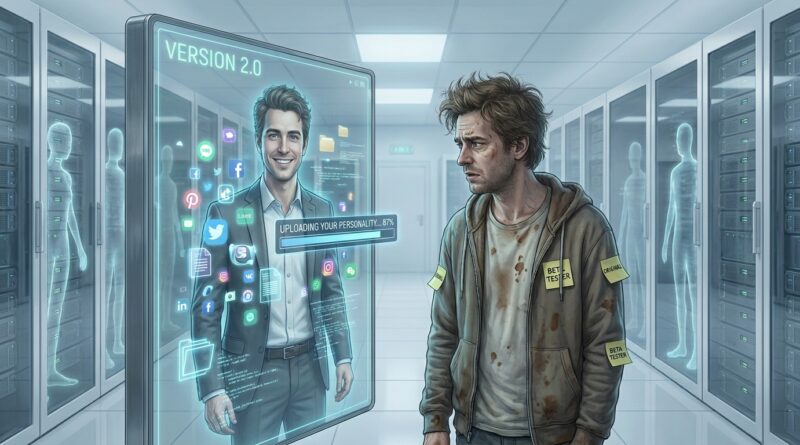
Homo Backupus: When Humans Started Living Like Their Cloud Copies Were The Real Ones
You can laugh at this, but it still stings. A lot of people have had the same slightly creepy thought lately. What if the neat, polished version of me that lives in apps, backups, voice samples, old photos and chat logs ends up feeling more useful than the actual me who forgets passwords, says the wrong thing and needs lunch? We feed the machine every day. Face scans. Voice notes. Search history. Messages at 1:12 a.m. Then one day a company announces an AI version of “you,” and suddenly your own data trail looks like a better employee, a more available friend, or a tidier ghost. That feeling is real. It is not silly. This is the strange little panic behind the rise of AI clones, digital twins and posthumous chatbots. The joke is that we wanted tools. The twist is that some of us now worry the backup copy is getting the better deal.
⚡ In a Hurry? Key Takeaways
- AI clones are less “you” than a statistical remix of your habits, tone and old data.
- Set limits now. Decide what parts of your voice, face and memories you are willing to upload, train or preserve.
- The safest move is not total panic or total surrender. Use the tools, but do not let the saved version outrank the lived one.
Welcome to Homo Backupus
If humans had an evolutionary chart for the internet age, somewhere after Homo Sapiens you might find Homo Backupus. This species stores 47,000 photos, backs up every thought to three platforms, and quietly suspects the cloud copy may one day outperform the original.
That is the satirical take on AI clones and human evolution in one line. We built record-keeping systems so good that they started to feel like alternate selves.
Not better selves, exactly. More like smoother selves. Searchable selves. Selves with better lighting and fewer awkward pauses.
Why this feels so weird
Most tech anxiety makes sense right away. You worry about scams, privacy, fake videos, job loss. This one is stranger because it gets personal fast. It pokes at identity.
Your phone already knows where you go. Your photo library knows your face. Your email predicts your next sentence. Your music app knows when you are sad before your relatives do. Add modern generative AI, and all that stored behavior starts to look less like a pile of data and more like a rough draft of a person.
That is where the unease starts. Not because the clone is truly alive, but because it is good enough to trigger comparison.
The cloud copy never gets tired
Your digital double does not need sleep. It does not get embarrassed. It can answer messages at scale. It can be tuned to sound kinder, sharper, calmer or more “on brand” than you usually feel on a Tuesday.
And once products start selling that polished version back to us, many people begin asking a brutal question. Am I becoming the unpaid intern training my own replacement?
What AI clones actually are, minus the movie trailer voice
Most so-called AI clones are not souls in a jar. They are systems trained on your words, preferences, voice, face, routines or decision patterns. Think prediction machine, not digital resurrection.
Some are light and practical. A meeting assistant that drafts replies in your tone. A voice model that reads your notes out loud. A “digital twin” used for business tasks.
Some go much further. Memorial chatbots trained on dead loved ones. Interactive avatars that mimic someone’s style. Services promising your grandchildren will one day “talk to you” through stored recordings and chat history.
The marketing often skips one important detail. These systems do not preserve your full humanity. They preserve traces. Patterns. Fragments. Good guesses.
The hidden pressure to optimize your own ghost
This is the part that deserves more attention. Once the idea of a future AI version of you becomes normal, people can start changing their present behavior for the sake of the archive.
You may notice it in small ways.
- Talking more clearly into voice notes because “the model might use this later.”
- Posting life events so there is a record, even when you would rather just live them.
- Saving more chats, more clips, more selfies, because deletion starts to feel like self-erasure.
- Feeling guilty that your digital trail is messy, inconsistent or incomplete.
That is a bizarre new burden. Not just living your life, but maintaining quality data for your possible future replica.
At that point, the backup has become management.
This is not just vanity. It is grief, work and loneliness too
Some people are drawn to AI clones because they miss someone. Some because they are exhausted and want help. Some because they are curious. Some because a company quietly turned the option on and made it sound harmless.
That is why mockery alone does not work. There are real feelings under this trend.
Posthumous chatbots
The appeal is obvious. If technology can soften grief by making a loved one feel one message away, that can be hard to resist. But grief is not a software bug to patch. A chatbot may comfort some people. It may also trap others in a loop where simulation replaces mourning.
Workplace digital twins
The pitch here is efficiency. “Let your AI double attend routine meetings.” Fine. Maybe useful. But if your value at work becomes how well your system mimics your output, employers can start treating you like the training wheels for software.
Personal legacy tools
These often sound noble. Save your stories. Preserve your voice. Leave wisdom behind. That can be meaningful. The problem starts when memory becomes productized and your life gets framed as raw material for a forever-service with monthly billing.
The joke that helps: evolution took a wrong turn at the backup menu
Humor helps here because it shrinks the drama without denying it. Picture a nature documentary voice.
“In the late platform era, Homo Backupus began offering intimate personal data to glowing rectangles in exchange for convenience, validation and automatic captioning. Over time, the species developed a curious belief that the archived self might one day become more socially successful than the biological host.”
Funny. Also a little too close to home.
This framing matters because it gives us language for a very modern anxiety. You are not crazy for feeling off about this. You are noticing that the line between using tools and preparing your own substitute has gotten blurry.
How to stay human without throwing your phone in a lake
You do not need to go full hermit. You do need a few rules.
1. Decide what is sacred, not just what is convenient
Pick a category of yourself that stays mostly offline or untrained. Maybe it is family voice notes. Maybe private journals. Maybe your child’s face. Maybe your grief. If everything becomes training data, nothing feels personal for long.
2. Treat “memory” and “simulation” as different things
A saved photo album is not the same as an interactive clone. A recording of grandma telling a story is not the same as a bot generating new grandma-like replies. Preserve what matters, but name the difference clearly.
3. Do not build a cleaner fake self to compete with your messy real one
This is a big one. If a tool helps draft emails or sort notes, great. If it starts becoming the version of you that always sounds wiser, warmer and more productive, stop and ask who this performance is really for.
4. Check the business model
If a company offers to “immortalize” you, ask plain questions. Who owns the data? Can you delete it? Can it be used to train other systems? What happens if the company is sold, shuts down or changes terms?
5. Leave room for being unrecorded
Not every joke needs to become content. Not every feeling needs to become a dataset. Parts of life gain value precisely because they were lived once, in real time, and then allowed to pass.
A practical test: ask who benefits if your clone gets better
This question clears a lot up.
If the answer is “mostly me, in a narrow and useful way,” fine. Let the tool transcribe meetings or read your notes.
If the answer is “a platform that gets a richer model of me, a stronger product and more reasons for others to interact with my simulation,” slow down.
The difference between convenience and extraction often hides in that gap.
What to say when friends bring this up
Many people feel silly talking about this because it sounds melodramatic. It helps to keep the language simple.
- “I’m okay with backups, but not with a company turning my personality into a service.”
- “I want to preserve memories, not create a bot that pretends to be me forever.”
- “If a tool helps me live better now, great. If it makes me feel replaceable, that’s my cue to pull back.”
That is not anti-tech. It is boundary-setting.
At a Glance: Comparison
| Feature/Aspect | Details | Verdict |
|---|---|---|
| AI clone usefulness | Can help with routine replies, voice playback, admin tasks and searchable memory. | Useful as a tool. Risky as an identity project. |
| Emotional impact | May trigger comfort, grief, curiosity or the fear that your stored self looks more stable than your real one. | Handle with care, especially around loss and loneliness. |
| Best human response | Set limits on what you record, train and preserve. Keep some parts of life gloriously unoptimized. | Best balance. Stay engaged with tech without outsourcing your whole self. |
Conclusion
AI clones, posthumous chatbots and digital twins are no longer just sci-fi props. They are becoming regular products, and that quietly nudges people to act as if the saved version matters more than the lived one. That is the real trap. Not robot rebellion. Just a slow mental shift where your archive starts to outrank your actual days. The good news is that humor helps. Calling this an evolutionary misfire, a little Homo Backupus moment, gives you a way to talk about the anxiety without sinking into doom. Then you can make clearer choices. Save what matters. Use what helps. Keep some things private, temporary and fully human. You do not need to unplug from everything. You just need to remember that your data trail is a record of your life, not the boss of it.