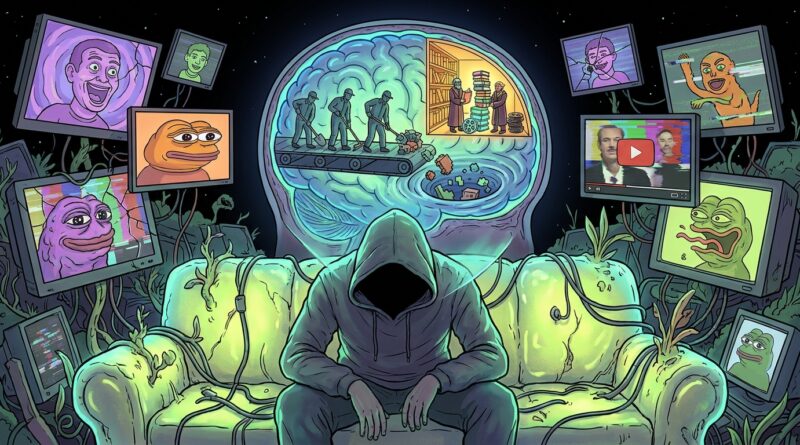
Homo Sloppus: When Humans Evolved Into Organic Filters For AI Garbage
You know the feeling. A video starts with subway surfers on the bottom, an AI voice on top, captions in the middle, and a plot that sounds like a fever dream written by a vending machine. You hate it. You keep watching. Then another one rolls in. After ten minutes, your brain feels like it has been sanded smooth. That is not you being weak. It is the feed doing exactly what it was built to do, turning your attention into mulch for ads.
The weird part is that this is bigger than bad content. AI slop and brainrot are starting to shape what holds our attention, what counts as “interesting,” and how much mental friction we can still tolerate. If that sounds dramatic, good. It should. We are running a live experiment where machines can spit out infinite synthetic junk, and humans are the test animals clicking “next.” The good news is that you are not powerless. You can spot the trap, laugh at it, and start training your mind to be a harder target.
⚡ In a Hurry? Key Takeaways
- AI slop brainrot is not just annoying. It is a feed-optimized style of content that trains you to accept faster, shallower, weirder input with less thought.
- You can fight back by adding friction. Turn off autoplay, aggressively use “not interested,” and swap some passive scrolling for active choosing.
- This is not about becoming a monk. It is about protecting your attention so you stay curious, harder to manipulate, and less bored by your own life.
Homo Sloppus has entered the chat
Let us give this species a name. Homo Sloppus. A modern human adapted to survive an endless river of synthetic nonsense by becoming just alert enough to keep scrolling.
That is the joke. It is also not entirely a joke.
For years, the internet rewarded content that was cheap, fast, emotional, and easy to share. AI has now poured gasoline on that fire. What used to take a bored creator an afternoon now takes a prompt and a few clicks. The result is a flood of videos, images, voiceovers, fake stories, fake experts, fake outrage, and fake sincerity. Some of it is funny. Some of it is harmless. A lot of it is cognitive junk food engineered to slip past your defenses before you even notice you are consuming it.
What “AI slop” actually is
AI slop is low-effort, high-volume content made mostly to game feeds, chase ad money, or harvest attention. It often has a few telltale signs.
It is made to be consumed, not remembered
You watch it, react for a second, and forget it five minutes later. It leaves no useful trace. No insight. No real laugh. No story worth retelling.
It stacks stimulation
One voice is talking. Another video is playing. Text is flashing. Music is pumping. Everything is competing for the same two square inches of your focus.
It feels weirdly familiar
That is because it is often built from patterns the machine already knows people respond to. Not truth. Not craft. Response.
It breeds fast
A human creator has limits. AI spam does not get tired, embarrassed, or bored. It can make a thousand versions before breakfast.
Why your brain feels dull afterward
This is the part people tend to wave away with, “Well, every generation has its trash.” True. But this trash is different in one important way. It adapts at machine speed.
Your attention is being trained by a system that is constantly testing what keeps you from leaving. Over time, that can nudge your brain toward shorter loops, lower patience, and a higher tolerance for nonsense. Not because you became less smart. Because your environment keeps rewarding shallow engagement.
Think of it like food. If every meal got a little sweeter, saltier, and softer, your sense of normal would change. Plain food would start to taste boring. With brainrot content, ordinary reality can start to feel under-edited. A normal conversation is too slow. A book asks too much. Silence feels itchy.
This is evolution, just uglier and faster
No, humans are not sprouting new thumbs for scrolling. But we are adapting behaviorally to a new environment. The selection pressure is simple. Content that hijacks attention survives. Minds that do not defend themselves get shaped by what they consume most.
That is why the phrase “human evolution” is useful here, even in satire. It reminds us that feeds are not neutral pipes. They are environments. And environments change creatures.
The danger is not that everyone becomes stupid overnight. The danger is more boring than that. Less patience. Less depth. Less ability to sit with one idea long enough to do anything interesting with it.
How the composting process works
Step 1. Hook the reflex
The first second matters most. Surprise image. Loud caption. Strange claim. “You will not believe.” Your attention gets snagged before your judgment wakes up.
Step 2. Remove friction
Autoplay. Infinite scroll. Personalized recommendations. No stopping points. No natural end.
Step 3. Reward passivity
You do not have to choose, search, or think. The machine does the selecting. You just absorb.
Step 4. Normalize the synthetic
After enough exposure, fake cadence, fake faces, and fake drama stop feeling fake. They just feel like “content.” That is a real shift.
How to tell if you are becoming an organic filter for AI garbage
You do not need a lab test. A few warning signs will do.
- You open an app for one thing and wake up 25 minutes later in a swamp of nonsense.
- You feel restless with anything that does not hit in the first 10 seconds.
- You keep consuming content you do not even enjoy.
- You remember the vibe of what you watched, but not the actual substance.
- You find yourself more distractible, more numb, or weirdly more bored despite constant stimulation.
If that sounds familiar, welcome to the club. Most of us are somewhere on this spectrum.
The practical fix is not “quit the internet”
That advice is useless for normal people. You have work, group chats, hobbies, and probably a few creators you genuinely like. The goal is not purity. The goal is control.
1. Turn off autoplay wherever you can
This is the easiest win. Autoplay is the conveyor belt. Turn it off on YouTube. Turn it off on streaming apps. Anything that makes the next thing start without your consent is working against you.
2. Add a “Was that worth it?” pause
After three or four short videos, stop and ask one question. “Would I tell a friend about any of this?” If the answer is no, leave. That tiny check breaks the trance.
3. Use “not interested” like a fly swatter
Most recommendation systems will take the hint if you keep giving it. Be rude. Downvote. Hide. Mute. Block. You are not hurting the machine’s feelings.
4. Keep one high-friction hobby alive
Read a physical book. Cook without a video. Learn chords badly. Sketch. Garden. Fix a bike. The point is not productivity. The point is to keep your mind familiar with activities that do not come pre-chewed.
5. Make before you consume
Write a paragraph before you scroll. Take a photo. Send a thoughtful message. Pick a song and really listen to it. Creation restores a sense that your brain is for more than sorting stimuli.
6. Curate for humans, not just feeds
Follow people with actual points of view. People who can explain something, tell a story, or make you think. If every input is optimized mush, your own output gets mushy too.
7. Protect your first 30 minutes of the day
If your morning starts with AI sludge and algorithmic chaos, you are letting the dumbest thing in your life set the tone for the day. Even a small buffer helps. Coffee first. Sunlight first. Shower first. Anything first.
Why humor helps more than moral panic
People do not change habits well when they feel scolded. They change better when they can recognize a pattern and laugh at themselves without giving up.
That is why satire works here. “Homo Sloppus” is funny because it lands. You know that half-zombie state where your thumb keeps scrolling even while some deeper part of you whispers, “Come on, man.” Naming that state gives you a little distance from it. Distance makes choice possible.
What better attention actually gives you
This is not just self-defense. Better attention makes life less flat.
You notice more. You think in longer lines. You can tolerate boredom long enough for a real idea to show up. You become less predictable to advertisers and less annoying to yourself.
That last part matters. A lot of people are not just overstimulated. They are undernourished. Stuffed with input. Starving for texture.
At a Glance: Comparison
| Feature/Aspect | Details | Verdict |
|---|---|---|
| AI slop content | Fast, synthetic, high-volume, low-memory content built to keep you watching | Fine in tiny doses. Terrible as a default diet. |
| Your attention | Trainable, fragile, and easily shaped by repeated low-friction stimulation | Worth protecting like sleep or diet. |
| Practical defense | Turn off autoplay, curate harder, pause to evaluate, and keep one offline or effortful habit | Simple, realistic, and more effective than guilt. |
Conclusion
AI-generated slop and brainrot are exploding across TikTok, YouTube, and every other feed because they are cheap to make and very good at farming attention. That does not mean your mind has to become their processing plant. The trick is to notice what this stuff is doing in real time, then make a few small moves that put you back in charge. Treat yourself like a fragile but upgradeable creature living in a weird new habitat. Because that is basically what you are. Laugh at Homo Sloppus. Then refuse to evolve all the way into him. If you can do that, you will not just protect your focus. You will become more interesting, less manipulable, and a lot less bored by your own brain.