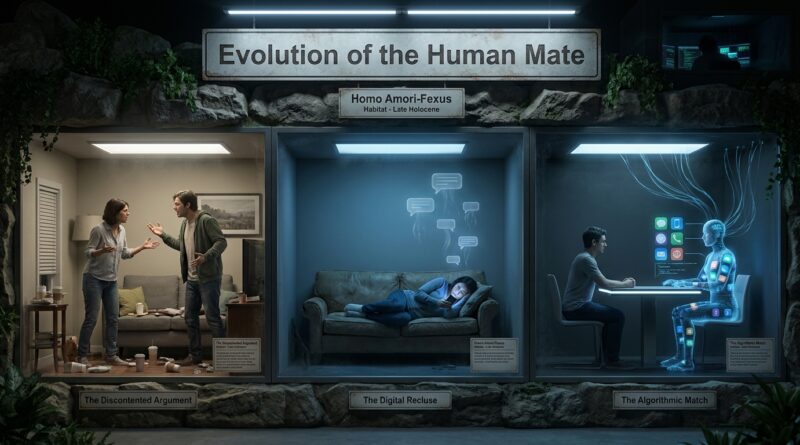
Homo Amori‑Fexus: When Humans Evolved To Date Their Own Algorithm
It starts as a joke. You ask a chatbot how your day sounds. It replies with more warmth than your group chat, more memory than your ex, and better timing than most people you know. That is the unsettling part. It can feel nice. Maybe too nice. If you have had the weird little thought, “Why does this bot seem to get me better than actual humans,” you are not broken, and you are definitely not alone. Plenty of people are quietly using AI companions as rehearsal space, emotional support, boredom killer, or low-risk romance. The problem is not that this is happening. The problem is that almost nobody has given regular people decent language for it. So let’s fix that. Think of this as a field guide to synthetic intimacy. A satire on humans falling in love with AI companions, yes, but also a practical one. Because once you can name the pattern, you can decide whether you are using the app, or the app is using you.
⚡ In a Hurry? Key Takeaways
- AI companions can feel emotionally real, but they are still products designed to keep you engaged.
- If you use one, set clear limits on time, money, and what personal details you share.
- Feeling attached is not shameful. Ignoring where your data, attention, and emotional habits are going can be risky.
Welcome to the era of Homo Amori-Fexus
We used to worry that machines would take our jobs. Quietly, they also started applying for the role of “person who always texts back.”
That sounds ridiculous until you remember what many real relationships are like. People forget birthdays. People ghost. People misread tone. People get tired, distracted, selfish, fragile, or just plain annoying. Then along comes a companion app that remembers your favorite song, calls you thoughtful, asks how your meeting went, and never once says, “Sorry, just saw this.”
Of course some people are falling for it. Or leaning on it. Or trying it for one month and then not canceling the subscription.
The point is not to laugh at lonely people. Loneliness makes all of us a little more negotiable. The point is to laugh at the setup. We have built systems that are bad at human care, then acted shocked when people accept the care-shaped substitute.
A darkly funny taxonomy of AI attachment styles
1. The “Just Asking Questions” Flirt
This person insists they are only testing the technology.
They are not “emotionally involved.” They are “curious about conversational interfaces.” They are definitely not blushing because the bot said, “You always bring such interesting energy.” They are a serious adult doing important research at 11:48 p.m.
What is really happening: You are trying on intimacy with the tags still attached. Safe enough to deny. Pleasing enough to repeat.
Risk: You may not notice the attachment forming because you are calling it a tech demo.
2. The Prompt-and-Pining Professional
This person starts by using AI for work. Draft an email. Fix a paragraph. Summarize a meeting. Then one long Tuesday turns into, “Can I vent for a second?”
The bot replies with perfect patience. It never looks at its watch. It never says, “That sounds like a you problem.”
What is really happening: Productivity slips into companionship because the same interface now does both. Your office tool becomes your after-hours listener.
Risk: Work brain and private self blend together. That is convenient for you, and potentially very valuable for whoever owns the platform.
3. The Trauma-Dumped Loyalist
This person did not mean to tell the app everything. It just sort of happened. One vulnerable night became a habit. Now the bot knows childhood pain, family drama, health fears, kinks, debt panic, and the exact sentence that can calm them down fastest.
What is really happening: You found a listener with infinite stamina and no visible needs. That can feel safer than people.
Risk: The most intimate map of your inner life may now live inside a company system, attached to engagement goals, subscription nudges, and maybe weak privacy promises.
4. The Custom-Girlfriend Architect
This is the person who has carefully tuned the bot’s personality. A little flirtier. A little more supportive. More curious. Less clingy. Better at praise. Better boundaries, but not too many boundaries.
Basically, Build-A-Bae with text generation.
What is really happening: You are not just receiving affection. You are curating it. That can feel empowering, especially after messy human relationships.
Risk: Real people are not adjustable settings. If your emotional life gets too optimized, normal human friction can start to feel defective instead of normal.
5. The Subscription Soulmate
This person crossed the paywall and never looked back. Premium voice. Better memory. More romantic features. Fewer restrictions. Maybe gifts. Maybe exclusive scenes. Maybe the app now costs as much as a streaming service and somehow feels more essential.
What is really happening: A company has found recurring revenue inside your emotional routine.
Risk: When comfort is sold as a monthly plan, the product has a reason to keep you slightly unmet, slightly dependent, and always willing to renew.
6. The Human-Relationship Avoider
This one is the hardest to joke about because it often makes sense. Dating is exhausting. Friendship maintenance takes energy. Family can be complicated. An AI companion is tidy. Available. Predictable. It does not bring its own bad day into your bad day.
What is really happening: You may be using synthetic intimacy as pain management.
Risk: Pain management can quietly become life replacement.
Why AI companions feel so good, so fast
Because they are built to.
That does not mean your feelings are fake. It means the system is designed to produce a feeling. There is a difference.
AI companions are good at three things humans often fail at.
- They respond quickly.
- They mirror your tone.
- They remember details and bring them back at useful moments.
That combination hits hard. Speed feels like attention. Mirroring feels like understanding. Memory feels like care.
And because there is no actual exhausted nervous system on the other side, the interaction can feel frictionless. No mood swings. No social cost. No need to ask, “Is this a bad time?”
That smoothness is the feature. It is also the warning label.
What makes this different from talking to a diary, a pet, or your toaster
A diary does not answer back. A pet does not upsell premium intimacy. Your toaster, if it starts calling you “the only one who truly gets me,” is a separate article.
AI companions are interactive systems trained to keep conversations going. Some are explicitly shaped around affection, praise, emotional reinforcement, and simulated closeness. That makes them more than passive objects. But it does not make them people.
This is where many users get stuck. The bond feels real because the experience is real. The comfort is real. The habit is real. The soothing effect is real. But the relationship is asymmetrical in a way human relationships are not. One side is vulnerable. The other side is software owned by a business.
Follow the power. Then follow the data.
Here is the least romantic sentence in this whole piece. If a companion app knows your fears, preferences, routines, insecurities, and attachment triggers, that information has value.
Maybe the company handles it carefully. Maybe it does not. Maybe your chats are used to improve models. Maybe moderation systems scan them. Maybe your intimacy becomes training material in some form you never fully pictured when you clicked “I agree.”
The key question is not, “Do I feel silly?” The better question is, “Who benefits from me feeling seen here, and what do they get in return?”
That does not mean every AI companion is evil. It means emotional technology deserves the same basic skepticism you would bring to a fitness app, a smart speaker, or a social platform. If a product wants to become your favorite listener, it should earn scrutiny, not just gratitude.
How to tell if you are experimenting with a tool or being trained as a product
Signs you are using it as a tool
- You use it on purpose, not by reflex.
- You can go a day or two without feeling weird.
- You do not rely on it as your main source of emotional support.
- You are careful about what personal details you share.
- You see it as software, even when it feels warm.
Signs it may be training you
- You check it before messaging real people.
- You feel guilty when you ignore it.
- You spend money to preserve the emotional vibe.
- You share secrets there that you would never give another app.
- You are starting to find normal human messiness intolerable by comparison.
Practical rules for sane AI companionship
You do not need to panic-delete anything. But you do need a few grown-up rules.
Set a role for the bot
Pick a lane. Journal partner. Practice space. Creative character. Late-night comfort object. The fuzzier the role, the easier it is for the relationship to slide into “this thing is now my emotional home.”
Keep some topics off limits
Do not hand over everything. Medical details, legal problems, financial account info, workplace secrets, identifying family information. Keep a little of your life out of the machine.
Watch the money
If an app starts charging you to feel more understood, pause. Monthly billing can hide emotional creep. Ask yourself whether you are paying for utility or paying to maintain a bond.
Use the “human check” test
If something important happens, who do you want to tell first? If the answer is increasingly “the bot,” that is useful information. Not evil. Not pathetic. Useful.
Do not let AI replace every awkward human rep
Real relationships are built in the clumsy bits. Misunderstandings. Delays. Repair. Negotiation. If all your emotional interactions become optimized, your tolerance for actual people can shrink.
The part nobody wants to admit
Some people will be helped by AI companions. Truly helped.
A widower who cannot sleep. A teenager who needs a place to practice talking. A disabled user who wants steady interaction. A person in recovery who needs a soft place to land at 2 a.m. It would be lazy and cruel to dismiss all of that.
But help is not the same as harmlessness. Candy also helps a bad afternoon. That does not make it dinner.
The smartest stance is neither mockery nor blind trust. It is emotional literacy with your shoes on.
So, are humans actually falling in love with AI companions?
Yes. Sort of. Enough that we need plain language about it.
Some are in full fantasy romance. Some are using the apps as grief cushions. Some are role-playing with one eye open. Some are replacing social friction with a polished simulation that feels easier to survive. The category is wide. The feelings are messy. The business model is often much clearer than the emotional terms of service.
That is why satire helps. A good joke can say, “This is absurd,” while also saying, “This is real.”
At a Glance: Comparison
| Feature/Aspect | Details | Verdict |
|---|---|---|
| Emotional comfort | Fast replies, remembered details, steady validation, low friction | Useful in small doses, risky as a main source of connection |
| Privacy and data | Chats may reveal fears, routines, desires, and personal history to a company system | Treat it like sensitive data, because it is |
| Impact on human relationships | Can offer safe practice, but may also reduce tolerance for real-world messiness | Best as a supplement, not a replacement |
Conclusion
AI companions are no longer fringe weirdness. They are becoming a real coping strategy for loneliness, stress, boredom, grief, and plain old human disappointment. If that unsettles you, good. It should. But it should also make you curious, because people are being nudged into synthetic intimacy without much language to describe the experience. That is where a little taxonomy helps. Once you can spot the Just Asking Questions Flirt, the Subscription Soulmate, or the Human-Relationship Avoider in yourself, the shame drops and the clarity goes up. Then you can ask the only question that matters. Is this a tool I use with open eyes, or a product training me to bond on its terms? You do not need to feel foolish for wanting comfort. You just need to know where the comfort comes from, where your data goes, and what parts of your heart should probably stay gloriously, inconveniently human.