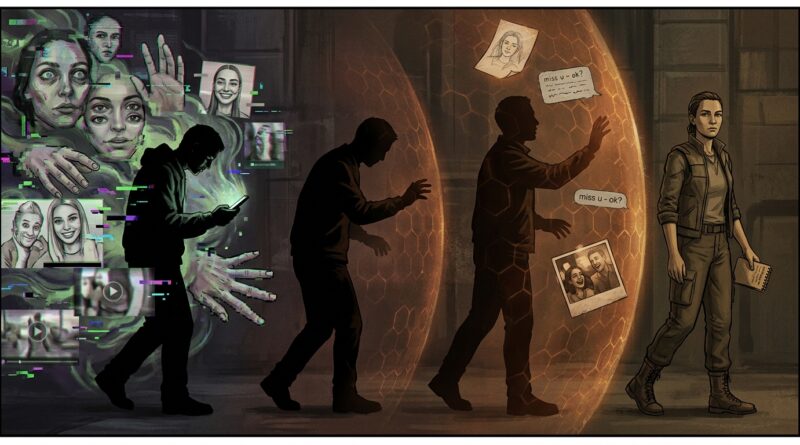
Homo Slop‑Resistor: When Humans Evolved A Reflex Against Infinite AI Garbage
If your feed has started to feel like a haunted dollar store, you are not imagining it. The cloned faces, the plastic emotions, the six-fingered hands, the fake movie posters, the same joke rebuilt 9,000 times. It wears you down. A lot of people call that burnout, but that is too polite. What you may be feeling is closer to rejection. Your brain is getting better at spotting mass-produced nonsense, and your attention is refusing to cooperate. That is not weakness. That is a healthy reflex kicking in. Call it Homo Slop-Resistor if you want. A slightly upgraded human who looks at industrial AI junk and feels an instant, full-body “no thanks.” The good news is that this feeling is useful. It means your nervous system still knows the difference between something made to connect with you and something made to keep you scrolling until your thoughts turn to wallpaper.
⚡ In a Hurry? Key Takeaways
- Your disgust with AI slop is not random. It is your brain pushing back against low-value repetition and fake signals.
- Try one tiny habit: when a post feels cheap or weird, do not hate-watch it. Exit in under two seconds and reward your feed only when something feels human.
- You are not a defective user. The backlash to AI slop satire and bot-like posting is a sign that people still want meaning, not just volume.
Why your brain feels numb
Humans are built to notice patterns. Usually that helps. You spot a face in a crowd. You hear worry in someone’s voice. You can tell when a story has a pulse behind it.
AI slop breaks that system by flooding it.
It gives you the outline of something meaningful without the actual substance. A face, but dead-eyed. A joke, but stretched thin. A motivational quote, but with the emotional texture of wet cardboard. Your brain keeps checking, “Is this worth my attention?” and the answer keeps coming back, “Not really.”
That constant mismatch is tiring. Not because you are lazy. Because your mind is spending energy sorting signal from sludge.
The biological explanation, minus the lab coat
Think of your attention like a smoke detector. It is supposed to react to things that matter. Novelty. Danger. Beauty. Real social cues.
Now imagine someone waves burnt toast under it all day.
That is what algorithmic junk does. It pokes the same triggers over and over with cheaper and cheaper material. At first, you react. Then you adapt. Then you get irritated. Then numb. This is not a moral failure. It is a protective response.
Your nervous system is trying to save processing power.
That is one reason the current wave of ai slop satire human evolution jokes lands so well. People are turning their frustration into a mock evolutionary story because it feels true. We are developing a survival trait. A fast, instinctive allergy to content that looks alive but is not.
Why people are pretending to be bots now
The weirdest part of this backlash is that some people have started posting like bots on purpose. Flat affect. Recycled phrasing. Glitchy sincerity. It is funny because it is awful. And it is awful because it is close to what the feed already feels like.
That kind of humor usually shows up when people are overloaded. Satire becomes a pressure valve. If the internet is going to treat us like livestock for engagement, fine. We will cosplay as broken software and make the whole thing look as stupid as it feels.
Under the joke, there is a real message. People are tired of being processed.
This is bigger than “bad content”
AI slop is not just ugly pictures and lazy captions. It changes your relationship with attention.
It trains you to expect less
When your feed fills with thin, repetitive filler, your standards can quietly drop. You stop looking for craft. You stop expecting surprise. You start consuming by reflex.
It muddies trust
If everything looks a little fake, polished, and detached, then even real people start to feel suspicious. That is not great for culture, and it is terrible for your sense of reality.
It rewards speed over meaning
The slop machine does not care if something is good. It cares if something is fast, cheap, and sticky enough to hold your eyeballs for another beat.
If this sounds familiar, you might enjoy Homo Sloppus: When Humans Evolved Into Organic Filters For AI Garbage, which nails that dead-inside feeling of scrolling through content that was assembled, not created.
The tiny habit that actually helps
You do not need a digital detox in the woods. You need one small rule your brain can follow.
The two-second exit
When a post gives you that familiar slop feeling, leave immediately. Do not linger to mock it. Do not send it to a friend with “lol this sucks.” Do not read the comments. Just exit.
Why? Because attention is still attention. Hate-watching trains the system just as surely as love-watching. If you keep touching the stove to confirm it is hot, the stove still wins.
Then add one positive signal
After you exit junk, choose one thing that feels made by an actual person. A thoughtful post. A weird drawing. A friend’s photo dump. A niche article. A human voice with some texture in it.
This matters because feeds learn from what you reward. More importantly, you learn from what you reward. You rebuild your own taste by acting on it.
How to tell the difference between weird and worthless
Not everything synthetic-looking is bad, and not every rough-looking thing is good. The question is simple.
Does it feel like someone meant something?
Good art can be strange. Funny posts can be dumb. Memes can be low-budget and still have a pulse. What makes slop feel like slop is not just the style. It is the emptiness. The sense that no real observation, risk, or care made it into the final product.
If it feels assembled to occupy you rather than made to say something, your slop-resistor is probably right.
You are allowed to become harder to impress
There is a quiet pressure online to stay open to everything, react to everything, and keep up with every new format no matter how hollow it feels. You do not have to do that.
Becoming more selective is not becoming old, bitter, or out of touch. It may just mean your filters still work.
A healthy internet user in 2026 might not be the person who can tolerate endless content. It might be the person who can reject it quickly and without guilt.
At a Glance: Comparison
| Feature/Aspect | Details | Verdict |
|---|---|---|
| How AI slop feels | Repetitive, synthetic, emotionally flat, built to trigger attention without satisfying it | Your irritation is a useful warning sign |
| What your brain is doing | Sorting fake novelty from real meaning, then conserving energy when the feed keeps failing the test | Not burnout alone. More like adaptive rejection |
| Best practical response | Use the two-second exit, stop hate-watching, and reward human-made posts that feel alive | Small habit, big improvement over time |
Conclusion
The backlash you are seeing right now is not just another meme cycle. It is a bunch of people realizing, all at once, that their attention has been treated like an open landfill. The jokes about bots, the fake-bot posting, the disgust with AI slop, all of it points to the same thing. People are not broken. They are resisting. That is the useful part of this whole ugly phase. Once you understand the feeling as a biological pushback instead of a personal failure, you can do something simple and real. Exit junk faster. Reward what feels human. Let your standards rise. You do not need to become a monk or smash your phone. You just need to act a little more like an upgraded species that knows how to say no.