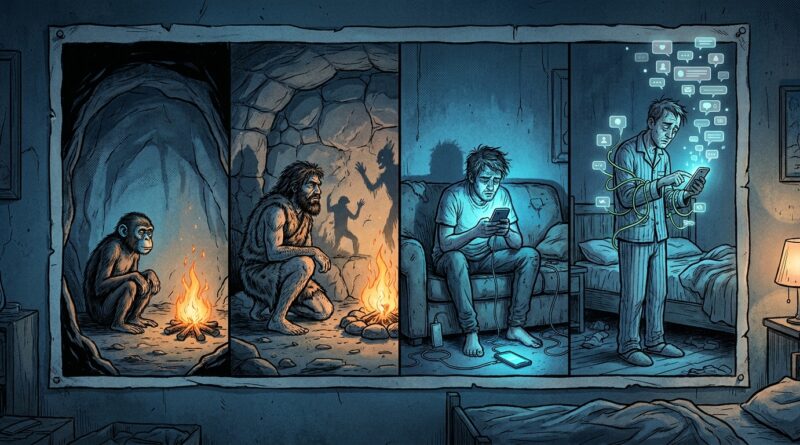
Homo Scroll-Somnus: When Humans Evolved To Sleepwalk Through Infinite Feeds
You know this move. You grab your phone for one last check before bed. Maybe you meant to answer a text, look up the weather, or see whether that package shipped. Then something weird happens. An hour disappears. Your thumb has been working overtime, your eyes feel dry, your brain feels buzzy, and if someone asked what you actually watched or read, you would have almost nothing to report. It is not laziness. It is not moral failure. It is what happens when a very old human brain meets a very modern feed designed to never run out. That trance has a shape, and it deserves a name. Call it Homo Scroll-Somnus, the late-night cousin of Rise of Homo Distractus: How Smartphones Out-Evolved Our Brains. Once you can spot the species, you can start escaping it.
⚡ In a Hurry? Key Takeaways
- Doomscrolling is not proof that your brain is broken. It is a predictable response to endless, high-reward feeds.
- The easiest fix is not more willpower. It is adding friction, like app timers, charging your phone outside the bedroom, and setting a clear stopping cue.
- If your sleep, mood, or focus are taking a real hit, take that seriously. Small changes help fast, and bigger support is okay too.
Meet Homo Scroll-Somnus
This is the subspecies that appears around 10:47 p.m. It says things like, “I am just checking one thing,” then wakes up in a pile of reels, hot takes, skin-care routines, war footage, jokes, ads, and a video of a raccoon stealing cat food.
The key trait is not simple distraction. It is trance. You are alert enough to keep scrolling, but not present enough to choose. Your body is tired. Your brain is still hunting. It is a weird half-sleep, half-stimulus fog.
That is why the phrase “wired and empty” feels so accurate. You took in a lot. You kept almost none of it. Like running on a treadmill while someone throws trivia at your face.
Why this keeps happening
Your brain likes novelty
Human brains are built to notice surprises. In the wild, novelty could mean food, danger, or gossip useful enough to keep you alive. In a feed, novelty means a cooking hack, then a scandal, then a puppy, then a disaster, then a joke. Your attention system does not get a clean signal that says, “Good work. We are done here.”
Infinite feeds remove stopping points
Books have chapters. Newspapers have page ends. Even old websites had bottoms. Feeds do not. They are like slot machines with better lighting. There is always one more pull, one more swipe, one more maybe-interesting thing.
Nighttime makes you worse at resisting
This matters. Late at night, your brain is tired, your self-control is lower, and your need for easy reward is higher. The app gets stronger exactly when you get weaker. That is not you failing. That is timing.
The satire part matters more than it seems
The search term here is “doomscrolling evolution satire,” but the joke is doing real work. If you can laugh at Homo Scroll-Somnus, you can step outside the trance for a second and see it. That tiny gap is useful. It turns “I am broken” into “Ah, the species has returned.”
That shift matters because a lot of people are being told they have “AI brain rot” or “chatbot addiction” or some other label that sounds like a personal flaw. Sometimes there is a real behavior problem that needs attention, yes. But a lot of the time this is simpler and more annoying. A stone-age nervous system got dropped into a carnival run by engagement metrics.
What the feed is actually selling
It is not content. Not really. Content is the bait. The product is your continued presence.
Most feeds make money when you stay, react, tap, share, or return tomorrow. So the system is built to reduce your chances of asking a very basic question: “Do I still want to be here?”
That is why doomscrolling feels so passive. The app is doing a lot of the choosing for you. It keeps loading. It keeps guessing. It keeps offering tiny emotional jolts so you do not leave long enough to notice that you are tired.
How to break the trance without pretending you will become a monk
1. Use a stopping cue, not a vague promise
“I will stop soon” is useless at 11:30 p.m. Give your brain a finish line. Try one of these:
- “I can watch 3 videos, then phone down.”
- “When I plug in my phone, the feed is over.”
- “At 10:30, I switch to music, a podcast, or an actual book.”
2. Charge your phone outside the bedroom
This is boring advice because it works. If your phone is across the room, your tired self can still reach for it. If it is in the kitchen, your tired self suddenly needs a plan, pants, and a reason.
3. Make the bad habit slightly more annoying
You do not need to delete every app and move to the woods. Just add friction.
- Log out of the worst offender.
- Turn off autoplay where you can.
- Remove the app from your home screen.
- Use grayscale at night if bright color hooks you.
- Set an app timer, then make the passcode inconvenient.
4. Replace the feed with a softer landing
People often scroll because they are tired but not ready for sleep. So give yourself a low-stimulation bridge. A light novel. A silly crossword. A podcast with the screen off. Anything that does not keep poking your reward system with a stick.
5. Notice your trigger phrase
Most people have one. “One last check.” “Just for a minute.” “I should see what I missed.” That phrase is the rustle in the bushes before Homo Scroll-Somnus appears. Catch it early.
What not to do
Do not turn this into a shame project. Shame is weirdly good at sending people right back to the feed. You feel bad, so you seek easy comfort, which is the exact thing that got you there.
Also, do not build a life plan around perfect discipline. The smarter move is environment first, willpower second. Put another way, do not ask your midnight brain to beat a casino.
When it might be more than “just scrolling”
If the pattern is seriously messing with sleep, work, school, or your mood, do not brush it off. If you are losing hours every night, feeling anxious when you cannot check your phone, or using feeds to avoid everything else, that is worth attention.
It does not mean you are doomed. It means the habit has gotten strong enough that basic tweaks may need backup. Talk to someone you trust. Use built-in screen time tools. If it feels tied to anxiety, depression, or insomnia, professional help is a smart move, not an overreaction.
The tiny rebellion
One of the funniest things about modern tech is that logging off for 30 minutes can feel like an act of resistance. But it is. Every moment you break the trance, you reclaim attention that a platform was planning to rent from you.
That is why naming this state helps. It turns a foggy bad habit into a visible pattern. You can point at it. Joke about it. Interrupt it. The same way Rise of Homo Distractus: How Smartphones Out-Evolved Our Brains made smartphone scatterbrain feel oddly recognizable, Homo Scroll-Somnus gives a face to the bedtime feed zombie many of us become.
At a Glance: Comparison
| Feature/Aspect | Details | Verdict |
|---|---|---|
| What it is | A late-night doomscrolling trance where you keep consuming but barely remember any of it. | Common, predictable, and very design-driven. |
| Main cause | Old human reward systems colliding with endless feeds built to hold attention. | Not a character flaw. |
| Best fix | Add friction, set stopping cues, and keep the phone out of bed-range at night. | Practical and more reliable than pure willpower. |
Conclusion
If you have been told your fried attention span means you are weak, lazy, or uniquely broken, take a breath. A lot of this is just what happens when Paleolithic brains get parked in front of casino-grade feeds that never ask whether you are done. That does not mean you are powerless. It means the fix starts with seeing the trick clearly. Make fun of Homo Scroll-Somnus. Spot the ritual. Add a little friction. Reclaim a little time. That is not some grand digital detox fantasy. It is a small, practical rebellion against tech that profits when we forget we exist.