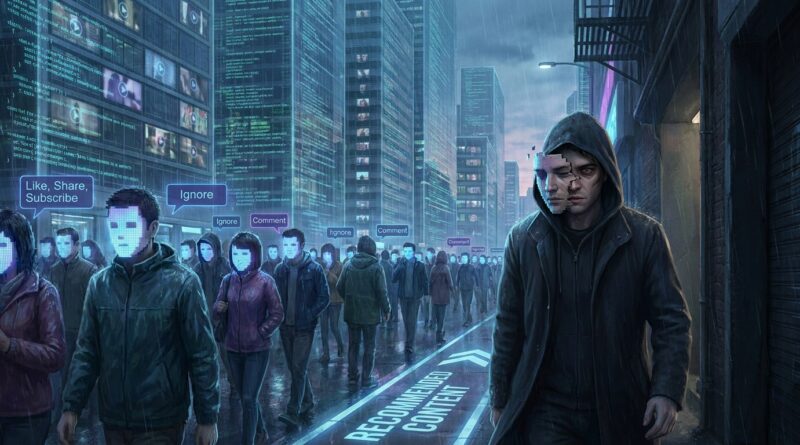
Homo NPC‑eus: When Humans Evolved Into Background Characters In Their Own Feeds
You know the feeling. You open an app to relax for five minutes, and somehow everyone sounds the same. Same joke format. Same face angle. Same carefully messy caption pretending not to care while clearly caring a lot. It is funny until it gets weird. Then a little sad. A lot of people joke that the internet is full of NPCs, but the joke lands because it brushes against something real. We are being trained, nudged, and polished into more predictable versions of ourselves. Not because we are lazy or fake, but because feeds reward repetition. The algorithm likes patterns. Brands like safety. AI tools smooth out rough edges. Before long, your online self can start to feel like a background character built for engagement instead of a person with odd habits, mixed opinions, and a life that does not fit neatly into content buckets.
⚡ In a Hurry? Key Takeaways
- The “NPC humans” feeling is often a real response to AI polish and algorithm pressure, not just internet paranoia.
- One practical fix is to post, say, or do one thing each week that is not optimized for likes, search, or approval.
- This matters because predictable behavior is easier to manipulate, sort, and turn into training data.
Field Guide Entry: Homo NPC‑eus
Common name: The Feed Native.
Habitat: Comment sections, short-video apps, productivity threads, “day in my life” reels, and any platform where the same three audio clips somehow explain all of human experience.
Call: “Not me doing this again.” “Core memory.” “POV.” “I was today years old.”
Defense mechanism: Irony layered over sincerity so nobody can tell if the creature means it.
Satire works because it lets you laugh before you admit, “Oh no, that is me.” Homo NPC‑eus is not stupid. It is adaptive. This creature evolved under strange conditions. Instead of trying to impress a village, it tries to satisfy a ranking system. Instead of earning trust slowly, it performs familiarity at speed.
Why everybody suddenly feels scripted
The algorithm rewards recognizable behavior
Feeds are pattern machines. They cannot truly know you, but they can measure what keeps your thumb moving. So they reward things that are easy to classify. Familiar formats. Familiar outrage. Familiar vulnerability. Familiar beauty. If one version of your personality gets more engagement, platforms quietly ask for more of that version.
That is how a joke becomes a persona, then a brand, then a cage.
AI makes polish cheap
It used to take effort to sound slick, look polished, or build a coherent online identity. Now software can write the caption, fix the photo, smooth the audio, generate the headshot, and suggest the hook. Useful tools, sure. But they also flatten people into the same clean, readable style.
The result is not always obvious fakery. It is often low-grade sameness. Everyone looks a little more camera-ready, a little more optimized, a little less accidental.
Relatability is now a script
Even chaos can be curated. “Here is my unfiltered life” is often filtered through twelve takes, trend research, and a caption tested against what usually works. That does not make the person evil. It means the performance incentives are strong.
If you want a deeper version of this same unease, Are We the NPCs Now? How AI Turned Humans Into Background Characters in Our Own Evolution gets at why the internet feels off even when nothing looks obviously broken.
Signs you may be drifting into Homo NPC‑eus territory
None of these mean you have “failed.” They are just clues.
- You rewrite a post until it sounds like everybody else in your niche.
- You avoid saying what you really think because the “correct” version will perform better.
- You feel pressure to make your life legible, tidy, and content-shaped.
- You keep using AI to sand off every weird edge until your words no longer sound like you.
- You consume so many trends that your own taste starts feeling suspiciously quiet.
The real cost of becoming a background character
The obvious cost is boredom. The less obvious cost is loss of agency.
Predictable people are easier to sort. Easier to sell to. Easier to provoke. Easier to model. If your online identity becomes a set of highly repeatable signals, platforms and marketers do not need to understand you very deeply. They only need to know what version of you gets a click.
That can spill offline too. You may start making decisions based on how they would look in public, not how they feel in private. It becomes harder to tell whether you like something or whether you have simply seen it rewarded enough times to think you should.
One way to act less like an NPC
Do one unoptimized human thing every week
This is the practical part. Once a week, make one choice that is intentionally bad for the algorithm and good for your humanity.
Examples:
- Post something with no trending audio, no bait caption, and no attempt to “scale” your personality.
- Share an opinion that is specific rather than maximally agreeable.
- Leave your phone behind for a walk and notice what you think when nothing is being performed.
- Text one friend directly instead of broadcasting a feeling to an audience.
- Keep a photo that matters to you even if it is not flattering enough to post.
The point is not to become random for the sake of it. The point is to break the feedback loop where every expression gets trained toward efficiency.
How to use AI without letting it use your personality
AI is not the villain in every case. Sometimes it helps. It can clean up grammar, organize a messy draft, or save time on boring tasks. The problem starts when it becomes your default voice.
Try this rule
Use AI for structure. Keep the weird bits yourself.
Let a tool help with outlines, summaries, or edits. But keep your odd phrasing, your specific story, your slightly uneven opinion, your little detours. Those are often the parts that sound most human because they are least optimized.
If it sounds too smooth, it may be less true
A useful gut check is simple. Read your post out loud. If it sounds like a very competent stranger with perfect posture wrote it, put some of yourself back in.
Why this weird satire matters
The phrase “npc humans satire ai algorithms” sounds like an internet fever dream, but it points to a serious issue. More of our social life now happens in systems that reward imitation and readability. Satire gives people a safe way to talk about that without sounding dramatic.
Calling someone an NPC can be cheap and cruel. But using Homo NPC‑eus as a fake species profile turns the lens back on the environment. Maybe the issue is not that people are soulless. Maybe they are adapting to a digital habitat that punishes complexity.
At a Glance: Comparison
| Feature/Aspect | Details | Verdict |
|---|---|---|
| Algorithm-friendly self | Consistent, readable, easy to categorize, often rewarded with reach | Useful in small doses, but flattening if it becomes your whole identity |
| AI-polished profile | Cleaner wording, nicer images, more professional presentation, less friction | Fine for support tasks, risky when it replaces your natural voice |
| Unoptimized human behavior | Messier, more specific, not always rewarded, harder to predict | Best defense against becoming interchangeable |
Conclusion
The reason this joke sticks is that many people already feel it in their bones. Feeds can make you feel scripted, interchangeable, and oddly replaceable, like a side character in a life that is supposed to be yours. Thinking about Homo NPC‑eus as a satirical species helps name the problem without pretending it is all your fault. A lot of us have been nudged to evolve around opaque algorithms instead of real communities. The good news is that you do not need a total digital detox to push back. Start small. Do one unoptimized human thing this week. Say the less polished thing. Keep the imperfect photo. Talk to a person instead of performing for a feed. That single break in the script can help you spot manipulation faster, protect your identity from getting flattened for engagement, and feel a little less like disposable training data.