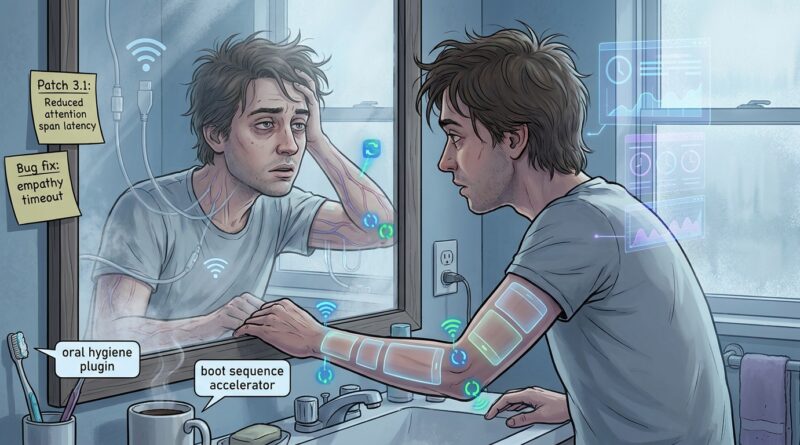
Homo Patchworkus: When Humans Evolved Into Walking Software Updates
You are not imagining it. A lot of modern life feels less like “using technology” and more like being recruited by it. Your phone wants an update. Your watch wants more steps. Your inbox wants faster replies. Your calendar wants tighter slots. Somewhere between the sleep tracker and the passive-aggressive productivity app, it starts to feel like you are not the customer. You are the patch. While everyone online is yelling about whether AI will replace humans, many of us are living through a smaller, stranger thing first. We are already acting like support staff for software. We smooth over its limits. We adjust our bodies to its alerts. We call this convenience, then wonder why we feel tired, twitchy, and a bit obsolete. The good news is that once you can name the feeling, you can start pushing back without throwing your router into a lake.
⚡ In a Hurry? Key Takeaways
- We are not just worried about AI replacing us. Many of us already feel like unpaid bug-fixes for the machines around us.
- Start tracking one simple thing each day: when did you change your body, mood, or routine to make a system work better?
- The point is not to reject technology. It is to notice where convenience quietly turned into obedience.
When your day starts with patch notes
You wake up and before your feet hit the floor, a device has opinions.
Your phone updated overnight. Your email app has changed the buttons again. Your watch says your sleep was “fair,” which is a rude thing for a wrist object to say at 6:40 in the morning. Your health app wants more consistency. Your work chat wants a reaction. Your bank wants identity verification. Your streaming app wants you to continue a show you do not even remember starting.
None of this is dramatic on its own. That is the trick. It arrives as tiny nudges, tiny fixes, tiny little “improvements.” But stack enough of them together and you begin to feel less like a person living a life and more like a nervous system wrapped around several unfinished products.
That is the real joke at the center of this satirical article about humans as software updates in the age of AI. The future is not only robots doing your job. It is also you spending half your Tuesday adapting yourself so a badly designed login process can feel successful.
Homo Patchworkus, the upgradeable ape
Humans have always used tools. That part is normal. Glasses are a tool. Shoes are a tool. A calendar is a tool. The weirdness starts when the tool keeps asking you to change in order to suit it.
You do not just use a map app. You start trusting it over your own sense of place. You do not just use a fitness tracker. You start feeling guilty on days when your body wanted rest but your graph wanted a neat line. You do not just use chat at work. You learn to perform availability as if your soul has a typing indicator.
That is Homo Patchworkus. A human stitched together by updates, prompts, dashboards, and settings menus. The hardware is still ancient. Bad back. Dry eyes. Mood swings. Hunger every few hours. Yet the software layer around us keeps acting shocked that the ape inside the system has not become frictionless.
The hardware is old, and that is not a bug
Your biological firmware is not obsolete because it gets tired, distracted, emotional, or bored. Those are not design failures. They are signs that you are alive.
Machines love repetition. Humans can do repetition, but we pay for it in odd ways. We get headaches. We doomscroll. We snack while standing next to the fridge. We laugh at terrible memes at midnight because our brains need relief valves.
That is one reason pieces like Homo Gigglus: When 15 Million Years Of Laughter Got Trapped In The Group Chat land so well. The joke works because it is true. We keep trying to optimize creatures that were built for walking, gossip, sunlight, and occasional berries, then act surprised when the result is chaos in a Slack window.
How we became customer support for our own tools
The old promise of technology was simple. Machines would handle the tedious bits so humans could get more time, more ease, more breathing room.
Sometimes that happened. Online maps are great. Video calls save travel. Search is useful. Shared documents beat emailing fifteen versions of “final_final_revised2.”
But then something flipped. More and more often, the machine does not remove work. It moves the work onto you.
Examples you probably know too well
You remember the password rules for twelve services.
You scan a QR code to see a menu.
You verify you are not a robot by identifying blurry bicycles.
You reformat your thoughts so an app can sort them.
You sit through a meeting where someone reads bullet points from software that was supposed to save time.
The machine looks efficient from far away. Up close, a human is doing all the awkward glue work.
That is what people often miss in big AI debates. They picture replacement. But a lot of daily tech reality is augmentation in the most annoying sense possible. Not “you gain superpowers.” More like “you now have to compensate for system quirks with your attention span.”
The emotional bug reports are getting weird
One of the stranger parts of this era is how software has started talking back in the language of care.
Your app does not just say “open me.” It says “build better habits.” It does not just say “you missed a target.” It says “stay on track.” It does not just collect your sleep data. It quietly grades your rest and lets that judgment sit in your chest all morning.
This would be funny if it were not so effective.
Many people now get a low-level feeling that they are underperforming as organisms. Not because a doctor said so. Because a stack of apps keeps issuing soft bug reports on their lives. Focus inconsistent. Recovery incomplete. Output below trend. Social response time suboptimal.
That can make you feel defective, when the real issue is often much simpler. The system expects clean data from a messy animal.
A small rebellion that actually helps
You do not need a cabin in the woods. You do not need to smash your smartwatch with a rock. You just need a way to notice when the relationship has flipped and you are now serving the tool.
Try the “Who is patching whom?” habit
For one week, keep a tiny note on your phone or on paper. Once or twice a day, jot down one moment when you adapted yourself to make a system run more smoothly.
Examples:
“Skipped lunch because my meeting app packed the schedule too tightly.”
“Walked in circles at night to please the step counter.”
“Rewrote a perfectly clear email to sound more machine-searchable.”
“Checked work chat during family time because silence now feels suspicious.”
“Felt bad about my mood because an app called the day unproductive.”
That is it. No scoring. No streaks. No dashboard. Please, for the love of your remaining humanity, do not turn this into another optimization project.
Why this works
It names the hidden trade. You begin to see where convenience costs attention, dignity, or rest. Once visible, these moments stop feeling like personal failure and start looking like design choices. That matters.
Because if the problem is “I am lazy and outdated,” you will keep trying to fix yourself. If the problem is “this system quietly trained me to act like middleware,” you can start changing the arrangement.
How to steal back some control without becoming a luddite cartoon
You can like technology and still set limits. In fact, that is the healthiest version of liking it.
1. Make one part of the day non-responsive
Pick a block of time when nothing gets answered instantly. Maybe breakfast. Maybe the first 30 minutes after work. Maybe your walk. The point is to remind your body that it is allowed to exist without being callable.
2. Turn off one judgmental metric
If a number helps, keep it. If it just makes you feel vaguely scolded, turn it off. This could be calorie estimates, screen time guilt popups, readiness scores, or any app that acts like a disappointed vice principal.
3. Keep one task gloriously offline
Write your shopping list on paper. Read a printed article. Take a walk without tracking it. Let one useful human activity remain unserialized.
4. Ask a rude but necessary question
When a tool adds friction, ask: “Is this helping me, or am I helping it?”
That question cuts through a lot of nonsense very quickly.
Why the satire hits a nerve
Humor helps because this whole situation is absurd. We are mammals with taxes, posture issues, and a deep ancient need to stare at trees. Yet somehow we ended up in a world where our fridge can notify us, our mattress can score us, and our job can reach us through six channels before lunch.
Laughing at that is not denial. It is clarity.
Satire gives people a way to say, “Ah. That is the thing I have been feeling.” Not fear of a dramatic robot takeover, but the smaller erosion of being constantly adjusted by systems that call themselves smart.
At a Glance: Comparison
| Feature/Aspect | Details | Verdict |
|---|---|---|
| AI replacement panic | Big, loud debate about whether machines will take over human work and creativity. | Real, but often distracts from the quieter daily problem. |
| Humans as software patches | People constantly adjust habits, moods, bodies, and time to fit poorly behaved systems. | This is already happening, and it explains a lot of modern fatigue. |
| Simple pushback | Track moments when you are acting like a bug-fix for a device, app, or platform. | Practical, funny, and surprisingly good at restoring perspective. |
Conclusion
The loud story online is still about AI replacing human creativity or saving it, depending on which pundit had coffee first. But the quieter story is often closer to home. Our bodies and habits are already being treated like extension slots for constant software updates, while the human hardware underneath remains gloriously scruffy, emotional, distractible, and unfinished. That does not make you obsolete. It makes you human. If this piece gives you anything, let it be a name for that weird feeling and one useful habit. Notice where you are behaving like a bug-fix for a machine instead of a messy animal with your own priorities. Once you can see it, you can laugh. And once you can laugh, you can start taking pieces of your day back.