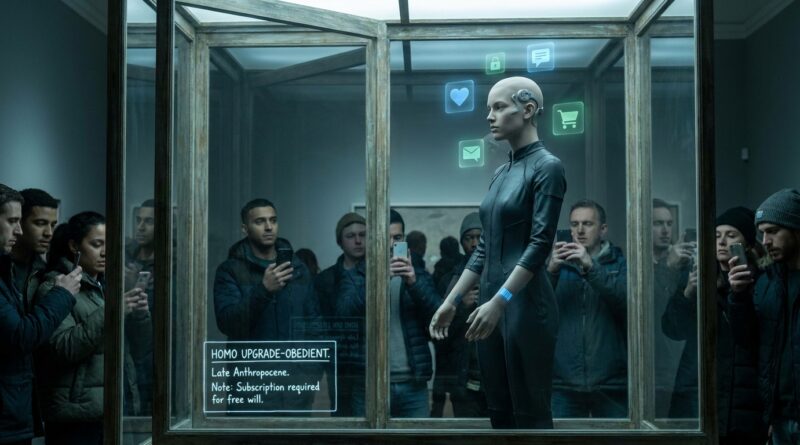
Homo Upgrade-Obedient: When Humans Evolved To Take Software Updates From Tech Gods
You are not crazy for feeling a little insulted every time some glossy future prophet talks about “upgrading humanity” while your actual problems are things like rent, insurance, burnout, and whether your phone has enough storage for one more software patch. The sales pitch is always grand. Smarter bodies. Longer lives. Enhanced minds. The fine print is always familiar. Subscription vibes, luxury pricing, and a strong hint that regular unenhanced humans are about to become the flip phones of the species. That is where the joke turns sour. A lot of this talk about human evolution is not really about helping people live better now. It is about turning the human body into the next premium device category. And somehow the rest of us are expected to clap politely while being told our unmodified selves are obsolete, glitchy, and due for replacement by Version Rich Guy 2.0.
⚡ In a Hurry? Key Takeaways
- This satire on transhumanism and human evolution is really about power. Who gets called “the future,” and who gets treated like outdated hardware.
- When you hear promises about upgrading humans, ask the boring question first. Who can afford it, who controls it, and what problem does it actually solve today.
- You do not owe tech culture your obedience. Being human is not a software bug that needs a billionaire-backed patch.
When Evolution Starts Sounding Like a Product Launch
There was a time when evolution meant random mutation, natural selection, and a lot of unfortunate teeth. Now it sounds like a keynote speech.
Someone in a black shirt steps on stage and tells us humanity is entering its next phase. The old human will soon be replaced by the upgraded human. Better memory. Better mood. Better lifespan. Probably a titanium jawline.
It is hard not to notice the tone. Less “here is a medical breakthrough that could reduce suffering” and more “your current body no longer meets minimum system requirements.”
That is why satire on transhumanism and human evolution lands so well right now. The whole script already feels absurd. We are told to dream about brain chips while people crowdsource insulin money. We hear about digital immortality from men who cannot design a social platform without making everyone miserable.
Homo Upgrade-Obedient
The modern ideal citizen, at least in some corners of tech culture, is not Homo sapiens. It is Homo upgrade-obedient. A person trained to accept permanent revision.
New phone. New firmware. New terms of service. New body plan. Click accept.
The dream being sold is not just better health. It is compliance disguised as progress. You are supposed to welcome the idea that your body, memory, fertility, attention span, and lifespan are all product categories waiting for investment.
That would be funny if it were not so revealing.
The weirdest part is how often this gets framed as liberation. You will be free, they say, once you are fully integrated into systems you do not control, priced by companies you cannot afford, and updated according to priorities you did not choose.
The Billionaire Version of “Helping Humanity”
When powerful people say they want to “improve the human species,” it is worth keeping one hand on your wallet and the other on your sense of humor.
Because history has taught us that plans to improve humanity often become plans to sort humanity. Who gets access first. Who gets locked out. Who gets called visionary. Who gets called irresponsible for not upgrading their child, their brain, their genes, their sleep, their mood, their lifespan.
That is what makes the whole thing feel less like evolution and more like a gated community.
If this theme sounds familiar, Transhumanism For The Rest Of Us: When Only Rich People Get To Upgrade Their Bodies hits the nerve directly. The promise is universal. The access plan is not.
Why the Sales Pitch Works Anyway
It borrows the language of medicine
This is part of the trick. Some technologies really can help people. Better prosthetics, vision tools, hearing tech, neural treatments, and mobility devices matter. They are not a joke.
But the language of genuine care gets mixed with luxury fantasy. Soon a treatment becomes an enhancement. An enhancement becomes a status marker. A status marker becomes a moral expectation.
Then you are no longer talking about relieving pain. You are talking about optimizing the species.
It flatters people who already have power
There is also a very old fantasy hiding under the shiny surface. The rich do not just want comfort. Some want exemption. Exemption from aging, limits, dependence, decay, and eventually death.
That desire is understandable on a basic human level. Nobody loves mortality.
But it becomes politically ugly when the people talking loudest about escaping the human condition are often the least interested in improving ordinary human life in the meantime.
It makes everyone else feel temporary
Once the story takes hold, regular people start getting described like outdated laptops. Too slow. Too emotional. Too fragile. Too biological.
That language matters. It trains us to think of ordinary human needs as embarrassing legacy features instead of the basis for a decent society.
The Real Problem Is Not Curiosity
Wanting to extend healthy life is not evil. Wanting better tools for disability, disease, or recovery is not evil either. Curiosity about human potential is fine.
The problem starts when every question about technology gets swallowed by one giant assumption. Newer must mean better. More artificial must mean more advanced. And richer people choosing first must mean the rest of us should admire them for it.
No, thank you.
That is not neutral science. That is ideology in a lab coat.
What Ordinary People Can Ask Instead
You do not need a PhD to push back. You just need a few grounded questions.
1. What pain does this solve right now?
If the answer is vague, cosmic, or full of words like “redefine,” be suspicious.
2. Who gets access first?
If it is only the ultra-rich, then this is not a human future. It is a luxury rollout.
3. What new dependency does it create?
If your memory, mood, fertility, or mobility starts depending on a private company, that is not a tiny detail. That is the story.
4. What kind of person does this pressure us to become?
Some tools help people live more freely. Others quietly punish anyone who stays ordinary.
Messy Biology Is Not a Personal Failure
Tech marketing has a way of making normal human limits sound shameful. You get tired. Your back hurts. You forget names. You age. You grieve. You heal slowly. You cannot multitask like a machine. Congratulations. You are a mammal.
There is dignity in that.
The fantasy of total optimization often strips away exactly the things that make a life recognizable. Dependence on others. Imperfection. Vulnerability. Surprise. Bodies that need rest instead of patches.
Not every limit is sacred. Some should be treated, reduced, or cured where possible. But not every limit is proof that humanity needs a full redesign by investors.
The Satirical Part Writes Itself
Imagine explaining our era to your grandparents.
“Yes, grandma, the most powerful people on earth believe the next great moral project is giving themselves premium cognitive upgrades while school nurses buy supplies with their own money.”
“Yes, grandpa, some of the same people who cannot make a search result page without ten ads would also like direct access to the inside of our skulls.”
“No, we still have not fixed public housing, but the immortality prototype looks promising.”
That is why satire on transhumanism and human evolution matters. It pops the inflated language. It reminds us that many grand future stories are just old class systems wearing smart glasses.
At a Glance: Comparison
| Feature/Aspect | Details | Verdict |
|---|---|---|
| Upgrade rhetoric | Frames ordinary humans as outdated systems that need constant improvement through products and platforms. | Good for hype, bad for human dignity. |
| Actual public benefit | Some medical and assistive tech can reduce suffering, but many headline-grabbing ideas mainly serve elite fantasies first. | Judge by access and usefulness, not by science-fiction mood. |
| Human choice | People are pushed to treat constant optimization as common sense, even when they do not want that life. | You are allowed to stay gloriously, inconveniently human. |
Conclusion
The loudest stories about the future of humans and AI often come from people who look at ordinary human beings like an outdated operating system. You do not have to accept that framing. You can laugh at it, question it, and ask who benefits when biology gets treated like bad design. That is the real value here. Not blind rejection of new tech, but clearer language for spotting when “the future” is just a sales pitch aimed upward. You get to decide what kind of messy, biological human you want to remain. That choice should belong to people, not to marketing departments quietly drafting the next version of the species.