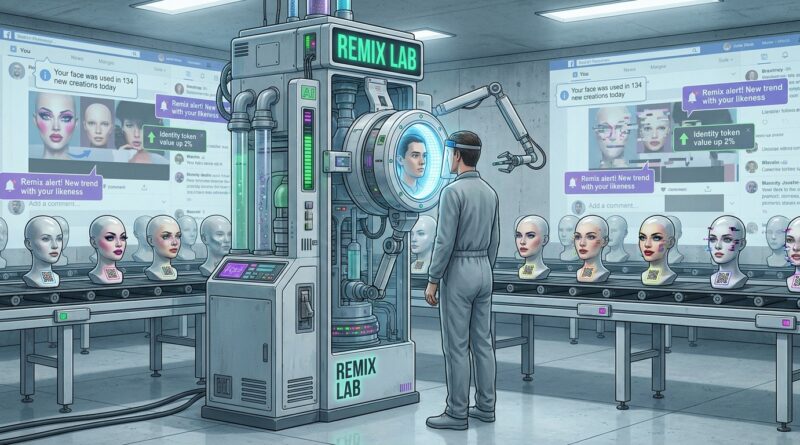
Homo Face‑Swappus: When Humans Evolved Into Free Stock Photos For Everyone’s AI
You post a photo. A platform sees “training data.” That is the part making people feel a little feral right now, and honestly, fair enough. One day your selfie is just a selfie. The next, some app is smoothing your skin, guessing your age from your cheekbones, or offering to “remix” your public photos into something you never asked for. Maybe it is your face. Maybe it is your kid’s face. Maybe it is that cursed 2013 haircut you thought the internet had agreed to forget. If you are worried about AI remixing my photos without consent, you are not overreacting. You are noticing that the rules quietly changed while everyone was busy arguing about chatbots. This is not only about privacy. It is about control, identity, and the weird new fact that your body can be copied, edited, scored, and repackaged before you even find the settings menu.
⚡ In a Hurry? Key Takeaways
- Yes, platforms can use public photos in new AI features unless you change settings, delete content, or make posts less visible.
- Check privacy, face recognition, ad, and AI settings now. Then stop posting public photos of kids or anyone who has not clearly agreed.
- Beauty filters and age-guessing tools are not harmless toys. They turn your face into data and can shape how systems judge you.
So what is actually happening?
The short version is ugly. Tech companies have a lot of photos. AI tools need a lot of photos. Somehow those two facts keep bumping into each other and calling it innovation.
Meta and other platforms are testing or rolling out tools that can transform, restyle, animate, or “remix” images. Public posts are often the easiest fuel for this. Not because users threw a parade and said “please use my face as machine chow,” but because public content is easier to reach, easier to process, and often buried under terms people never truly read.
At the same time, apps and platforms are getting better at reading faces. Not just recognizing who you are, but guessing how old you are, whether your face fits a beauty template, and how to alter it into something more clickable. It is less “cool future” and more “digital department store mannequin, now with your eyebrows.”
Why this feels so creepy, even when the feature sounds harmless
Because it crosses a line most normal people still believe exists.
You may accept that a social platform stores your photos. You may even expect it to crop them, compress them, or suggest tags. But using your image to train, test, or feed AI systems feels different because it is different. It turns a personal photo into reusable raw material.
That matters for three reasons.
1. Your photo stops being just a memory
It becomes a component. A nose shape. A skin texture. A smile pattern. A data point in a giant pile used to teach software how humans look and how human faces can be changed.
2. Consent gets fuzzy on purpose
Most people do not click a giant red button labeled “Yes, please make my head part of the robot future.” They leave an account public. They miss a pop-up. They do not realize a new feature arrived switched on by default. That is not meaningful consent. That is exhaustion with extra steps.
3. The edits are not neutral
Beauty filters do not just “improve” photos. They push faces toward a standard. Smoother skin. Bigger eyes. Narrower nose. Sharper jaw. Younger, cleaner, more generic. After enough exposure, real human faces start looking like the rough draft. That does a number on self-image, especially for teens.
What “AI remixing my photos without consent” usually looks like in real life
It is not always a dramatic deepfake scandal. Sometimes it is quieter and more annoying.
- A platform uses public images to power a generative feature.
- An app offers AI avatars built from your gallery and stores more than you expected.
- A beauty filter subtly changes your face until you start preferring the fake version.
- An age-estimation system scans facial structure to decide what content or ads you should see.
- A friend uploads a group shot, and now your face joins a system you never signed up for.
That last one is worth underlining. Even if you are careful, other people may not be. We are all standing in each other’s camera rolls now.
The big myth: “If it’s public, it’s fair game”
Legally, platforms often push in that direction. Ethically, it is nonsense.
Putting a photo on a public account is not the same as volunteering for facial analysis, model training, or image generation experiments. A public post means “people can see this.” It does not automatically mean “machines can ingest this forever and make new things from it.”
Tech companies love blurry lines because blurry lines save them paperwork.
How to pull the emergency brake, starting today
You probably cannot remove your face from every training set already built. Sorry. That ship may already be halfway across the ocean wearing your cheekbones. But you can still reduce future damage.
Make your accounts less public
This is the simplest move and still one of the best. Change Instagram, Facebook, TikTok, and other social accounts from public to private if you can. If you need a public account for work, be much more selective about what goes there.
Review AI and privacy settings
Look for anything mentioning:
- Generative AI
- Photo remixing
- Face recognition
- Personalization
- Training data
- Improving services
Those last two especially are where companies hide the bodies. Or, more accurately, your selfies.
Remove old public albums you forgot about
Many people lock down current posts but leave a graveyard of old public photos behind. Go back and check old Facebook albums, tagged photos, profile pictures, and ancient app accounts you have not visited in years.
Stop uploading kids’ faces casually
This one is uncomfortable, but important. Children cannot meaningfully agree to lifetime biometric exposure. If you do share, keep it private and limited. Better yet, skip full-face public posts when possible.
Use the opt-out forms when available
Some companies offer forms to object to AI training or certain data uses. They are often clunky. Fill them out anyway. One form will not save humanity, but it creates a record and limits passive consent.
Think twice before trying “fun” face apps
If an app wants your whole camera roll so it can turn you into a space elf, pause. Read the permissions. Check whether images are stored, reused, or shared with third parties. If the privacy policy reads like it was drafted by a haunted vending machine, close it.
What to check in Meta settings specifically
Because Meta is where a lot of people are getting surprised.
Settings change often, which is its own special hobby, but here is the general checklist:
- Set Facebook and Instagram posts to Friends or Private where possible.
- Review old public posts and limit their audience.
- Check ad settings and activity settings.
- Look for any notices about Meta AI, image generation, or content use.
- Turn off face recognition features if they are offered in your region.
- Read any objection or privacy rights form linked from Meta’s help pages.
If you are in a region with stronger privacy rights, use them. If you are not, use whatever controls exist and assume defaults are not there to protect you.
This is not vanity. It is power.
People sometimes dismiss this whole issue with, “Who cares, it’s just pictures.” That misses the point by a mile.
Your face is not just a picture online. It is a biometric identifier. It can be tracked across platforms, matched to accounts, scored by algorithms, and altered to fit commercial goals. Once that becomes normal, the real risk is not only embarrassment. It is losing the right to decide what counts as “you.”
And when systems get used to synthetic, polished, endlessly editable humans, actual human messiness starts to look like an error. That is bleak. Also bad for everyone with pores.
How to talk to family and friends without sounding like a bunker person
Try this simple version:
“I’m not against photos. I just don’t want apps using our faces to train tools or make edits we didn’t agree to. Let’s share more privately.”
That usually lands better than a 40-minute speech about machine learning and digital feudalism, though I admit the speech has its charms.
At a Glance: Comparison
| Feature/Aspect | Details | Verdict |
|---|---|---|
| Public photo sharing | Easy for friends to see, but also easiest for platforms to reuse in new AI features and analysis systems. | Convenient, but high risk. |
| Private or limited-audience posts | Cuts exposure and lowers the chance your photos become default fuel for remix tools. | Best everyday move. |
| Face filters and avatar apps | Fun for five minutes, but often collect sensitive facial data and normalize edited versions of you. | Use sparingly, if at all. |
Conclusion
The strange truth of this moment is that your online face can now matter more to platforms than your actual one. Meta is rolling out AI remix tools that can lean on public photos while people scramble to find the off switch. Other systems are scanning facial structure to guess age, sort users, or push faces through beauty templates until everyone starts looking like the same politely airbrushed cousin. That is why this is bigger than privacy and bigger than vanity. It is about whether humans get to stay authors of their own image, or whether we become unpaid parts suppliers for machine-made identity. The good news is you are not powerless. Tighten privacy settings. Cut public sharing. Question face apps. Be stingy with photos of kids. Make consent boring, clear, and stubborn. The emergency brake is not perfect, but it still works better than doing nothing while the internet quietly turns your face into a feature.