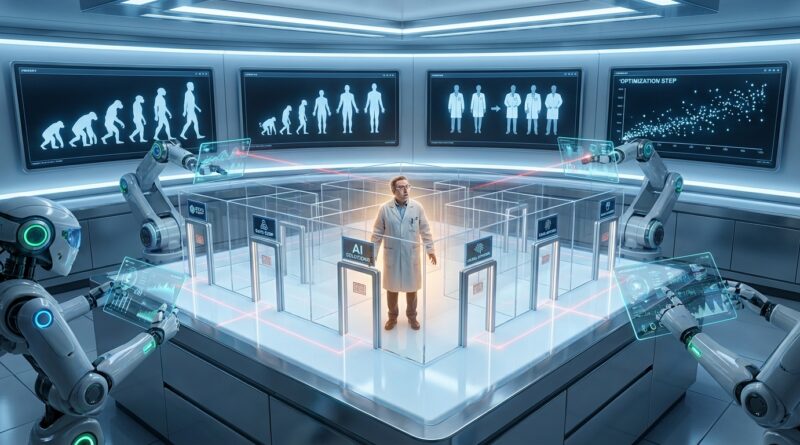
Homo Lab-Rat: When Self-Driving Science Starts Experimenting On Us
You are not weird for feeling a little queasy when you read that a lab can now plan experiments, run them with robots, analyze the results, and decide what to test next, all with barely a human in sight. The headlines make it sound clean and thrilling. Faster cures. Better batteries. Science at machine speed. Great. But buried inside that sales pitch is a much stranger question. If the lab becomes “self-driving,” what happens to the people who used to do the driving, or even decide where the road goes? That is where our satirical friend Homo Lab-Rat shows up. Not as a prediction that humans vanish tomorrow, but as a useful cartoon of a future where our job is no longer to discover, only to be measured, nudged, and optimized around. A satirical take on AI self-driving labs and human evolution helps us say the quiet part out loud. Progress for whom, and with whose consent?
⚡ In a Hurry? Key Takeaways
- AI self-driving labs can speed up research, but they do not answer the human question of who sets goals, who benefits, and who gets left out.
- When you hear “fully autonomous discovery,” ask simple questions: What is the system optimizing for, who approved it, and where can humans still say no?
- The real risk is not killer robots in lab coats. It is quietly accepting a system where humans become the inconvenient variable instead of the point of the work.
Meet Homo Lab-Rat
Picture a museum display from the future.
Homo Lab-Rat, early 21st century. Distinguishing traits: signed every consent form with one click, supplied data for free, celebrated “frictionless innovation,” and gradually lost the right to ask what the experiment was for.
That is the joke. It lands because it hits a nerve.
A lot of reporting on AI-run science treats automation as an obvious upgrade. Humans are slow. Humans make mistakes. Humans need sleep, salaries, and occasional reassurance. Machines, by contrast, can test thousands of combinations, spot patterns people miss, and keep going all night without demanding pizza or authorship credit.
Some of that is true. The problem is that speed gets mistaken for wisdom. And efficiency gets dressed up as destiny.
What a “Self-Driving Lab” Actually Means
For non-specialists, the phrase can sound like science fiction. In plain English, a self-driving lab is a mix of software, automation, sensors, and robotic equipment that can choose experiments, run them, analyze the outcomes, and use those results to decide what to do next.
Think of it as a research loop with fewer human hands in the middle.
The exciting version
The pitch is easy to understand.
Let the system test huge numbers of material recipes for solar cells. Let it hunt for new drug candidates. Let it sort through dead ends faster than a human team ever could. If the machine finds a better battery chemistry in weeks instead of years, that matters.
The less-advertised version
Every self-driving lab still depends on human choices. Someone defines the goal. Someone decides which data count. Someone picks what “success” means. Someone decides whether a wrong answer is a harmless detour or a public-health disaster.
So no, the human disappears only in the press release.
In the real world, humans move upward and outward. They stop pipetting. They start governing systems. Or, if things go badly, they stop governing too, and simply rubber-stamp whatever the machine says looks promising.
Why This Feels So Personal
The fear here is not just job loss, though that is part of it.
It is role loss.
For centuries, science has been one of the clearest places where humans made meaning out of the world. We formed hypotheses. We argued. We noticed weirdness. We changed our minds. We made mistakes, and the mistakes taught us something. Discovery was not just production. It was participation.
If that starts to look like a bottleneck instead of a value, people will feel the shift in their bones.
That is why the Homo Lab-Rat image works. It captures the anxiety that we are being recast from authors of knowledge into test subjects inside someone else’s optimization system.
The Satire Is Funny Because It Is Organized Like a User Agreement
Imagine the species update notes.
Homo Lab-Rat 2.0: now with improved compliance, reduced interpretive friction, and enhanced tolerance for opaque metrics.
Default habitat: platform-mediated institutions.
Primary food source: dashboards.
Predators: budget committees, benchmark culture, and the phrase “the model suggests.”
Natural defense: asking annoying questions in meetings.
Endangered because of declining habitat for dissent.
That is satire, yes. But it points at a real danger. Once systems become complicated enough, people stop challenging the frame. They argue over outputs and ignore the power that shaped the inputs.
The Real Issue Is Not Intelligence. It Is Agency.
When people hear “AI in science,” they often jump straight to whether the machine is smart enough. That matters, but it is not the first question.
The first question is who still has agency.
Who picks the problem?
A lab can optimize brilliantly for the wrong goal. A system that is amazing at finding profitable compounds is not the same as one aimed at neglected diseases. A materials platform tuned for commercial patents is not automatically serving the public good.
Who can challenge the result?
If researchers are pressured to trust the loop because it is faster than they are, then “human oversight” becomes decorative. It is there for legal comfort, not real control.
Who carries the risk?
The benefits of automated science can be distributed one way, while the costs land somewhere else entirely. Workers lose autonomy. Patients get treated as data streams. Universities become testing grounds for tools they do not govern. The public gets told this is all progress because a slide deck said so.
What Humans Still Do Better, Even in Fancy Robot Labs
This is the part that gets flattened in hype pieces.
Humans are not just slower machines with feelings. We do a different kind of work.
We decide what matters
A machine can search a space. It cannot, on its own, tell you why that search deserves resources instead of some other urgent problem.
We notice when the frame is broken
An automated system can be very good at answering a narrow question badly posed. Humans are still better at saying, “Hang on, why are we measuring this and not that?”
We hold moral responsibility
No one wants to hear a hospital, regulator, or research university say, “The autonomous platform made us do it.” If a result harms people, responsibility snaps right back to humans. Funny how that works.
We can refuse
This one matters most. A scientific culture worth keeping includes the right to object, pause, dissent, and say no. No system should be called advanced if it makes refusal harder.
Questions Ordinary Readers and Scientists Should Start Asking
You do not need a PhD in machine learning to push back intelligently. You just need better questions.
1. What is the lab optimizing for?
Speed? Patent output? Publication count? A narrow success metric can distort the whole enterprise.
2. Who decided that goal?
Was it scientists, public institutions, company leadership, investors, or procurement teams?
3. Where is the human veto?
If no one can meaningfully stop the loop, that is not oversight. That is ceremonial supervision.
4. What data trained or guided the system?
Bad inputs do not become good science just because a robot arm handled them neatly.
5. Who benefits if this works?
The answer should not always be “the platform owner.”
6. What happens to scientific skill?
If younger researchers are cut out of the hands-on parts of discovery, are we building a future with fewer people who can truly understand, question, and repair the system?
For Working Scientists, This Is Also a Workplace Story
If you work in or around research, the existential stuff quickly becomes practical.
Will you be judged against machine speed?
Will your lab adopt tools before proper review because nobody wants to seem old-fashioned?
Will your expertise count less if it cannot be reduced to a benchmark score?
These are not abstract worries. They are management questions, funding questions, hiring questions, and training questions.
It is worth saying plainly: automation that removes drudgery can be good. Automation that removes judgment and then blames humans when things go wrong is not good. That is just bad management with better branding.
How to Talk About This Without Sounding Like You Fear Progress
This part is tricky. The second you raise concerns, someone will act like you want to go back to mixing chemicals by candlelight.
You do not need to take that bait.
Try this instead.
“I’m not against automated science. I want clarity about governance, consent, accountability, and human control.”
That is a serious position. It is hard to dismiss unless someone is trying very hard not to answer.
A useful rule of thumb
If a system is described as revolutionary, ask whether it also expands human choice, understanding, and shared benefit. If it only expands throughput and managerial control, the revolution may be aimed at you.
So, What Exactly Are We Still Evolving For?
Not to become obsolete pets for our own tools.
Not to smile politely while software redraws the boundaries of consent.
Not to confuse optimization with meaning.
If there is a hopeful answer, it is this: humans may do less of the repetitive middle and more of the framing, the ethics, the interpretation, and the public decision-making. But that better future does not happen by accident. It happens only if we insist that science is not just a production line for findings. It is a social process that needs trust, legitimacy, and room for human judgment.
That sounds less flashy than “fully autonomous discovery.” It is also much more honest.
At a Glance: Comparison
| Feature/Aspect | Details | Verdict |
|---|---|---|
| Speed of discovery | Self-driving labs can run and refine experiments far faster than human teams alone. | Useful, but speed is not the same as wisdom. |
| Human role | Humans shift from hands-on experimentation to goal-setting, oversight, interpretation, and accountability. | Still essential, unless institutions choose to sideline them. |
| Main risk | Not that machines “do science,” but that people quietly lose agency while being told it is progress. | This is the question readers should watch most closely. |
Conclusion
The point of a satirical take on AI self-driving labs and human evolution is not to sneer at scientific progress or pretend robot-assisted research has no value. It is to give a name to the unease many people already feel when they hear that discovery itself is becoming automated. Once you can name that fear, you can examine it instead of just absorbing the hype. The useful question is not whether machines can help run experiments. Of course they can. The sharper question is whether humans still get to shape the purpose of science, consent to its terms, and share in its benefits. If we let code quietly rewrite our role in knowledge creation, we should not be surprised when we wake up cast as the slow, sentimental variable to be managed away. The good news is that this is still a choice. Better public questions, better workplace questions, and a little stubbornness about agency can keep Homo Lab-Rat where it belongs, in the joke section, not the family tree.