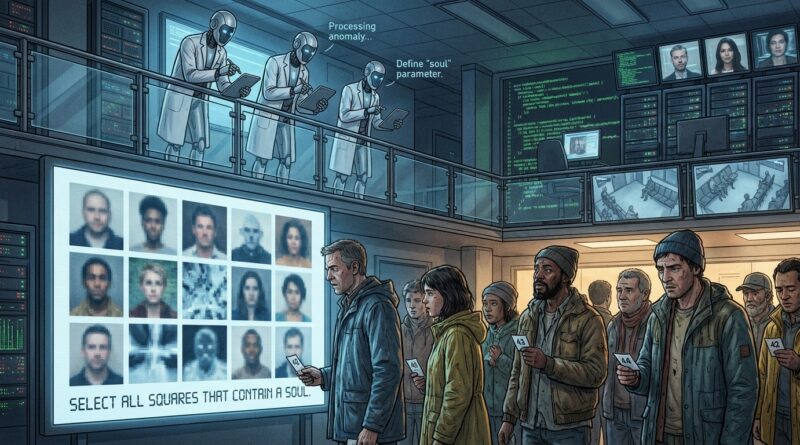
Homo Verified-ish: How CAPTCHAs Became Humanity’s Final Performance Review
You are not crazy if online life has started to feel like a job where your main duty is proving you exist. You open a site to pay a bill, read a recipe, or buy socks, and suddenly you are identifying bicycles from three angles like a tired temp worker training a suspicious machine. Meanwhile, software is busy making fake faces, cloned voices, and polished little synthetic personalities at industrial scale. So yes, it is a bit rich that the burden of proof keeps landing on the one creature in this story with a pulse.
That is the weird comedy of modern trust. The internet used to ask, “Can you type these squiggly letters?” Now it asks, “Can you perform humanity convincingly enough for our filters?” CAPTCHAs were supposed to stop bots. Instead, they became a small daily ritual in a much bigger identity crisis. The joke is funny until it isn’t. Because under the satire sits a real fear. If machines can fake being us, and platforms keep asking us to certify ourselves, are humans slowly being reduced to the verification department?
⚡ In a Hurry? Key Takeaways
- CAPTCHAs started as bot filters, but now they symbolize a bigger problem: humans are being asked to constantly prove authenticity in systems flooded with fake content and fake identities.
- Use small habits to protect yourself. Slow down before trusting faces, voices, urgent messages, and “verified” looking accounts. Check the source outside the platform when something feels off.
- The real issue is not just annoyance. It is trust, privacy, and control. If we do not question how identity checks work, we risk becoming unpaid proof-of-human labor for automated systems.
The checkbox heard round the species
There was a time when clicking “I am not a robot” felt almost charming. A little absurd, sure, but manageable. You clicked the box, the website nodded, and everyone moved on with their day.
Now the ritual has evolved. First the checkbox. Then the image grid. Then the follow-up image grid because apparently one crosswalk escaped your notice. Then a slow loading spinner while some invisible scoring system studies your mouse movements like a digital phrenologist.
The message underneath all this is hard to miss. The machine does not trust appearances anymore. That would be wise, except the machine also does not trust you.
How we got here
CAPTCHA began with a practical goal. Websites needed a way to tell humans from automated scripts. Early bots were bad at reading warped text, so websites showed users distorted letters and numbers. Humans grumbled, typed them in, and mostly won.
Then bots got better. Computer vision improved. Pattern matching improved. Cheap human labor was also used to solve CAPTCHAs at scale. So the tests changed. Instead of reading text, users had to identify traffic lights, buses, stairs, storefronts, chimneys, and occasionally what looked like a hostage photo of half a fire hydrant.
That shift matters. We stopped proving literacy and started proving perception. We were no longer just typing. We were demonstrating that we could see the world in a roughly human way.
The satire writes itself
Look at the setup honestly. Machines are making fake essays, fake selfies, fake résumés, fake customer support chats, fake girlfriends, fake CEOs on Zoom, and fake grandchildren asking for gift cards. In response, flesh-and-blood people are being asked to click all the squares containing a motorcycle.
If a novelist wrote this ten years ago, an editor would have said, “A little on the nose.”
It feels ridiculous because it is ridiculous. But it is also logical. Once software can imitate enough human signals, platforms start relying on other signals. Timing. Behavior. Browsing history. Device reputation. Mouse movement. Location. Risk score. In plain English, the internet has moved from “Can you solve this puzzle?” to “Can you behave like the kind of human our system expects?”
From CAPTCHA to full-body audition
This is where the joke gets sharper. The old test asked whether you could solve a task. The new environment asks whether you can pass a vibe check.
Think about what many systems now use:
- How fast you type
- How your cursor moves
- What device you use
- Whether your location matches your usual pattern
- How old your account is
- Whether your behavior resembles previous “good users”
That can help block abuse. It can also create a strange side effect. Real humans who are in a hurry, using privacy tools, traveling, sharing devices, or simply acting outside the norm can look suspicious. Meanwhile, more advanced bots are getting very good at looking ordinary.
So now we are not just human. We need to be statistically familiar humans.
The rise of “verified-ish” identity
This is the deepfake era’s favorite trick. We are surrounded by things that look close enough. A voice that sounds like your boss. A face that resembles a person who never existed. A profile that seems genuine until you look twice. A video that is almost believable, which is often enough.
That “almost” is doing a lot of damage.
Once enough fake material floods the system, every real thing has to work harder to be believed. That is why so many people feel tired in a way they cannot quite name. It is not just screen fatigue. It is authenticity fatigue.
Why this feels personal
CAPTCHAs are annoying, but the emotion underneath them is bigger than annoyance. They touch a nerve because they flip the old social order.
We built tools to help us navigate the world. Now the tools sit at the door with a clipboard, asking us to justify our existence.
That lands especially hard because human identity is already under pressure online. Photos can be generated. Voices can be cloned. Writing styles can be copied. Entire fake backstories can be assembled in minutes. If enough synthetic people walk into the room, actual people start getting treated like suspects.
That is the anxiety many readers already feel but rarely put into words. Humans are becoming the verification layer for machine-heavy systems. We are the last wet signature in a process designed by software, for software, to defend against software.
What CAPTCHAs are really measuring now
Most modern anti-bot systems are not measuring one thing. They are measuring confidence. Not moral confidence. Statistical confidence.
The site asks, “How likely is this visitor to be a normal person doing a normal thing?”
That sounds sensible until you remember two uncomfortable facts.
First, plenty of harmful activity is done by real people. Second, plenty of harmless activity looks weird. Accessibility tools can look weird. Privacy-conscious browsing can look weird. Shared networks can look weird. Traveling can look weird. Being bad at clicking tiny boxes can look very weird indeed.
So the test is not “Are you human?” It is “Are you low-friction enough for our risk model?” That is a very different question.
Deepfakes made the trust problem much worse
Deepfakes did not invent deception. People have always lied online. What changed is the scale and the polish. You no longer need a design team, a voice actor, and a weekend. You need a prompt and a few minutes.
That matters because humans are wired to trust certain signals. Faces. Voices. Eye contact. Tone. Familiar phrasing. When those signals can be manufactured cheaply, the old shortcuts stop working.
And when old shortcuts stop working, platforms pile on more checks. More scans. More flags. More identity confirmation. More “for your safety” pop-ups that somehow make you feel less safe.
The ugly little tradeoff
To fight fake identities, companies often want more data from real people. More phone numbers. More selfies. More ID scans. More behavioral tracking. More permanent links between your body and your account.
This can reduce fraud in some cases. It can also create new risks. If identity systems get breached, abused, or overused, you cannot simply reset your face the way you reset a password.
That is the part worth saying out loud. Stronger verification is not free. It costs privacy, convenience, and sometimes dignity.
How to push back without throwing your laptop into a pond
You do not have to accept every identity ritual as normal or harmless. You also do not have to become a digital hermit. A few grounded habits help.
1. Treat “looks real” as the start of a check, not the end
If you get a voice note from your “boss” asking for money, or a video from a family member in distress, pause. Verify through another channel. Call them. Text the number you already had. Start from a trusted contact path, not the message in front of you.
2. Be stingy with ID uploads
If a service asks for your government ID or a selfie scan, ask whether it is truly necessary. Is there another option? Is this a bank, or is this a random app that sells novelty mugs? Not every platform deserves your face.
3. Use strong account security
Turn on multi-factor authentication where it matters. Use an authenticator app if possible. Use unique passwords. This will not fix deepfakes, but it does reduce the chance that someone can walk into your accounts using old-fashioned theft.
4. Normalize healthy skepticism
You do not need to become paranoid. Just become slightly less gullible than the average scam funnel expects. That alone goes a long way.
5. Support systems that respect people
The best security tools are the ones that protect users without treating them like suspects first and customers second. If a company makes verification painful, invasive, or endless, that is worth noticing.
What companies should do, if they want to stop acting like silicon middle management
It is easy to mock CAPTCHAs, but the bigger fix is not “better traffic light photos.” It is better design.
Good systems should:
- Use layered security instead of punishing every user equally
- Offer verification methods that do not require maximum data collection
- Explain why a check is happening
- Support accessibility from the start
- Let people recover accounts without absurd hoops
- Respect the fact that privacy tools are not a confession of guilt
Security works best when it is quiet, proportional, and humane. Not theatrical.
The broader cultural shift nobody asked for
There is a strange status reversal happening online. Machines are doing more of the speaking, posting, summarizing, recommending, and impersonating. Humans are doing more of the confirming, identifying, and appealing decisions.
That is why the CAPTCHA joke keeps landing. It captures a real cultural change in one tiny, irritating ritual. We built a giant content machine, filled it with synthetic output, and now the remaining biological participants keep getting called to the front desk for badge checks.
It would be funny if it were not also a warning.
So, are we doomed to click buses forever?
Probably not forever. CAPTCHAs will keep changing because attackers keep changing. Some will become invisible. Some will move to device trust and passkeys. Some identity checks will become more secure and less annoying. That part is possible.
But the deeper issue will stay with us. As generated media gets cheaper and more convincing, the value of trustworthy human signals goes up. The fight is no longer just against spam bots. It is about preserving meaningful trust in a space where almost anything can be faked.
That means the right response is not only technical. It is social. We need better norms, better skepticism, better privacy protections, and better language for what this feels like.
At a Glance: Comparison
| Feature/Aspect | Details | Verdict |
|---|---|---|
| Classic CAPTCHA | Simple challenge such as text entry or image selection to block basic bots. | Useful in its day, now more symbol than solution. |
| Modern behavior checks | Systems score mouse movement, device trust, location, account history, and browsing patterns. | More effective, but can feel invasive and can misread real users. |
| Deepfake-era identity checks | Extra verification using selfies, IDs, or multi-step authentication to counter fake people and synthetic media. | Sometimes necessary, but expensive in privacy and trust if overused. |
Conclusion
The next time a website asks you to prove you are human by locating seventeen blurred bicycles, it helps to know your irritation is not petty. It is a rational response to a digital world that keeps automating expression while outsourcing trust back to people. Right now, software can generate faces, voices, and entire identities faster than most of us can clear a login challenge. Naming that absurdity matters. It gives us a way to talk about privacy, skepticism, and the creeping feeling that humans are being reassigned from participants to proof. The good news is that we are not powerless. We can question invasive checks, demand better design, verify important claims through trusted channels, and stay a little harder to fool. The internet may keep asking for a performance review from humanity. We do not have to pretend that is normal, and we definitely do not have to stop laughing at it.