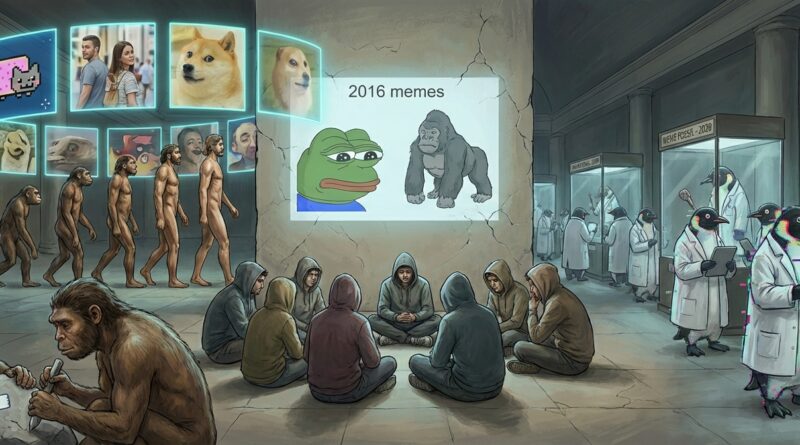
Homo Nostalgicus: When Humans Reboot Their Memes Instead Of Their Brains
You are not crazy. The feed really does feel haunted. One minute it is the same 2016 joke in a fresh font. The next, some AI slop account is posting fake science about resurrecting dire wolves or decoding your personality from coffee order data. Meanwhile, younger users scroll past all this like it is normal, or worse, charmingly retro. That sting you feel is real. It is the weird discomfort of watching human culture act less like progress and more like a desktop computer trapped in a restart loop. We used to worry technology would make us less human in some dramatic sci-fi way. Instead, it mostly turned us into creatures that remix panic, nostalgia, and recycled punchlines at industrial scale. If you want a satirical take on human evolution and AI memes, this is the uncomfortable punchline. We are still evolving. We are just doing it in public, badly, and with the comments on.
⚡ In a Hurry? Key Takeaways
- Humans are not losing originality all at once. We are slowly trading it for faster, safer, more repeatable cultural habits like memes, nostalgia, and AI-assisted remixing.
- If your feed feels stale, change your inputs on purpose. Follow fewer trend accounts, save longer reads, and spend more time making than reposting.
- The danger is not just bad AI. It is becoming so predictable that your tastes, fears, and jokes turn into easy training data for someone else’s machine.
Welcome to Homo Nostalgicus
Biology gave us opposable thumbs, large brains, and the ability to panic about the future. The internet added infinite copying, zero memory, and an attention economy that rewards the same joke every eleven months.
That is how we got Homo Nostalgicus. A highly social creature that mistakes repetition for meaning and calls it community.
This species is easy to spot. It shares old reaction images like sacred cave paintings. It treats every tech fear from ten years ago as a reusable aesthetic. It sees AI-generated garbage and responds not with alarm, but with another layered meme referencing a Vine that referenced a Tumblr post that was already referencing an older joke.
None of this means people are dumb. It means platforms train us toward low-risk behavior. Familiarity travels. Originality limps.
The Algorithm Loves a Rerun
If you have ever wondered why your feed feels less alive than it used to, the answer is boring and a little depressing. Repetition works.
Platforms do not care whether a joke is fresh. They care whether it gets a reaction. Nostalgia is reliable. Outrage is reliable. Fake breakthroughs are extremely reliable. Put all three together and you get the modern feed, where every week brings a new miracle AI claim, a rebooted meme format, and a comment section pretending this is either utopia or the end times.
The machine is not picky. It will serve you old panic in a new wrapper forever.
Why old jokes keep beating new ideas
New ideas take effort. Old jokes come with instructions built in. You already know the tone. You already know how to respond. You already know which side of the argument to join.
That makes old formats perfect for algorithmic life. They spread quickly, require little context, and let people signal identity without saying much. In evolutionary terms, they are the cockroaches of culture. Not glamorous. Very hard to kill.
If this sounds familiar, it overlaps with Homo Copy-Pasta: How We Outsourced Original Thought To The Algorithmic Hive Mind, which makes the same ugly point from another angle. Once the system rewards remix over risk, copy-paste stops being a bad habit and starts looking like survival.
AI Did Not Kill Original Thought. It Industrialized the Shortcut
A lot of people talk about AI as if it arrived from space and suddenly ruined everything. That gives humans too much credit and too little blame.
We were already primed for this. We had built years of culture around speed, familiarity, and low-friction sharing. AI just turned that tendency into a factory line.
Now the same internet that once rewarded mediocre reposting can reward synthetic mediocre reposting at scale. That is a big shift. Not because machines became creative masters, but because they became extremely good at making “close enough” content faster than humans can get bored of it.
The real creepiness
The real issue is not that AI can draw weird hands or write bland captions. It is that it can flood the zone with average. It can fill every cultural gap with something almost human, almost funny, almost insightful.
And once “almost” is good enough for the feed, the feed stops asking for better.
That is the moment many people are feeling but struggling to name. It is not just fear of AI. It is grief for friction. For weirdness. For the old days when seeing something original felt possible, even if rare.
Why younger users seem weirdly calm about it
This part unsettles a lot of adults. You look at younger users and think, why are they treating my deepest tech anxieties like a mood board?
Because for them, instability is the default setting.
If you grew up through platform churn, fake viral stories, endless repost culture, and influencer sincerity that turned out to be performance, then AI slop does not feel like a shocking break from reality. It feels like the next skin on the same app.
That does not mean younger users are naive. Often they are more fluent in spotting fakes, more flexible with identity, and less sentimental about authenticity as a sacred object. But it also means they can normalize a lot of nonsense very quickly.
What older users call cultural decay, younger users may call background texture.
Hoax science, meme panic, and the cosplay of knowledge
One of the stranger side effects of all this is how fake expertise spreads. Every week there is a miracle discovery, a terrifying warning, or a breathless claim that scientists have confirmed something absurd. Most of it is half-read, over-shared, and stripped of context before lunch.
This is not new. What is new is the speed of decorative intelligence. People can now sound informed faster than ever. AI helps write the summary. Memes help carry it. Nostalgia helps soften skepticism because the format feels familiar, cozy, and safe.
So a fake story about brain chips, immortality, ancient DNA, or consciousness in chatbots can move through the culture not because people truly believe it, but because it is emotionally useful. It helps them perform fear, wonder, or cleverness on cue.
That is a very human trait, unfortunately.
A satirical field guide to our latest evolutionary traits
Trait 1. Pattern worship
We now trust repeated formats more than fresh thinking. If we have seen the structure before, we lower our guard.
Trait 2. Panic as identity
Some people build a whole personality around either loving AI or fearing it. Both are easy. Both are marketable. Neither requires much thought.
Trait 3. Nostalgia camouflage
Old media styles make new nonsense feel acceptable. Put a bad idea in retro packaging and suddenly it looks like culture.
Trait 4. Synthetic companionship
People increasingly relate to generated content as if it contains intention, soul, or at least vibes. That sounds silly until you remember humans name cars and cry at cartoon lamps.
Trait 5. Outsourced memory
We no longer remember things. We remember formats for finding things again. This is efficient. It is also how you end up feeling informed while knowing almost nothing.
How not to devolve into training data with shoes
You do not need to flee to a cabin and write your thoughts in tree bark. You just need a little resistance.
Choose slower inputs
Add at least a few sources that are not optimized for immediate reaction. Long reads, books, newsletters, niche forums, and podcasts with actual reporting help rebuild your tolerance for context.
Make more than you repost
Write your own bad paragraph. Take your own mediocre photo. Have your own half-finished opinion. Human originality is often awkward at first. That is not failure. That is proof of life.
Teach kids and teens to ask one extra question
Not “is this true?” They already know everything online can be fake. Ask “who benefits if I keep watching this?” That is the more useful survival skill now.
Treat nostalgia like dessert
Fun in small doses. A bad diet if it becomes your main fuel.
Notice when your panic is prepackaged
If your fear arrives in a perfectly shareable format with a ready-made joke attached, pause. Somebody probably did a lot of work to make that emotion frictionless.
At a Glance: Comparison
| Feature/Aspect | Details | Verdict |
|---|---|---|
| Meme culture | Fast, familiar, easy to share, but heavily dependent on repetition and recycled context | Useful for connection, bad as a full-time replacement for thought |
| AI-generated content | Cheap, endless, good at producing “close enough” text and images that fill attention gaps | Handy tool, dangerous when quantity starts setting the cultural standard |
| Human originality | Slower, messier, less optimized, but capable of surprise, depth, and actual perspective | Still worth protecting, especially because it looks inefficient at first |
Conclusion
If your feed has started to feel like a museum gift shop stocked by a chatbot, you are picking up on something real. Too much of online life now swings between AI worship and AI apocalypse talk, while the quieter issue gets missed. Our sense of what it means to be human is being shaped by recycled memes, hoax science stories, nostalgia loops, and machine-made filler that rewards familiarity over depth. Looking at this mess through a satirical, biology-minded lens helps because it lowers the temperature without lowering the stakes. It gives you a name for the feeling that time, originality, and even panic are being remixed by systems built to keep you scrolling. And once you can name it, you can push back. You can choose better inputs, model better habits for your kids, and resist becoming just more background noise for somebody else’s training set. That may not feel heroic. It is still evolution, just with better boundaries.