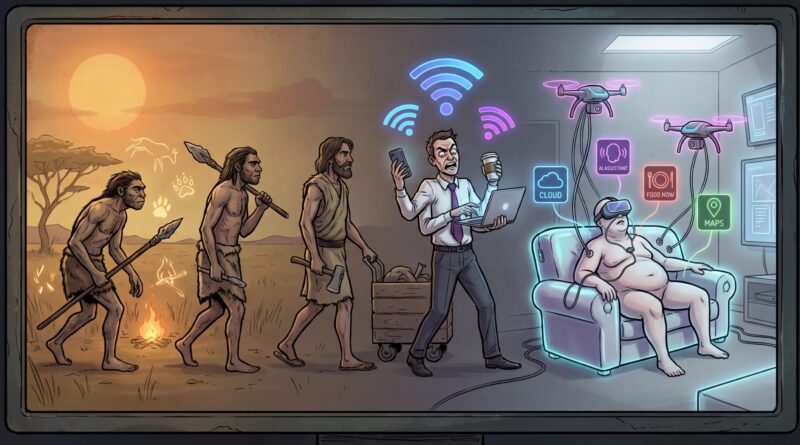
Homo Lazy-Us: How We Outsourced Survival Instinct To Convenience Apps
You are not lazy because you ordered toothpaste at 11:47 p.m. You are not weak because your brain now expects dinner, entertainment, answers and emotional validation to arrive with a tap. A lot of people feel the same strange mix right now. We are overstimulated, mildly helpless and somehow tired from doing less. That is the joke at the center of modern life. Our ancestors learned to track weather, food and danger. We learn to track packages, battery percentage and whether the delivery driver is “2 stops away.” Convenience tech did not just save us time. It retrained our instincts. The result is a very advanced species that can summon pad thai from bed but may need three apps, two reminders and a tutorial to mail a letter. That is funny. It is also worth taking seriously, because the real human experiment is already underway, and your nervous system is in the beta group.
⚡ In a Hurry? Key Takeaways
- Convenience technology is not making humans useless, but it is quietly shrinking our tolerance for friction, delay and uncertainty.
- Pick one small task each week to do without an app, like navigating a short route from memory or cooking one basic meal without a video.
- The goal is not to reject tech. It is to keep a few core skills and a calmer brain so every tiny inconvenience does not feel like a survival event.
The rise of Homo Lazy-Us
Let us be fair to ourselves first. Most convenience tools started as genuine help. GPS got us unstuck. Grocery delivery saved time. Smart assistants removed boring steps. Predictive text made thumbs less miserable. None of this is evil. A map app is not a villain. Neither is same-day shipping.
The problem starts when help becomes default, and default becomes dependency.
Humans are very good at outsourcing effort. That is part of why civilization exists. We made wheels so we would not carry everything. We made washing machines so we would not beat shirts against rocks. Great. Progress. No notes.
But convenience apps do something sneakier than old-school tools. They do not just reduce labor. They reduce waiting, uncertainty, memory use, planning and even minor discomfort. Those are small mental workouts. When you remove enough of them, the brain gets less practice at being patient, adaptable and resourceful.
So now a lot of us can compare 47 air fryers in under five minutes, yet feel spiritually attacked when the Wi-Fi drops for 20 seconds.
Your survival hardware met a product team
Ancient human wiring is pretty simple. Notice novelty. Seek reward. Avoid pain. Save energy. Watch for threats. Stay near the tribe. That hardware kept people alive.
Now imagine pitching that same wiring to a modern app company.
Novelty
Infinite feeds serve fresh content forever. Your brain says, “Something new. Maybe important.” Usually it is a raccoon stealing cat food or a stranger reviewing a blender with unusual passion, but the wiring does not know that.
Reward
Likes, streaks, deliveries, recommendations and little red badges all trigger the same basic loop. Maybe this next tap gives me something good.
Avoid pain
Hungry. Tap. Bored. Tap. Lonely. Tap. Need to think. Autocomplete. Need to remember. Cloud backup. Need to choose. Algorithm picks for you.
Save energy
This is the big one. The brain loves shortcuts. It always has. That was useful when calories were scarce. It is less useful when every service on earth is competing to remove one more second of effort from buying socks.
So no, you are not imagining it. Many people really are becoming less tolerant of normal life friction because technology has been very carefully optimized to smooth it away.
How convenience changed the definition of “hard”
“Hard” used to mean hunting, hauling, fixing, walking, waiting, enduring weather and figuring things out with limited information.
Now “hard” often means:
- Choosing a restaurant without reading 300 reviews
- Getting across town when your phone battery is dead
- Cooking rice without opening a video
- Being alone with your thoughts in a checkout line
- Remembering a phone number that is not your own
That sounds silly until you realize how much confidence comes from basic competence. When every task gets outsourced, you save effort in the short term but lose self-trust in the long term. You start to feel capable only when the system is working. App up. Signal strong. Delivery on time. Calendar synced. AI assistant awake.
The minute one of those layers breaks, modern humans can go from “peak productivity” to “Victorian orphan in a storm” very quickly.
The GPS brain and the YouTube egg problem
There are two especially clear examples of this shift.
Navigation
GPS is amazing. It has also made many people worse at building mental maps. When an app gives turn-by-turn instructions, you can arrive somewhere without ever really learning where you are. Left here. Right there. Recalculating. Done.
That is fine until you lose signal, take a detour or need to explain the route to someone else. Many people can reach a place repeatedly and still not know how it connects to the rest of the city. They did not navigate. They followed.
Basic tasks
The internet is a wonderful teacher. It is also now a crutch for things we used to learn by doing. Need to boil an egg? Watch a short. Need to sew a button? Video. Need to restart a router? Search. Again, not bad on its own. But if every tiny skill requires content first, action second, then confidence never really forms.
You begin to feel “unprepared for life” not because life got impossible, but because your first move is no longer to try. It is to consult the machine.
AI copilots are the newest comfort blanket
This is where the conversation gets sharper. AI tools are often sold as assistants, and many are genuinely useful. They can summarize, draft, brainstorm, organize and answer questions fast.
But they also slide neatly into the same pattern as every other convenience tool. Less effort. Less uncertainty. Less blank-page pain.
That can be helpful. It can also make thinking feel optional.
If every email starts with AI, every idea gets polished by AI, every question gets answered before you wrestle with it, then your brain gets fewer reps in ambiguity. And ambiguity is where judgment grows.
Having help is fine. Never practicing without help is where people get soft around the edges.
This is not a moral failure. It is a system doing its job
Here is the relieving part. If you feel oddly dependent, distractible or low-grade helpless, that does not mean you personally failed at adulthood. It means you are a human nervous system living inside a giant convenience casino.
Every major platform wants to reduce your effort and increase your return visits. Every logistics company wants waiting to feel unnatural. Every productivity app wants forgetting to feel unacceptable. Every recommendation engine wants deciding to feel unnecessary.
That is not a conspiracy. It is a business model.
Which means the fix is not shame. The fix is noticing what is happening, then putting a little useful friction back into your life on purpose.
How to become slightly less domesticated by your devices
1. Keep one survival skill analog
Pick one thing you can still do if your phone dies. It could be reading a paper map, memorizing key phone numbers, making one week of simple meals, using cash, or knowing the route to your doctor without GPS.
You do not need to become a wilderness prepper. Just stop being completely cloud-based as a person.
2. Practice “micro-friction”
Do one small annoying thing manually each day. Look up store hours without a voice assistant. Walk to the corner shop instead of ordering. Wait ten minutes before checking a notification. Write a short list on paper. These are tiny acts, but they rebuild patience fast.
3. Learn one boring household skill
Boil eggs. Sew a button. Unclog a drain. Reset the breaker. Cook pasta without checking a reel every 45 seconds. Basic competence calms the nervous system because it reminds you that not every problem needs an interface.
4. Use AI as a second brain, not your only one
Try this simple rule. Think first, ask second. Draft badly before getting help. Solve part of the problem before handing it over. You want AI to extend your thinking, not replace the part that can still reason through a mess.
5. Remove one layer of fake urgency
Not every message is urgent. Not every package needs tracking updates. Not every app deserves notification privileges. Turn off the alerts that convert normal life into a series of tiny alarms.
6. Let yourself be mildly lost once in a while
Safely, obviously. But yes, let yourself navigate a familiar area without GPS now and then. Your brain is better at spatial learning than it gets credit for. It just needs a chance to do the work.
The satire part, because we need it
There is something deeply funny about a species that crossed oceans, domesticated fire and built cities, only to become emotionally destabilized when a food delivery estimate changes from 18 minutes to 31.
We have smart homes full of devices that answer questions no one asked, while half of us still cannot find the apartment fuse box. We carry more computing power than the Apollo missions, then use it to ask whether almond milk has gone bad.
This is why a satirical article on human evolution and convenience technology hits a nerve. The joke lands because it is true. We are not becoming robot slaves in one dramatic moment. We are becoming slightly less sturdy in a thousand comfortable ways.
And to be clear, comfort is not the enemy. Total dependence on comfort is.
What healthy convenience actually looks like
The goal is not to throw your phone into a river and churn your own butter. Healthy convenience means using tools where they genuinely help, while keeping enough skill, patience and judgment that a small disruption does not wreck your day.
A good test is this: if the app vanished tomorrow, would you be inconvenienced or incapacitated?
Inconvenienced is normal. Incapacitated is the warning light.
That is the difference between using technology and being quietly trained by it.
At a Glance: Comparison
| Feature/Aspect | Details | Verdict |
|---|---|---|
| GPS and navigation | Gets you there fast, but can weaken your mental map if you never navigate on your own. | Useful tool. Bad boss. |
| Delivery and on-demand services | Saves time and energy, but can make waiting, planning and minor errands feel unbearable. | Best in moderation. |
| AI copilots and autocomplete | Great for speed and support, but risky if you stop drafting, deciding and reasoning for yourself. | Assist, do not surrender. |
Conclusion
The loudest AI debates keep jumping straight to machine overlords, extinction plots and robot genius. Meanwhile, the more immediate and much funnier story is happening in plain sight. Our nervous systems are being stress-tested by notifications, instant logistics and predictive everything. If that has left you feeling overstimulated, underprepared or weirdly fragile in the face of tiny inconveniences, take comfort in this. You are not broken. You are living through a large, messy experiment in outsourced effort. The useful response is not panic. It is practice. Laugh at the absurdity. Then pick one small thing this week to do without the comfort layer. Walk somewhere without GPS. Cook one meal from memory. Turn off one unnecessary alert. That is how you start getting a little less domesticated by your devices, while still enjoying the parts of modern tech that actually help.