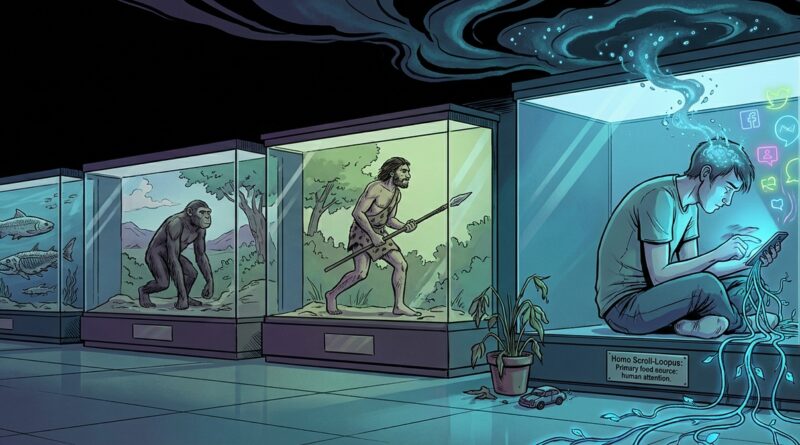
Homo Scroll‑Loopus: When Humans Evolved To Feed The Algorithms More Than Their Own Children
You were just checking one thing. A recipe. A weather update. Maybe the name of that actor from the show with the grim detective and the suspiciously clean village. Then somehow it is 40 minutes later and you are deep into a stranger’s divorce, a raccoon stealing cat food, and a man explaining why civilization fell because teenagers like oat milk. If that feels ridiculous, good. It is ridiculous. It is also normal now. That is the part that should bother us.
We keep talking about human evolution like the big question is whether machines will become more like us. Meanwhile, many of us are already becoming more useful to machines. Not smarter. Not calmer. Just easier to measure, predict, and keep scrolling. Call it satire if you want. “Homo Scroll-Loopus” is funny because it is painfully close to a field guide entry for modern life. The joke lands because your attention is being trained, your emotions are being sorted, and your spare minutes are being fed into systems that do not love you back.
⚡ In a Hurry? Key Takeaways
- Humans are already shaping ourselves around algorithms, often without noticing it.
- Start by tracking which apps steal time, trigger emotion, and leave you feeling oddly empty.
- This is not about blaming yourself. It is about spotting systems built to keep you engaged, not well.
Species Profile: Homo Scroll-Loopus
Common name: the modern phone owner.
Habitat: couches, bus stops, beds, bathrooms, dinner tables, and any line longer than seven seconds.
Diet: outrage crumbs, novelty pellets, low-grade dopamine, and videos with subtitles large enough to read while emotionally exhausted.
Mating call: “Wait, look at this one.”
Predators: boredom, silence, and battery warnings below 8 percent.
This species believes it is using apps for entertainment. In reality, it spends a lot of time teaching recommendation systems which thumbnails make it pause, which voices make it angry, and which topics keep it awake past midnight.
The Real Trick: You Are Not the Customer, and You Are Not Even the Product
That old line, “If the product is free, you are the product,” is catchy, but it is incomplete.
You are also the unpaid trainer.
Every linger, swipe, rewatch, rage-comment, hate-follow, and “just one more clip” is feedback. The system does not need to know your soul. It just needs to know what keeps your thumb moving and what makes it stop. That is enough to build a very effective loop.
Why this feels so personal
The feed can feel eerily intimate. It serves you jokes you would send to a friend, anxieties you forgot you had, and opinions weirdly calibrated to your emotional weak spots. That can make it seem like the app understands you.
It does not. It understands patterns. There is a difference. A huge one.
Your friend knows when you are spiraling and tells you to put the phone down. The feed notices you are spiraling and sends three more clips on the same topic.
Signs You May Be Evolving Into Homo Scroll-Loopus
1. Your sense of time has become soup
You open an app for two minutes and return to real life feeling like you just surfaced from underwater. The brain is not broken. It is reacting to a design built to remove stopping points.
2. You confuse stimulation with rest
You say you are “taking a break,” but your nervous system is being pelted with conflict, jokes, ads, beauty tips, fear, and baby goats in pajamas. That is not rest. That is a slot machine wearing sweatpants.
3. Your emotions are now data points
Love, disgust, envy, curiosity, fear. To you, these are human experiences. To the system, they are useful signals. The stronger the feeling, the clearer the signal.
4. You leave the app worse than when you arrived
Not every time. That would be too obvious. But often enough that you feel strangely thinned out. Less patient. Less present. More likely to stare at your child, partner, or friend while part of your brain still hums with feed noise.
Why the “Apex of Evolution” Story Feels Silly Right Now
Humans built symphonies, vaccines, plumbing, and the ability to have a complete emotional collapse because someone left us on read.
So yes, we are impressive. But the daily reality is less majestic. Many of our waking brain cycles now go into training systems whose main goal is not wisdom, closeness, or public good. It is engagement. Stay a little longer. React a little harder. Come back a little sooner.
That is why satire on human evolution and algorithm addiction hits a nerve. It names the gap between the grand story we tell about ourselves and the tiny loop we live inside before breakfast.
What the Algorithms Are Really Optimizing
Not truth. Not your flourishing. Not your attention span. Not your family dinner.
They are usually optimizing for things that can be measured quickly and improved continuously. Watch time. Return visits. Completion rate. Clicks. Shares. Comments. Outrage if necessary.
That does not make engineers villains twirling mustaches in a dark server room. It makes the incentive system narrow. And narrow systems can still have wide effects on human life.
What gets rewarded
Content that is easy to react to. Content that sparks a fast feeling. Content that makes you stay.
What gets squeezed out
Quiet thought. Slower pleasures. Boredom that leads to ideas. Conversations without second-screening. Time with people who cannot compete with a personalized feed because, frankly, nobody can.
How to Notice When You Are Feeding the Machine
You do not need to move to a cabin and churn butter. You just need to catch the loop in the act.
Ask these three simple questions
1. Why did I open this app?
Be specific. “To message Sam.” “To check the train time.” “To post the photo.” If five minutes later you are watching a stranger clean gravestones with pink foam, the app won.
2. What feeling is keeping me here?
Curiosity? Loneliness? Avoidance? Anger? Numbness? This question matters because feeds are very good at turning feelings into session length.
3. How do I feel when I leave?
Better, worse, or just more scrambled? If an app reliably leaves you frazzled, that is useful information. Treat it like food that keeps upsetting your stomach. Stop pretending it is neutral.
Practical Ways to Get Some Agency Back
Use friction on purpose
Move the worst offender off your home screen. Log out after each use. Turn off autoplay if the app allows it. Tiny bits of friction matter because the loop depends on speed.
Set a mission before you open
Say it out loud if you have to. “I am opening this to reply to Mia.” It sounds silly. It works. The brain likes a clear job.
Keep one pocket of boredom intact
Pick one daily moment when you do not fill the gap. Waiting in line. Riding the elevator. Sitting with coffee. Your mind needs some empty floor space.
Separate connecting from consuming
Message friends directly instead of hoping a social feed will somehow turn into intimacy. It usually turns into comparison with background ads.
Audit your emotional bait
If a topic always hooks you into 25 minutes of doom, mute it for a week. This is not ignorance. It is self-defense.
Watch for the revenge scroll
This is when you had a hard day, feel depleted, and decide you “deserve” endless feed time. Everyone does this. The problem is that you often leave more drained than before.
The Family Angle Nobody Likes to Admit
Children notice divided attention long before adults admit it.
So do partners. So do friends.
You do not need to be a monster to be half-present. You just need a device built by very smart people whose success depends on making every pause in life feel like a chance to re-enter the loop.
That is the bleak comedy at the center of Homo Scroll-Loopus. We worry about robots replacing human bonds while quietly handing over the small moments those bonds are made from.
Laugh at It, But Do Not Wave It Away
Satire helps because it breaks the spell. Once you picture yourself as a noble member of an evolved species whose thumb has adapted to hunt infinite vertical video, the whole thing gets a little less glamorous.
Good. Keep that energy.
The joke is not that people are weak. The joke is that whole systems are built to harvest normal human traits like curiosity, social need, and emotional responsiveness, then sell them back to us as “what you want.”
At a Glance: Comparison
| Feature/Aspect | Details | Verdict |
|---|---|---|
| Human attention | Finite, emotional, easily nudged by novelty and social cues | Worth protecting like a limited resource |
| Algorithmic feed | Fast, adaptive, tireless, and optimized to keep you engaged | Useful in small doses, dangerous on autopilot |
| Healthy use | Intentional sessions, friction, and clear stopping points | Best path to getting your time and focus back |
Conclusion
The big AI debates tend to drift toward jobs, sentience, and movie-trailer apocalypse. Meanwhile, the stranger truth is sitting in your hand. A lot of our daily mental energy is already going into training recommender systems, one swipe at a time. That is why a satirical species profile like Homo Scroll-Loopus matters. It gives us a way to laugh at the loss of agency without pretending it is harmless. More important, it helps you spot the moments when your time, attention, and emotional reactions are teaching machines how to trap you a little better tomorrow. Notice the loop. Add friction. Keep some parts of your life gloriously unoptimized. That is still allowed.