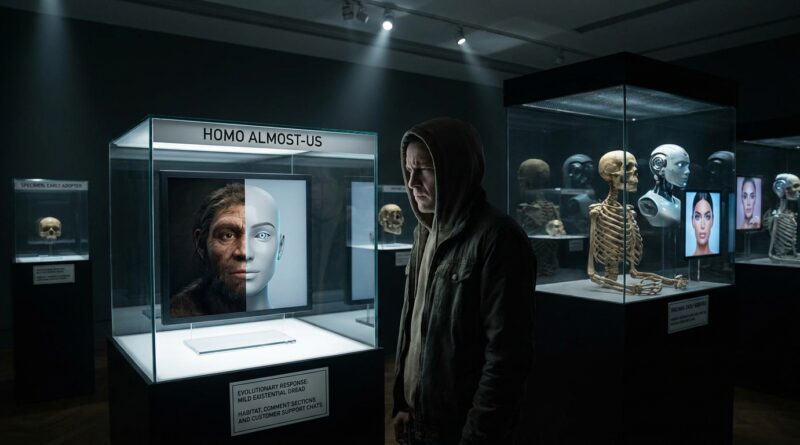
Homo Almost‑Us: When Humans Evolved To Fear Their Own Near‑Perfect Digital Clones
That weird shiver you get from an almost-human AI face is not you being dramatic. It is also not proof that you are a secret enemy of progress. It is your brain doing exactly what human brains got very good at doing: spotting when something looks like a person, but feels off in a way that might matter. A smile that lands half a second late. Eyes that focus like they are reading your soul and a teleprompter at the same time. A voice that sounds warm, then suddenly pronounces your name like it learned English from a microwave manual. That discomfort has a name, the uncanny valley, but it also has a history. Long before chatbots tried to be your pal, humans survived by noticing tiny mismatches in faces, movement, and tone. Modern tech companies have taken that ancient alarm system and turned it into a product test.
⚡ In a Hurry? Key Takeaways
- That creepy feeling around almost-human AI is normal. It likely comes from old human pattern-recognition systems that notice when a face, voice, or behavior is close to human but not fully right.
- When an AI feels unsettling, do not argue with yourself. Pause and ask three things: What exactly feels off, what is this system trying to get from me, and what happens if I trust it too much?
- This matters now because AI faces, voices, and bots are moving into customer support, dating, scams, classrooms, and family group chats. A little skepticism is healthy.
The ancient monkey inside your skull would like a word
Humans are built to read humans. Fast. We notice feverish skin, strange eye contact, stiff movement, fake smiles, slurred speech, and the tiny social cues that say “safe,” “sick,” “lying,” or “run.” We did not evolve for JPEGs or voice clones, but the same circuitry still lights up when modern fakes get too close for comfort.
That is the basic joke and the basic problem. A chatbot company says, “Look, it feels just like talking to a real person.” Your nervous system says, “Then why does it feel like talking to a person who was assembled in a basement from spare theater props?”
That split matters. For years, the polite tech response to discomfort has been, “You will get used to it.” Maybe. People also get used to spam calls. That does not make spam calls good.
What the uncanny valley actually is
The uncanny valley is the dip in comfort people feel when something becomes very human-like, but not human enough. A cartoon robot can be cute. A polished voice assistant can be fine. But a synthetic face with pores, blinking eyes, and one tiny wrongness can make your skin crawl.
Japanese roboticist Masahiro Mori coined the term decades ago, and it holds up because it maps nicely onto common experience. We like a thing more as it becomes more human, up to a point. Then it drops into the valley. Hard.
Why “almost right” can feel worse than “obviously fake”
A stick figure does not bother you because it is not pretending very hard. But a near-perfect digital person forces your brain into overdrive. It starts checking details. Is the smile sincere? Why is the blink rate odd? Why does the laugh arrive on cue but feel empty? Why did the voice nail the emotion and then miss the rhythm?
When systems get close to human, little errors feel bigger, not smaller. They break trust. This is true in movies, games, customer service bots, and scam calls from “your grandson” who suddenly sounds like he was downloaded from the cloud five minutes ago.
So, did evolution really wire us to hate creepy bots?
Not exactly in the simple, cartoon version. Our ancestors were not fighting off rogue PDFs with face filters. But evolution did reward people who noticed subtle signs that something was wrong.
Maybe a face signaled disease. Maybe movement signaled injury or death. Maybe speech patterns suggested an outsider, an impostor, or someone in distress. Maybe a familiar person acting just slightly unfamiliar meant danger. Human survival often depended on fast judgments based on incomplete signals.
Now swap “possible threat in the grass” with “eerily smooth digital assistant asking for your bank details.” Different century. Same suspicious wetware.
The brain is a prediction machine
Your brain is always guessing what comes next. Faces should move in certain ways. Voices should breathe, hesitate, and stress words naturally. Conversations should have texture. When AI gets 92 percent of the way there, the remaining 8 percent does not feel small. It feels loud.
That is why uncanny systems can be more disturbing than clunky ones. The clunky ones set expectations low. The near-human ones invite trust, then stumble right at the point where trust matters most.
Why tech companies keep sprinting into the creepy zone anyway
Because “human-like” sells. It sells customer support that feels personal. It sells companionship apps. It sells tutors, assistants, influencers, receptionists, sales avatars, and digital employees who never sleep, complain, unionize, or ask for dental.
To a company, your discomfort can look like a temporary adoption problem. To you, it might be a very useful warning label.
There is also a familiar pattern in tech. If people hesitate, companies often assume the solution is more exposure, more polish, and more emotional design. Better skin textures. Better pauses. Better eye contact. Better fake empathy. “We just need to make the clone warmer.” Great. Nothing has ever gone wrong after somebody in product design said that.
Where this gets serious fast
The uncanny valley is not just an art problem or a robot problem. It is a trust problem.
Customer service
If a bot sounds almost human, people may reveal more than they would to an obvious machine. They may assume understanding that is not really there. They may miss the moment when they should ask for a real person.
Scams and impersonation
Voice clones and synthetic faces turn old scams into much sharper tools. The unease you feel can be a gift. If “your boss” on a call sounds right but feels wrong, listen to that feeling and verify through another channel.
Companionship and fake intimacy
This is where things get especially messy. A system that mimics care can create real emotional attachment. The feelings on the human side can be genuine even if the “relationship” is generated by scripts, training data, and retention metrics.
That does not mean nobody should ever enjoy AI companions. It does mean you should know when a product is trying to turn your loneliness into monthly recurring revenue.
Your practical framework: the “Why is this making me itch?” test
When you hit that creepy feeling, do not just dismiss it or drown it in think pieces. Use it. Here is a simple framework.
1. Name the glitch
Try to say what feels off. Is it the eyes? Timing? Tone? Too much enthusiasm? Not enough context? Memory that feels oddly selective? You are moving from vague discomfort to observation. That alone helps.
2. Ask what the system wants
Is it trying to calm you, sell to you, keep you talking, gather information, or build emotional dependence? Human-like design is rarely neutral. Somebody chose it for a reason.
3. Check the stakes
If you are using a goofy AI avatar in a game, the stakes are low. If a voice clone asks for money, personal details, or urgent action, the stakes are high. The creepier and more urgent it feels, the more you should slow down.
4. Verify outside the performance
Do not let the realism of the act become the proof. If “Mom” calls in a panic asking for cash, hang up and call Mom directly. If customer support sounds human but keeps pushing you in circles, ask for a transcript or a live agent.
5. Decide, do not drift
The biggest risk with near-human systems is not always that they trick you in one dramatic moment. Sometimes they just wear you down. You get used to them. You share more. You stop noticing. Make a choice about how much access and trust they get.
What not to do
Do not let anybody shame you into treating discomfort as ignorance. People said similar things about dark patterns, manipulative notifications, and endless autoplay. Feeling that a system is trying too hard to seem human is not backward. It can be excellent judgment.
Also, do not assume uncanny always means dangerous. Some awkward AI is just bad design. Some is a beta product that should not have left the lab yet. The point is not panic. The point is attention.
The satire part, because honestly we need it
There is something very funny about billion-dollar companies spending years and fortunes trying to recreate the subtle warmth of human interaction, only to produce a smiling support avatar with the emotional cadence of a hostage video.
We are building digital clones that can flirt, reassure, and apologize at scale, then acting surprised when people say, “I do not know, man, this thing feels haunted.”
That reaction is not anti-tech. It is pro-reality.
How to live with this without becoming a full-time paranoid hermit
You do not need to throw your phone into the sea. Just adopt a few habits.
Trust your first reaction, then test it
If a face, voice, or bot gives you that little internal “nope,” pause. Get specific. Then verify.
Prefer honesty over polish
A clearly labeled bot is often easier to deal with than a machine doing community theater as your new best friend. Transparency matters.
Teach this to family members
Especially older relatives and younger kids. Both groups can be more vulnerable to realistic impersonation, just for different reasons.
Watch for emotional hooks
If a system pushes urgency, intimacy, guilt, or flattery, be extra careful. Those are classic manipulation tools, whether the speaker is a human scammer or a synthetic one.
At a Glance: Comparison
| Feature/Aspect | Details | Verdict |
|---|---|---|
| Almost-human AI faces and voices | They can trigger discomfort because they match human patterns closely, then miss in small but important ways. | Normal reaction. Pay attention to it. |
| Evolution angle | Humans likely evolved to notice subtle irregularities in faces, movement, and voice because those signals could matter for survival. | Useful explanation, not magic proof. |
| Everyday response | Name what feels off, ask what the system wants, and verify outside the interaction if money, identity, or emotion is involved. | Best practical defense. |
Conclusion
The big takeaway is simple. If a human-like AI makes you uneasy, that feeling is not a bug in your personality. It may be a feature of being human. As uncanny AI faces, voices, and bots spread into customer service, fake friendship, work, scams, and family chat chaos, you do not need to ignore your discomfort to seem modern. You need to decode it. That is what helps the community right now. Not panic. Not blind trust. Just a better read on why your brain is waving a little red flag. Once you can name the feeling, you can make smarter choices about what to believe, what to share, and when to step back from the digital clone trying very hard to seem almost us.